India’s Historic Labour Reform: Four New Labour Codes Take Effect from 21 Nov 2025 : What It Means for Workers & Employers
India’s four new Labour Codes have taken effect from November 21, 2025, consolidating 29 existing laws to provide universal minimum wages, expanded social security, enhanced safety standards, and simplified compliance for employers.
The reforms aim to modernize the workforce ecosystem, balancing worker welfare with ease of doing business.
Introduction
India ushered in a major overhaul of its labour laws , all four Labour Codes came into force, replacing 29 outdated central labour laws. This reform is being hailed as one of the biggest workforce changes since Independence, aimed at modernising worker protections, simplifying compliance for businesses, and extending social security to previously unprotected workers.
In this article, we will break down what each code does, highlight key benefits and challenges, and explain why this matters , especially for workers in sectors like IT/ITES, gig platforms, MSMEs, and hazardous industries.
What Are the Four Labour Codes?
The four new Labour Codes are:
1. Code on Wages (2019)
2. Industrial Relations Code (2020)
3. Code on Social Security (2020)
4. Occupational Safety, Health and Working Conditions (OSHWC) Code (2020)
These codes consolidate and rationalise 29 older labour laws, many of which dated back to the pre-independence or early post-independence era.
Key Highlights & What’s New:
Here are the most important changes and benefits introduced by the new labour codes:
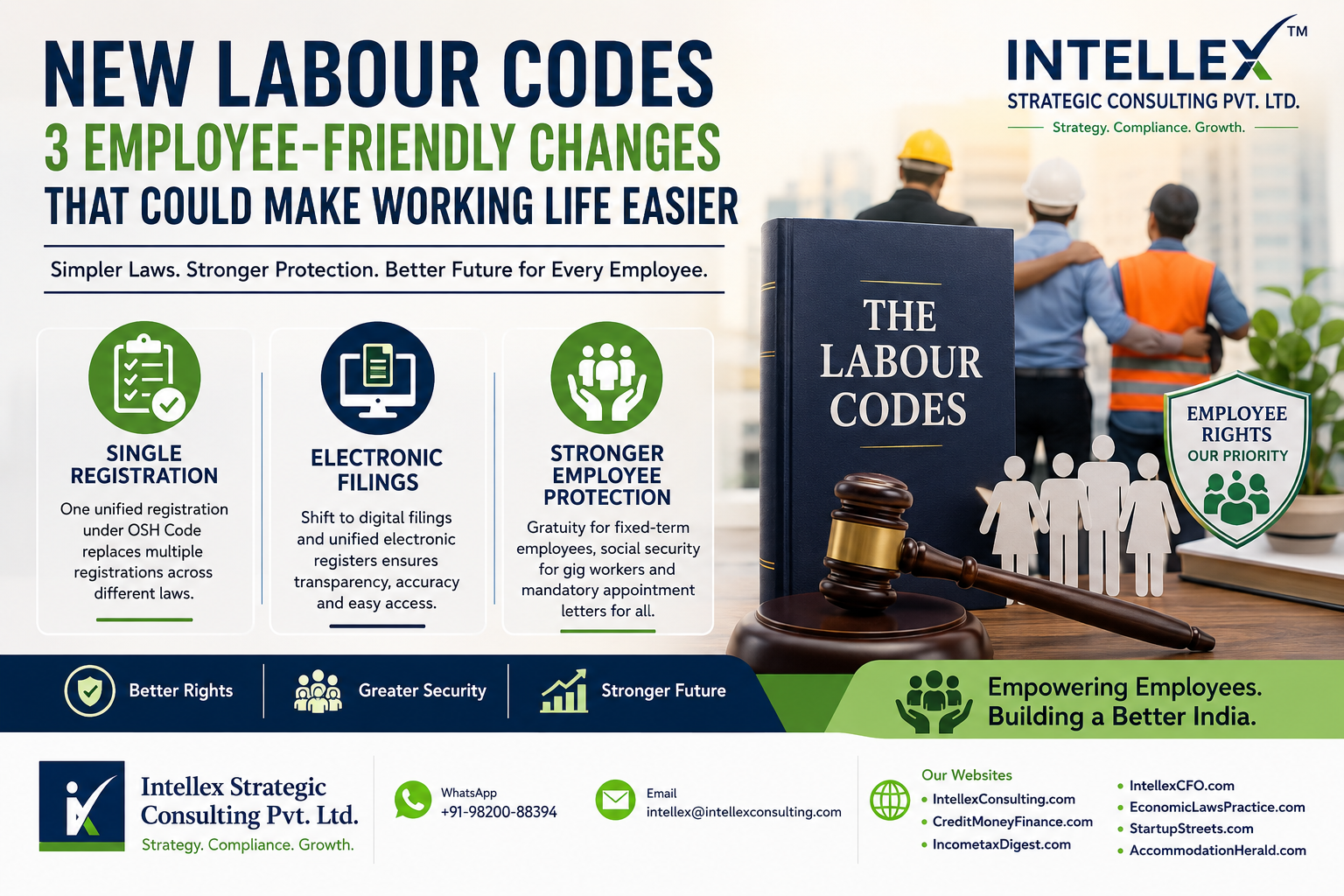
1. Mandatory Appointment Letters:
Every worker must receive a formal appointment letter specifying their wages, duties, and entitlements.
2. Universal Minimum Wages & Timely Payment:
There is now a concept of a national floor wage to ensure no worker is paid below a minimum threshold.
Minimum wage rules apply across all sectors, not just “scheduled employments.”
Wages must be paid in a timely manner, eliminating common delays.
3. Expanded Social Security:
The Code on Social Security extends benefits like Provident Fund (PF), Employees’ State Insurance (ESIC), and other welfare schemes to more workers, including gig and platform workers.
Portability of benefits is a key feature, making it easier for migrant, contract, and unorganized workers to access social security.
A gig worker welfare fund is introduced: platform aggregators (like ride-hailing or delivery platforms) may need to contribute (e.g., 1–2%) toward this fund.
4. Fixed-Term Employees (FTEs)
FTEs will now receive the same benefits as permanent employees.
Crucially, FTEs become eligible for gratuity after just 1 year of service — far shorter than the previous requirement of 5 years.
5. Safety, Health & Working Conditions
The OSHWC Code brings uniform safety standards for workplaces, including national-level norms.
For large establishments (500+ workers), safety committees are mandatory.
There is a National OSH Board to harmonise practices.
Workers above the age of 40 are entitled to free annual health check-ups.
Women can work night shifts, provided there are appropriate safety arrangements and their consent.
6. Industrial Relations & Dispute Resolution
The Industrial Relations Code streamlines trade union processes, dispute resolution, layoffs, and closures.
There is a shift toward two-member industrial tribunals for faster dispute resolution.
7. Simplified Compliance for Employers
Employers now have a single registration, single licence, and single return instead of dealing with multiple filings.
A new inspector-cum-facilitator system will guide compliance rather than relying only on punitive inspections.
The reform supports ease of doing business by reducing bureaucratic burden.
8. Inclusivity & Non-Discrimination
The Codes include gender-neutral protections, including for transgender workers.
They also expand the definition of “worker” to better accommodate unorganised, migrant, and platform workers.
Who Stands to Benefit Most?
Some of the key beneficiary sectors and worker categories include:
Gig / Platform Workers: Recognised under social security; eligible for welfare fund.
Fixed-Term Employees: Now get parity in benefits and earlier gratuity.
MSMEs (Micro, Small & Medium Enterprises): Simplified compliance + more coverage.
Hazardous Industries, Mines & Plantations: Standardised safety norms + social security.
IT / ITES: Better compliance, documentation, and worker protections.
Audio-Visual / Media / OTT Workers: Appointment letters and structured employment benefits.
Dock Workers / Export Sector: Formal safety and social security protections.
Women Workers: Night-shift options (with safeguards), non-discrimination.
Why This Reform Matters:
1. Modernises Labour Laws: Many existing labour statutes were outdated, scattered, and fragmented — dating back decades.
2. Formalises Vulnerable Workforce: Gig workers, contract labour, migrants, and FTEs get access to social security and legal protections.
3. Boosts Ease of Doing Business: Simplified regulatory processes help both employers and startups run more efficiently.
4. Promotes Social Justice: Gender neutrality, broader worker definitions, and minimum wages aim to ensure fairer treatment.
5. Improves Safety & Health: A unified approach to workplace safety can reduce accidents and health risks, especially in high-risk sectors.
6. Economic Competitiveness: With compliant, protected workers and predictable labour rules, India becomes more attractive for investment.
Potential Challenges & Criticisms:
While widely praised, the new labour codes are not without concerns:
Trade Union Pushback: Some trade unions argue that the codes weaken collective bargaining rights and restrict the right to strike.
State-Level Implementation: Labour is a concurrent subject. Some states have yet to finalise the rules under all four codes, delaying uniform implementation.
Rulemaking & Enforcement: Several detailed rules and schemes under each code still need to be notified; the impact depends heavily on how they are implemented.
Resource Constraints: Small enterprises may struggle with the new compliance system initially, even if it’s “simplified.”
Inspection vs Facilitation: Transitioning from traditional inspections to a “facilitator” model may take time and capacity-building.
What Workers & Employers Should Do Now:
For Workers:
Ask for appointment letters if not already provided.
Check whether your wages meet the minimum wage / floor wage for your sector.
Understand your social security benefits: PF, ESIC, and any newly available schemes.
If you are a gig worker, check how your aggregator/platform contributes to the welfare fund.
For Employers:
Register under the unified system (single registration, license, return).
Review and update HR policies: job offer letters, contracts, safety committees.
Prepare for annual health check-ups for eligible employees (> 40 years).
Train inspector-facilitators or coordinate with the labour department to ensure a smooth compliance transition.
Consult legal or labour-law experts to align your business practices with the new codes.
Conclusion
The activation of the Four Labour Codes on 21 November 2025 is a landmark reform that reshapes India’s workforce governance. By consolidating 29 laws into a modern, simplified, and inclusive framework, the government aims to strengthen worker protections, expand social security, and reduce regulatory burden for employers.
While there are implementation challenges ahead , especially at the state level and in rulemaking. For workers, especially in gig, contract, and unorganised sectors, these codes promise more security and recognition. For businesses, they offer clarity, predictability, and a path toward more formal, compliant growth.
As India steps into this new era of labour regulation, all stakeholders , workers, employers, and regulators , will need to work together to make the promise of these codes a reality.
Team- Intellex Strategic Consulting Private Limited
Follow us on LinkedIn:
https://www.linkedin.com/company/intellexcfo-com/
https://www.linkedin.com/company/intellexconsulting
www.StartupStreets.com, www.GrowMoreLoans.com, www.GrowMoreFranchisees.com, www.intellexCFO.com, www.CreditMoneyFinance.com, www.StartupIndia.Club, www.EconomicLawsPractice.com