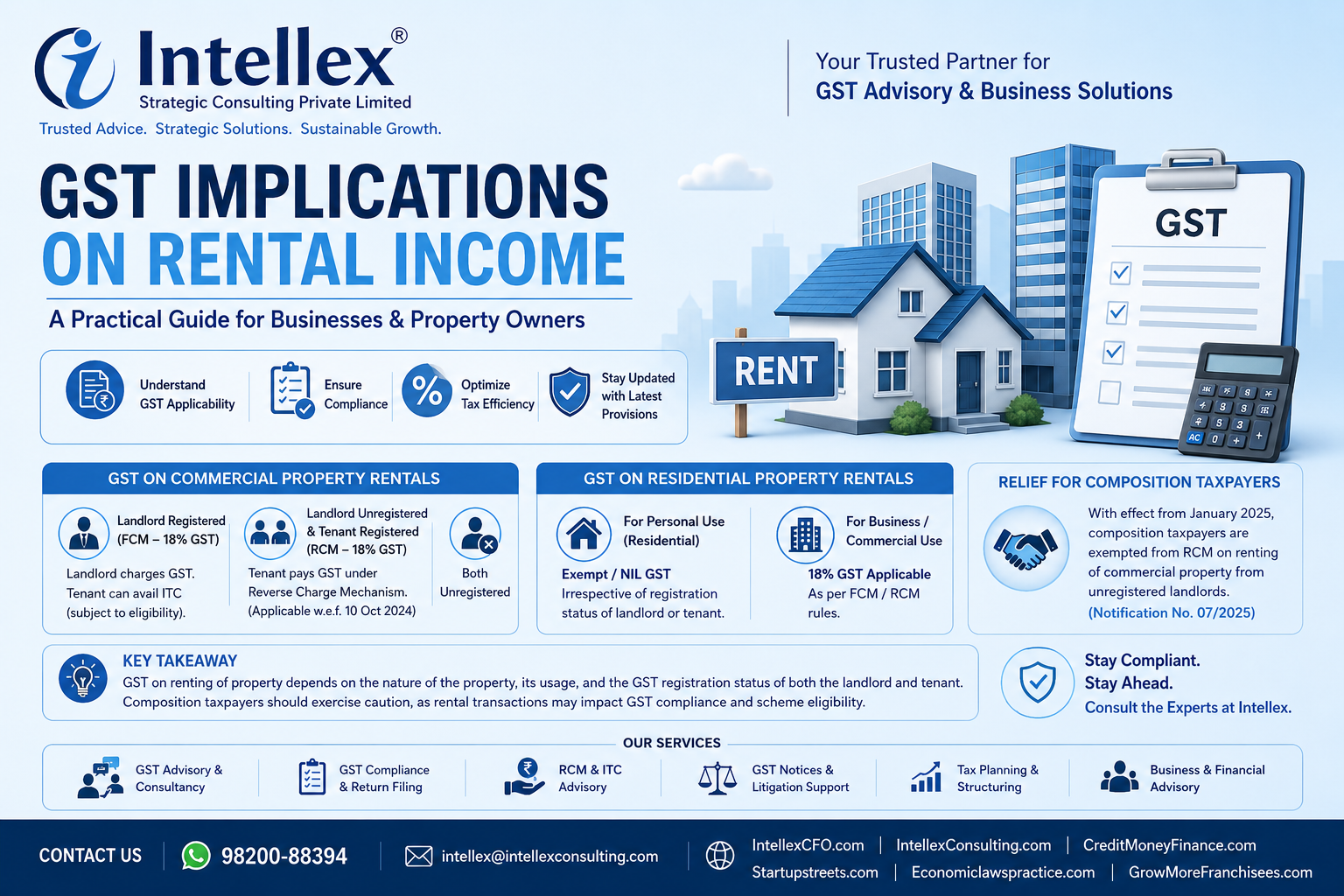
GST on Rental Income in India: Complete Guide to GST on Residential & Commercial Property Rentals (FY 2025-26).
GST Implications on Rental Income: A Practical Guide for Businesses, Property Owners & Taxpayers
Renting immovable property is one of the most common sources of income for individuals, businesses, HUFs, LLPs and companies. However, the Goods and Services Tax (GST) implications on rental income have undergone several important changes over the years, particularly regarding Reverse Charge Mechanism (RCM), commercial property rentals, residential property used for business, and the treatment of composition taxpayers.
Understanding these provisions correctly is essential to avoid GST disputes, interest, penalties and denial of Input Tax Credit (ITC).
At Intellex Strategic Consulting Private Limited, our GST experts assist landlords, tenants, businesses, developers and investors in ensuring complete GST compliance while optimizing tax efficiency.
GST on Renting Services – Basic Principle
Renting of immovable property is considered a supply of services under GST.
Wherever GST is applicable, the standard GST rate on renting services is 18%.
However, GST liability depends upon three critical factors:
- GST registration status of the landlord
- GST registration status of the tenant
- Nature and purpose of use of the property
GST on Commercial Property Rentals
Commercial properties include:
- Offices
- Shops
- Warehouses
- Industrial premises
- Godowns
- Business establishments
Scenario 1 – Registered Landlord
Where the landlord is registered under GST:
Forward Charge Mechanism (FCM) applies.
The landlord:
- Charges 18% GST on rent.
- Collects GST from the tenant.
- Deposits GST with the Government.
The registered tenant may claim Input Tax Credit (ITC), subject to eligibility and business use.
Scenario 2 – Unregistered Landlord & Registered Tenant
Effective 10 October 2024, GST is payable under the Reverse Charge Mechanism (RCM).
In this case:
- The landlord does not charge GST.
- The registered tenant pays 18% GST directly to the Government.
- Eligible ITC may be claimed, subject to applicable conditions.
This provision was introduced through Notification No. 09/2024–Central Tax (Rate).
Scenario 3 – Both Landlord & Tenant Unregistered
Where neither party is registered under GST:
- GST is generally not applicable.
GST on Residential Property Rentals
Residential Property Used for Personal Residence
Where the property is used purely as a residence:
Tenant Unregistered
- GST is exempt.
- No GST is payable irrespective of whether the landlord is registered.
Tenant Registered
Even if the tenant holds GST registration, the exemption continues provided the property is used exclusively for personal residential purposes.
Residential Property Used for Business Purposes
When a residential property is rented for commercial or business use, GST provisions become applicable.
Registered Landlord
Under the Forward Charge Mechanism:
- Landlord charges 18% GST.
- GST is deposited by the landlord.
Unregistered Landlord & Registered Tenant
Applicable from July 2022:
- Registered tenant pays GST under Reverse Charge Mechanism.
- GST rate remains 18%.
Both Parties Unregistered
GST is generally not applicable.
Special GST Provisions for Composition Taxpayers
Composition taxpayers should exercise additional caution while dealing with rental transactions.
When the Landlord is a Composition Dealer
Important considerations include:
- Renting of immovable property constitutes a taxable supply of services.
- Certain rental activities may require exiting the Composition Scheme or obtaining appropriate registration.
- GST liability does not cease merely because the landlord is registered under the Composition Scheme.
- Proper compliance is essential to avoid future disputes.
When the Tenant is a Composition Dealer
Under Section 10(2)(d) of the CGST Act:
Reverse Charge liability may impact eligibility under the Composition Scheme.
Professional review is recommended before entering into rental agreements involving RCM.
Major Relief for Composition Taxpayers (Effective January 2025)
A significant relief has been granted through Notification No. 07/2025.
Where commercial or immovable property (other than residential dwelling) is rented from an unregistered landlord:
Composition Taxpayers
- No Reverse Charge GST liability.
Regular Registered Taxpayers
- Reverse Charge provisions continue to apply.
This amendment provides substantial compliance relief to small businesses operating under the Composition Scheme.
Key GST Compliance Points
Before entering into any rental agreement, taxpayers should verify:
- GST registration status of both parties
- Nature of the property
- Purpose of use
- Applicability of Reverse Charge Mechanism
- Input Tax Credit eligibility
- Composition Scheme implications
- Latest GST notifications and amendments
Proper documentation and expert advice can significantly reduce future litigation and compliance risks.
How Intellex Strategic Consulting Private Limited Can Help
GST provisions relating to rental income are evolving rapidly. Businesses and property owners should obtain professional advice before taking any GST position.
Our expert team offers comprehensive services including:
- GST Registration
- GST Advisory & Consultancy
- GST Compliance Review
- GST Return Filing
- Reverse Charge (RCM) Advisory
- Input Tax Credit Planning
- GST Notices & Litigation Support
- Tax Structuring for Rental Income
- Real Estate GST Advisory
- Composition Scheme Advisory
Whether you are a landlord, tenant, investor, builder, developer or business owner, we provide practical, compliant and tax-efficient solutions.
Contact Us
Intellex Strategic Consulting Private Limited
📱 WhatsApp: 98200-88394
📧 Email: intellex@intellexconsulting.com
🌐 Websites:
• IntellexCFO.com
• IntellexConsulting.com
• CreditMoneyFinance.com
• StartupStreets.com
• EconomicLawsPractice.com
• GrowMoreFranchisees.com
Partner with Intellex Strategic Consulting Private Limited for reliable GST advisory, compliance management, tax planning and business consulting services. Our experienced professionals help businesses remain compliant while maximizing operational efficiency and minimizing tax risks.
Disclaimer: This article is intended for general informational purposes only and should not be construed as legal or tax advice. GST laws are subject to amendments, notifications and judicial interpretations. Professional consultation is recommended before taking any tax position.
More Featured Asrticles:
How Businesses in the UAE Can Stay Ahead of Compliance Demands in 2026.