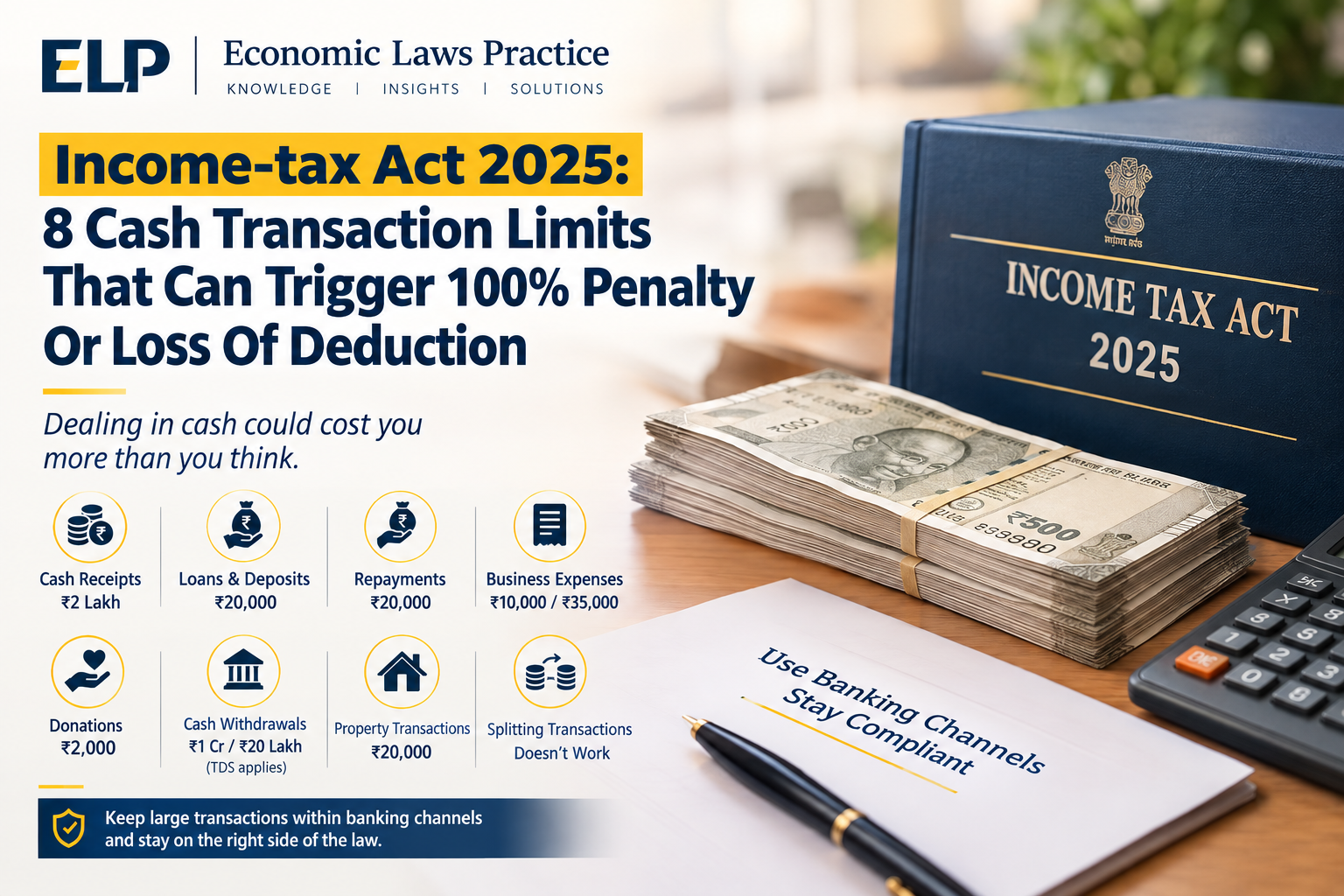
Income-tax Act 2025: 8 Cash Transaction Limits That Can Trigger 100% Penalty or Loss of Tax Deduction.
Dealing in Cash Could Cost You More Than You Think
Learn 8 important cash transaction limits under the Income-tax Act 2025, including ₹2 lakh receipts, ₹20,000 loans, ₹10,000 business expenses, ₹2,000 donations and cash withdrawal TDS rules.
Introduction
Cash remains a legitimate form of money in India, but the tax law places strict restrictions on how much cash can be received, paid, borrowed, repaid or claimed as a tax-deductible expense.
The objective is straightforward: reduce unaccounted transactions, create an auditable financial trail and encourage taxpayers to use banking and electronic payment channels.
From 1 April 2026, the Income-tax Act, 2025 replaced the Income-tax Act, 1961 for the new tax regime. Many of the familiar provisions relating to cash transactions continue in substance, but their section numbers have been reorganised.
For example:
| Subject | Earlier Income-tax Act, 1961 | Income-tax Act, 2025 |
|---|---|---|
| Cash receipt restriction | Section 269ST | Section 186 |
| Cash loans/deposits | Section 269SS | Section 185 |
| Cash repayment | Section 269T | Section 188 |
| Business cash expenditure | Section 40A(3) | Section 36 |
| Cash-withdrawal TDS | Section 194N | Section 393 framework |
| Penalty for cash receipt violation | Section 271DA | Corresponding new penalty framework |
The important point for taxpayers is that the cash limits have not simply disappeared because the law has been rewritten. Businesses, professionals, property buyers and ordinary taxpayers still need to understand the restrictions.
1. Cash Receipts: The ₹2 Lakh Limit
One of the most important restrictions concerns receiving large amounts in cash.
Under Section 186 of the Income-tax Act, 2025, a person cannot receive ₹2 lakh or more in cash:
- in aggregate from a person in a day;
- in respect of a single transaction; or
- in respect of transactions relating to one event or occasion from a person.
The permitted modes include account-payee cheque, account-payee bank draft, electronic clearing systems through a bank account and other prescribed electronic modes.
Example
Suppose a business receives:
- ₹1,20,000 in cash in the morning; and
- ₹90,000 in cash in the evening
from the same customer on the same day.
The aggregate is ₹2,10,000.
Simply recording the two receipts as separate cash transactions does not necessarily avoid the restriction.
What is the consequence?
The corresponding penalty framework can impose a charge equal to the amount of the receipt in cases of contravention.
Under the earlier law, this was Section 271DA, under which the penalty was equal to the amount received. The corresponding provision has been carried into the new Act’s reorganised framework.
Therefore, receiving ₹5 lakh in prohibited cash could potentially result in a penalty/fee of ₹5 lakh.
Important exceptions
The provision contains exceptions, including specified receipts involving Government, banking companies, post office savings banks and cooperative banks, along with other notified categories and transactions covered by the loan/deposit provisions.
2. Cash Loans, Deposits and Specified Sums: The ₹20,000 Threshold
Cash borrowing is another major area of risk.
Section 185 of the Income-tax Act, 2025 restricts taking or accepting a loan, deposit or specified sum otherwise than through prescribed banking or electronic modes where the relevant amount or aggregate reaches ₹20,000 or more.
The calculation can also take into account an earlier unpaid loan, deposit or specified sum from the same person.
This is particularly important for:
- businesses borrowing money from individuals;
- unsecured loans between companies and promoters;
- security deposits;
- advances;
- property-related specified sums; and
- informal loans between individuals.
Example
A proprietor accepts:
₹15,000 in cash today
and subsequently accepts another:
₹10,000 from the same person while the earlier amount remains outstanding.
The aggregate exposure can take the transaction within the restriction.
Potential consequence
The corresponding penalty provision provides for an amount equal to the loan, deposit or specified sum taken or accepted in contravention. The earlier Section 271D imposed a penalty equal to the amount involved, and the new Act carries forward this principle under its reorganised penalty provisions.
Practical lesson
If you are accepting a loan or deposit of ₹20,000 or more, do not rely on physical cash.
Use:
- NEFT;
- RTGS;
- IMPS;
- UPI where appropriate;
- account-payee cheque; or
- another permitted electronic mode.
3. Repayment of Loans or Deposits: The ₹20,000 Rule
The restriction does not stop when the money is borrowed.
Repayment is separately regulated.
Under Section 188 of the Income-tax Act, 2025, repayment of specified loans, deposits or specified advances of ₹20,000 or more must generally be made through permitted banking or electronic channels.
The calculation can involve:
- the amount being repaid;
- interest payable;
- aggregate outstanding loans or deposits; and
- specified advances.
Example
Suppose a business owes an individual:
- Principal: ₹18,000
- Interest: ₹3,000
The amount relevant to the repayment restriction can exceed ₹20,000.
Paying the amount in cash can therefore create a compliance problem.
Penalty exposure
Under the earlier Section 271E, repayment in violation of Section 269T attracted a penalty equal to the amount repaid. The corresponding provision under the new Act retains this principle.
Best practice
Repay loans and deposits through identifiable banking channels so that:
payer → bank account → recipient
creates a clear audit trail.
4. Business Expenses: The ₹10,000 Cash Payment Limit
Businesses need to be especially careful with cash expenditure.
The Income-tax Act, 2025 carries forward the substance of the earlier Section 40A(3) rules in Section 36.
Where payment or aggregate payments made to a person in a day exceed ₹10,000 and are not made through specified banking or online modes, the expenditure may be disallowed as a business deduction.
For payments relating to plying, hiring or leasing goods carriages, the threshold is ₹35,000.
Example
A company purchases raw materials from a supplier and pays:
₹15,000 in cash on one day.
Even though the purchase itself is genuine and properly recorded, the expenditure can be disallowed for income-tax purposes if the payment does not qualify for an exception.
This creates an important distinction:
The transaction may be commercially genuine but still fail to qualify for a tax deduction.
That means the taxpayer can end up paying tax on income that would otherwise have been reduced by the business expense.
Does Paying ₹8,000 Twice Avoid the Rule?
Not necessarily.
If:
- ₹8,000 is paid in the morning; and
- ₹5,000 is paid later that day
to the same person, the aggregate is ₹13,000.
The law specifically looks at payment or aggregate payments made to a person in a day.
Therefore, artificially splitting payments is not a reliable compliance strategy.
5. Cash Donations: The ₹2,000 Deduction Limit
Cash donations have a different consequence.
Under the rules relating to Section 80G, a taxpayer cannot claim a deduction for a cash donation exceeding ₹2,000. The Income Tax Department continues to specifically state that no deduction is allowed for donations made in cash above ₹2,000.
This does not mean that donating ₹2,500 in cash is necessarily illegal.
The problem is that the taxpayer cannot claim the Section 80G deduction for that cash donation.
Example
Suppose an individual makes a charitable donation of:
₹25,000
If the entire amount is paid in cash, the taxpayer cannot claim the Section 80G deduction merely because the charity is otherwise eligible.
If the donation is made through a qualifying non-cash mode and all other Section 80G conditions are satisfied, the deduction may be available subject to the applicable rules.
Practical advice
For donations intended to qualify for tax deduction, use:
- bank transfer;
- UPI;
- cheque;
- other permitted electronic modes.
Also retain the donation receipt and other supporting documentation.
6. Large Cash Withdrawals: TDS Can Apply
There is an important distinction between a legal prohibition on holding or withdrawing one’s own money and tax deduction at source on large cash withdrawals.
The law does not simply say that a taxpayer cannot withdraw more than a particular amount from their bank account.
However, TDS under Section 194N of the earlier Act, now carried into the Section 393 framework of the Income-tax Act, 2025, can apply to large cash withdrawals.
For a person who has filed the relevant income-tax returns as prescribed, TDS generally applies at 2% on cash withdrawals exceeding ₹1 crore in a financial year.
For certain non-filers, the thresholds are significantly lower:
- 2% on cash withdrawals exceeding ₹20 lakh and up to ₹1 crore; and
- 5% on the amount exceeding ₹1 crore.
The Income Tax Department confirms these rates and thresholds in its Section 194N guidance.
Important clarification
This is TDS, not necessarily an additional final tax cost.
The amount deducted can generally be reflected as tax deducted at source and dealt with in the taxpayer’s tax return, subject to the normal rules.
Example
A person who has not filed the relevant returns for the preceding three assessment years withdraws a large amount of cash.
Once the prescribed threshold is crossed, the bank/post office can deduct TDS at the applicable rate.
Therefore, large cash withdrawals should be planned carefully.
7. Property Transactions: Be Extremely Careful With Cash Advances
Property transactions deserve special attention because they often involve large amounts and multiple stages of payment.
The ₹20,000 restriction relating to loans, deposits and specified sums can become relevant to certain property-related advances or specified sums.
Under the corresponding framework, a specified sum received or accepted in connection with transactions involving immovable property can fall within the cash restriction. The underlying rule should therefore not be interpreted as simply saying that a buyer can freely pay a large cash “token amount” provided it is described as an advance.
Example
A property buyer agrees to purchase a property and pays:
₹50,000 in cash as a token/advance.
Calling the amount “token money”, “booking amount” or “bayana” does not automatically remove the tax-law implications.
The nature of the payment must be examined.
Safer approach
For property transactions, route payments through:
- RTGS;
- NEFT;
- account-payee cheque;
- other documented banking channels.
Maintain:
- agreement for sale;
- payment schedule;
- bank statements;
- receipts;
- PAN details where applicable; and
- other transaction documentation.
Property transactions should have a particularly strong documentary trail because they can involve income-tax, stamp-duty, registration and other compliance considerations.
8. Splitting Cash Transactions Does Not Automatically Make Them Legal
One of the most common misconceptions is:
“I will simply divide the payment into smaller amounts.”
Tax law frequently looks at the aggregate nature and substance of transactions, rather than merely the individual cash slips.
For example, Section 186 specifically covers:
- aggregate receipts from a person in a day;
- a single transaction; and
- transactions relating to one event or occasion.
Similarly, the business-expense rules consider aggregate payments to a person in a day.
Example
A business cannot safely assume that the following arrangement automatically avoids the rules:
- ₹1,90,000 cash on Monday
- ₹1,90,000 cash on Tuesday
- another payment connected with the same underlying transaction
The actual facts, contractual arrangement, timing and relationship between the payments matter.
Artificial fragmentation should never be treated as a substitute for genuine tax compliance.
A Quick Reference: 8 Cash Rules Every Taxpayer Should Know
| No. | Transaction | Important Threshold | Potential Consequence |
|---|---|---|---|
| 1 | Cash receipt from a person | ₹2 lakh or more | Penalty/fee can equal amount received |
| 2 | Cash loan/deposit/specified sum | ₹20,000 or more | Penalty/fee can equal amount involved |
| 3 | Cash repayment of loan/deposit | ₹20,000 or more | Penalty/fee can equal amount repaid |
| 4 | Business cash expenditure | ₹10,000 per person per day | Expense may be fully disallowed |
| 5 | Cash payment to goods-carriage operator | ₹35,000 | Higher threshold applies |
| 6 | Cash donation for 80G | Above ₹2,000 | No Section 80G deduction |
| 7 | Large cash withdrawal | ₹1 crore / ₹20 lakh depending on filing status | TDS may apply |
| 8 | Splitting transactions | No safe artificial workaround | Aggregate/substance can still matter |
What Businesses Should Do to Stay Compliant
Businesses can significantly reduce cash-related tax risk by introducing a simple internal payment policy.
1. Set internal cash thresholds
Do not wait until a transaction reaches the statutory limit.
For example, businesses can require management approval for cash payments above a much lower internal threshold.
2. Prefer banking channels
Where practical, use:
- NEFT;
- RTGS;
- IMPS;
- UPI;
- account-payee cheque; and
- other permitted electronic methods.
3. Reconcile cash regularly
The cash book should reconcile with:
- physical cash;
- accounting records;
- sales invoices;
- purchase invoices;
- expense vouchers; and
- bank withdrawals.
4. Watch related transactions
A transaction should not be evaluated only invoice-by-invoice.
Look at:
- same person;
- same day;
- same event;
- same contract;
- same property;
- same underlying obligation.
5. Maintain supporting documents
For significant transactions, retain:
- invoice;
- agreement;
- receipt;
- bank statement;
- payment confirmation;
- PAN/KYC information where applicable; and
- relevant correspondence.
Why Cash Compliance Is Becoming More Important
India’s tax administration increasingly operates through data matching and digital reporting.
Banks, financial institutions and other reporting entities can provide transaction information under the Statement of Financial Transactions (SFT) framework, while taxpayers also see increasing integration of information through the tax department’s digital systems.
Consequently, a transaction may no longer remain an isolated entry in a physical cash book.
A mismatch between:
- declared turnover;
- GST records;
- bank transactions;
- cash deposits;
- property purchases;
- investments;
- loans;
- TDS information; and
- income-tax returns
can potentially lead to questions from the tax authorities.
The broader direction of tax administration is therefore clear:
greater transparency + greater data availability + greater importance of documentary evidence.
Cash Is Not Banned — But Cash Must Be Used Carefully
It is important not to misunderstand these provisions.
The Income-tax Act, 2025 does not make every cash transaction illegal.
Cash remains a valid medium of payment in many circumstances.
The issue is that the tax law imposes restrictions on specific categories and amounts of cash transactions.
Some violations can result in penalties equal to 100% of the amount involved, while other violations can result in loss of tax deductions or TDS obligations.
That distinction is crucial.
Frequently Asked Questions
Can I receive ₹1.99 lakh in cash from one person?
A receipt below ₹2 lakh may fall outside the specific ₹2 lakh threshold in Section 186, but the transaction should still be genuine, properly accounted for and compliant with all other applicable provisions.
Can I accept a cash loan of ₹20,000?
The ₹20,000 threshold is important. Loans or deposits of ₹20,000 or more generally need to comply with the prescribed banking/electronic modes, subject to statutory exceptions.
Is a ₹20,000 cash property advance automatically illegal?
Property-related payments require careful analysis. A specified sum connected with an immovable-property transaction can fall within the relevant restrictions. Therefore, large cash property advances should be avoided and routed through documented banking channels.
Can I pay ₹9,000 cash twice to the same supplier?
The fact that each payment is below ₹10,000 does not automatically make the arrangement compliant. The rules consider aggregate payments to a person in a day.
Can I claim an 80G deduction for a ₹5,000 cash donation?
No. The Income Tax Department states that no Section 80G deduction is available for a cash donation exceeding ₹2,000.
Is withdrawing more than ₹1 crore from my bank account illegal?
Not simply because the amount exceeds ₹1 crore. However, Section 194N/its corresponding new framework can require TDS on large cash withdrawals, subject to the applicable taxpayer category and exceptions.
Does splitting one transaction into several cash payments solve the problem?
No. Several provisions expressly consider aggregate amounts, single transactions or transactions relating to the same event or obligation.
Final Takeaway
The Income-tax Act, 2025 has reinforced an important principle of Indian tax compliance:
The larger and more unusual the cash transaction, the greater the need for a clear banking trail and supporting documentation.
The most important figures to remember are:
₹2 lakh
Cash receipts from a person in a day, single transaction or one event/occasion.
₹20,000
Cash loans, deposits and specified sums, subject to the statutory framework and exceptions.
₹20,000
Cash repayment of specified loans, deposits and advances.
₹10,000
General business cash-payment threshold per person per day, subject to exceptions.
₹35,000
Higher threshold applicable to specified payments relating to goods carriages.
₹2,000
Maximum cash donation for which Section 80G deduction can be claimed.
₹1 crore / ₹20 lakh
Important cash-withdrawal thresholds for TDS under the Section 194N framework, depending on return-filing status and applicable category.
The safest principle for individuals, entrepreneurs, professionals and companies is simple:
If a transaction is substantial, document it properly and use the banking system wherever the law requires or where it materially reduces compliance risk.
The Income-tax Act, 2025 has changed the structure and numbering of many provisions, but the underlying message remains the same: cash transactions need discipline, documentation and careful tax planning.
Important Disclaimer
This article is intended for general educational and informational purposes and should not be treated as legal, tax or financial advice. The applicability of a provision can depend on the taxpayer’s status, nature of transaction, exceptions, prescribed modes, applicable rules and the relevant tax year. Taxpayers should obtain professional advice before undertaking significant cash transactions or relying on a particular tax treatment.
Reference: Taxpayers should verify the latest provisions, rules, notifications and circulars on the official Income Tax Department portal before taking a compliance decision.
More Featured Articles:
How Businesses in the UAE Can Stay Ahead of Compliance Demands in 2026.