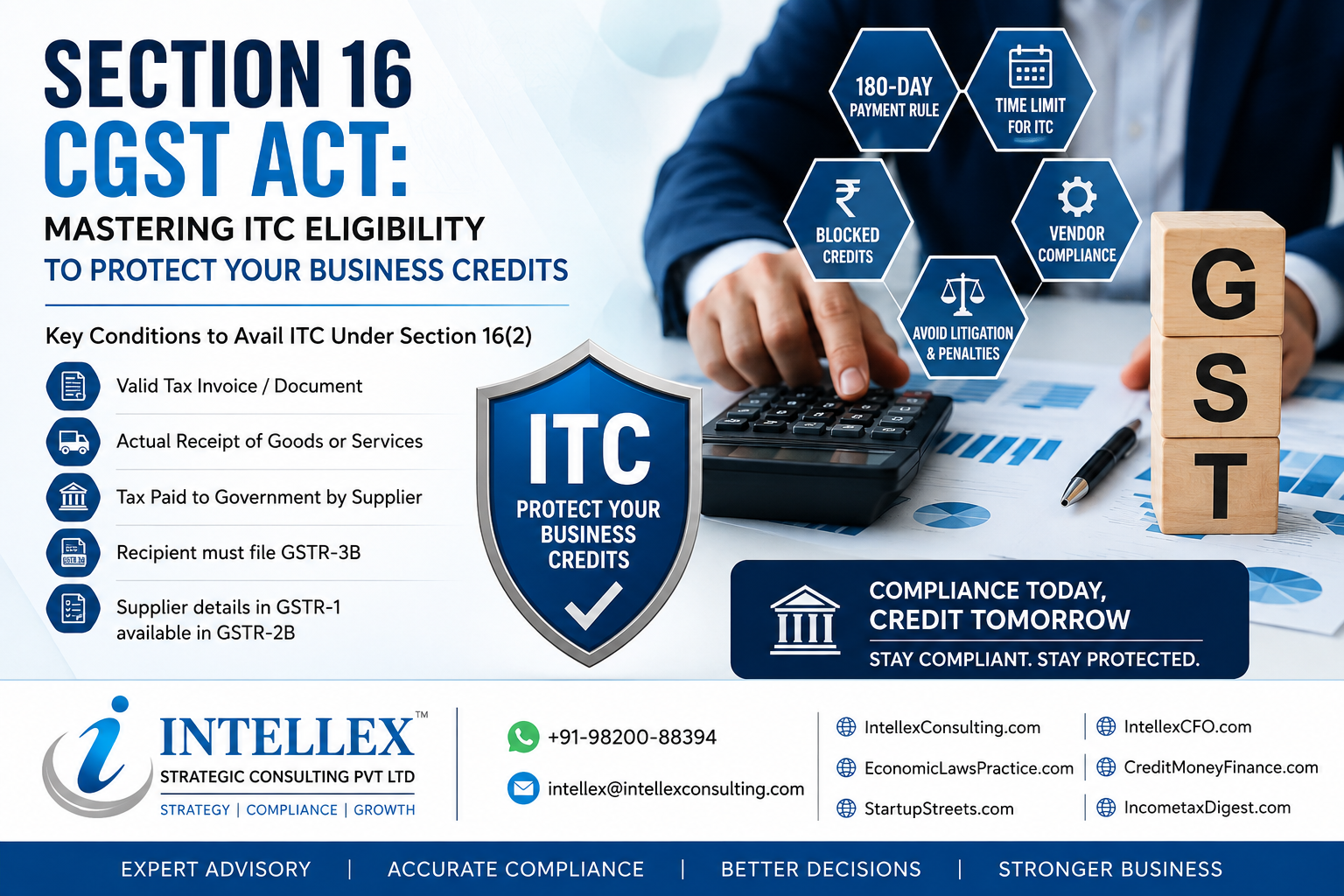
Section 16 of CGST Act: Mastering ITC Eligibility to Protect Your Business Credits and Avoid GST Disputes.
Understand Section 16 of the CGST Act in detail with complete guidance on Input Tax Credit (ITC) eligibility, GSTR-2B matching, 180-day payment rule, supplier compliance, blocked credits, and ITC time limits under GST. Learn how businesses can protect valuable GST credits and avoid notices, reversals, and penalties.
Section 16 CGST Act: The Foundation of Input Tax Credit Under GST
Under India’s Goods and Services Tax regime, Input Tax Credit (ITC) is the backbone of seamless tax flow and working capital efficiency. The legal framework governing ITC eligibility primarily revolves around Section 16 of the Central Goods and Services Tax (CGST) Act, 2017.
For businesses, ITC is not merely a tax adjustment mechanism — it is a critical financial asset. Incorrect availment, delayed reconciliation, vendor non-compliance, or missed statutory timelines can result in permanent loss of credit, interest liability, penalties, and extensive litigation.
As GST scrutiny and automated compliance analytics continue to intensify, mastering Section 16 has become essential for every taxpayer, finance team, CFO, accountant, and GST consultant.
Understanding Section 16 of the CGST Act
Section 16 lays down:
- The eligibility criteria for claiming ITC
- Mandatory conditions for availing credit
- Time limits for claiming ITC
- Restrictions and reversals
- Compliance obligations linked to vendor filings and payments
The provision ensures that tax credit flows only through genuine and compliant transactions within the GST ecosystem.
1. Core Eligibility Under Section 16(1)
Section 16(1) grants every registered person the right to claim ITC on:
- Goods
- Services
- Both goods and services
provided these are:
- Used or intended to be used
- In the course or furtherance of business
This means ITC is fundamentally linked to business usage.
Examples of Eligible ITC
Businesses can generally claim ITC on:
- Raw materials
- Trading inventory
- Professional services
- Office rent
- Machinery purchases
- Software subscriptions
- Transportation used for business
- Marketing and advertising expenses
The objective is to avoid cascading taxation and ensure tax is levied only on value addition.
2. Mandatory Conditions to Claim ITC – Section 16(2)
Section 16(2) is the most litigated and compliance-sensitive provision under GST law.
A taxpayer can avail ITC only when ALL prescribed conditions are satisfied simultaneously.
A. Possession of Valid Tax Invoice or Prescribed Document
The recipient must possess:
- Tax invoice
- Debit note
- Bill of entry
- ISD invoice
- Other prescribed GST documents
The document must contain:
- GSTIN of supplier and recipient
- Invoice number and date
- Tax amount
- HSN/SAC details
- Proper tax breakup
Any defective invoice can lead to denial of ITC during departmental scrutiny.
B. Actual Receipt of Goods or Services
ITC is allowed only after actual receipt of:
- Goods
- Services
- Both
Goods Received in Installments
Where goods are received in lots or installments:
- ITC becomes available only upon receipt of the last installment.
Deemed Receipt
Goods delivered directly to a third party on instruction of the buyer may still qualify as deemed receipt under GST law.
C. Tax Must Be Paid to Government by Supplier
This is one of the strictest compliance conditions under GST.
Even if:
- Buyer has paid the vendor,
- Buyer possesses invoice,
- Goods/services are received,
ITC can still be denied if the supplier:
- Fails to deposit GST,
- Does not file returns properly,
- Becomes non-compliant.
This effectively links recipient eligibility to supplier compliance behavior.
D. Filing of GSTR-3B Mandatory
The recipient must furnish:
- GSTR-3B return under Section 39
Without filing GSTR-3B:
- ITC legally cannot be availed.
Delayed return filing can also delay utilization of credits and impact working capital.
E. GSTR-2B Matching Requirement
One of the most important practical requirements today is reconciliation with GSTR-2B.
The supplier must:
- Upload invoice details in GSTR-1
- Which must reflect in recipient’s GSTR-2B
If invoices are missing in GSTR-2B:
- ITC may be denied,
- Notices may be issued,
- Credit may require reversal with interest.
Why GSTR-2B Matching Is Critical
GST authorities now rely heavily on automated data analytics and AI-based reconciliations.
Common reasons for mismatch:
- Supplier non-filing
- Incorrect GSTIN
- Invoice duplication
- Wrong invoice date
- Amended invoices
- Delayed filing by vendor
Businesses must therefore conduct:
- Monthly vendor reconciliations
- Vendor compliance reviews
- ITC health checks
3. Time Limit for Availing ITC – Section 16(4)
Section 16(4) imposes a strict statutory deadline.
ITC relating to a financial year can be claimed up to the earlier of:
- 30th November of the succeeding financial year, OR
- Date of filing annual return (GSTR-9)
whichever is earlier.
Example
For FY 2024-25:
- ITC can be claimed up to 30th November 2025,
OR - Actual date of GSTR-9 filing,
whichever occurs first.
After this deadline:
- ITC permanently lapses,
- No legal remedy is generally available.
4. 180-Day Payment Rule Under Section 16(2)
The second proviso to Section 16(2) introduces the famous “180-day payment condition.”
If recipient fails to pay:
- Invoice value PLUS GST amount
within 180 days from invoice date,
then:
- ITC availed must be reversed,
- Interest under Section 50 becomes payable.
Reclaiming ITC
The good news:
- ITC can be reclaimed once payment is eventually made to supplier.
Exceptions to 180-Day Rule
This condition does NOT apply to:
- Reverse Charge Mechanism (RCM) supplies
- Schedule I supplies made without consideration
5. Depreciation Restriction – Section 16(3)
Businesses cannot claim dual tax benefits.
If depreciation under the Income Tax Act is claimed on:
- GST component of capital goods,
then:
- ITC on that tax portion becomes unavailable.
Practical Example
Suppose machinery cost includes:
- ₹10 lakh value
- ₹1.8 lakh GST
If depreciation is claimed on ₹11.8 lakh:
- ITC on ₹1.8 lakh cannot be claimed.
Businesses should ensure:
- GST component is excluded from depreciable asset value when ITC is intended.
6. Blocked Credits Under Section 17(5)
Even if expenses are business-related, certain ITC claims are specifically restricted under Section 17(5).
These are commonly called “Blocked Credits.”
Common Blocked Credits
- Motor vehicles for personal use
- Club memberships
- Health and fitness memberships
- Personal consumption expenses
- Certain food and beverage expenses
- Employee vacation benefits
- Works contract for immovable property (subject to conditions)
Understanding interaction between Section 16 and Section 17(5) is crucial to avoid incorrect claims.
7. Why Section 16 Is Extremely Important for Businesses
A. ITC Directly Impacts Working Capital
Blocked or delayed ITC means:
- Higher tax cash outflow
- Reduced liquidity
- Increased borrowing requirement
For large businesses, even temporary ITC denial can significantly affect cash flow.
B. Vendor Compliance Has Become Business-Critical
Businesses must now evaluate vendors not only commercially but also from GST compliance perspective.
A non-compliant supplier can:
- Destroy recipient ITC,
- Trigger notices,
- Create litigation exposure.
This has made:
- Vendor onboarding controls,
- GST compliance ratings,
- Monthly reconciliation systems
essential operational processes.
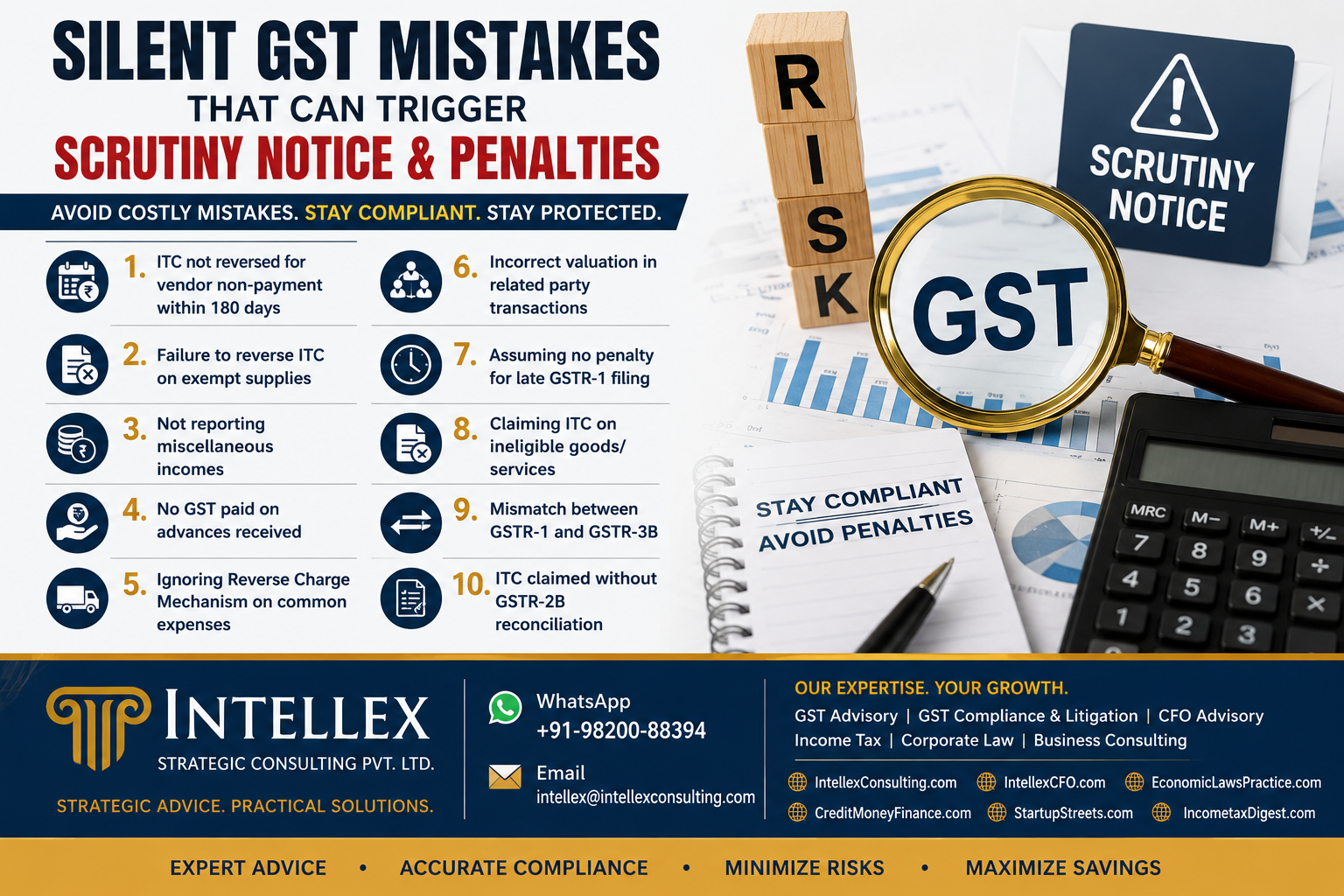
C. Major Source of GST Notices and Litigation
A substantial portion of GST disputes today arise from:
- GSTR-2B mismatches
- Fake invoices
- Supplier default
- Delayed ITC claims
- Incorrect reversals
- Blocked credit disputes
Authorities increasingly use:
- AI-driven reconciliation systems
- E-invoice analytics
- Data matching tools
to identify ITC irregularities automatically.
8. Best Practices to Protect Your ITC
Maintain Monthly Vendor Reconciliation
Reconcile:
- Purchase register
- GSTR-2B
- Vendor filings
every month.
Conduct Vendor Compliance Checks
Track:
- Return filing history
- GST registration status
- Tax payment behavior
of major vendors.
Monitor ITC Aging
Track invoices approaching:
- 180-day payment deadline
- Section 16(4) time limitation deadline
to avoid permanent credit loss.
Strengthen Documentation
Maintain:
- Invoices
- Delivery proofs
- Contracts
- Payment records
- E-way bills
for audit readiness.
Automate GST Compliance
Use:
- ERP integrations
- GST reconciliation software
- Automated compliance dashboards
to reduce human errors.
9. Key Judicial Trends Around Section 16
Indian courts and GST authorities continue to witness disputes involving:
- Genuine buyers denied ITC due to supplier defaults
- Technical mismatches in GSTR-2B
- Retrospective denial of credits
- Interpretation of “receipt of services”
- Procedural vs substantive compliance
While courts have occasionally granted relief to bona fide taxpayers, compliance discipline remains the safest strategy.
10. Future of ITC Compliance in India
GST compliance is becoming increasingly:
- Technology-driven
- Data-centric
- Automated
- Risk-based
With:
- E-invoicing,
- Real-time reporting,
- AI scrutiny,
- System-driven notices,
businesses must adopt proactive GST governance rather than reactive compliance.
The future belongs to businesses with:
- Strong vendor management,
- Automated reconciliations,
- Timely return filing,
- Robust internal controls.
Conclusion
Section 16 of the CGST Act is the heart of the Input Tax Credit mechanism under GST. While ITC significantly reduces tax costs and improves working capital, the law imposes strict compliance obligations on taxpayers.
Businesses must understand that:
- ITC is a conditional benefit,
- Not an automatic entitlement.
A single lapse involving:
- Vendor non-compliance,
- Delayed payment,
- Missing invoice,
- GSTR-2B mismatch,
- Expired deadline,
can result in irreversible financial loss.
In today’s highly automated GST ecosystem, protecting eligible ITC is as important as generating revenue itself.
Organizations that build strong GST compliance systems, vendor monitoring processes, and reconciliation frameworks will not only avoid litigation but also achieve superior financial efficiency and regulatory confidence.
Professional GST Advisory & Compliance Support
Businesses seeking expert assistance for:
- GST advisory
- ITC reconciliation
- GST litigation support
- Vendor compliance reviews
- GST audits
- GSTR-2B reconciliation
- GST notices and assessments
- CFO advisory services
- Startup GST structuring
can connect with:
Intellex Strategic Consulting Pvt Ltd
📱 WhatsApp: +91-98200-88394
📧 Email: intellex@intellexconsulting.com
EconomicLawsPractice.com
More Featured Articles:
Startup India Registration: Unlocking Tax Benefits and Growth
3 thoughts on “Section 16 of CGST Act: Mastering ITC Eligibility to Protect Your Business Credits and Avoid GST Disputes.”