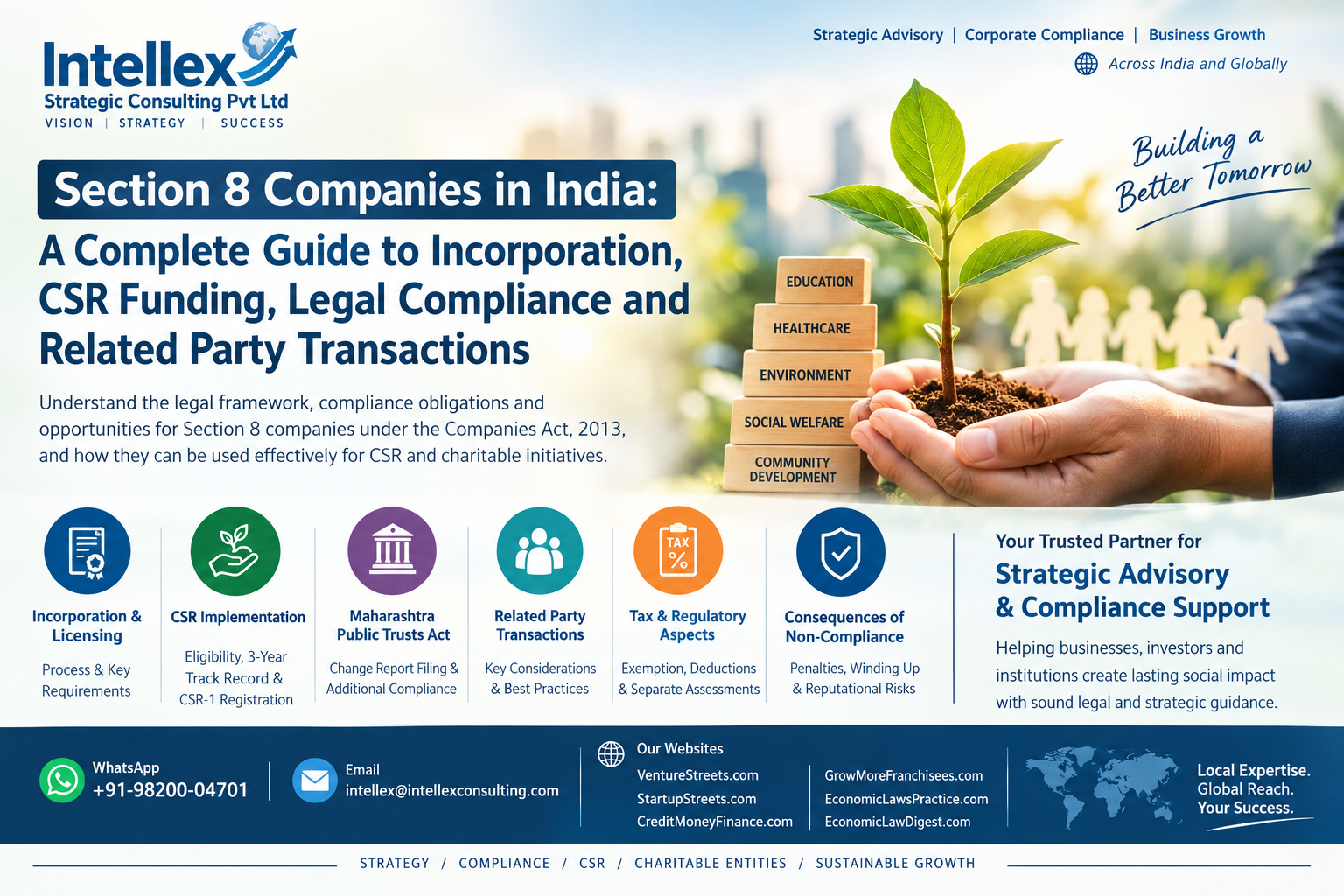
Section 8 Companies in India: A Complete Guide to Incorporation, CSR Funding, Legal Compliance and Related Party Transactions
Understand Section 8 companies under the Companies Act, 2013, including incorporation, charitable objects, CSR eligibility, compliance obligations, Maharashtra public trust regulations and related party transaction risks.
1. Introduction: Understanding Section 8 Companies
Section 8 of the Companies Act, 2013 provides a legal framework for establishing companies with charitable, social, educational, scientific, environmental, cultural and other public-benefit objectives. These entities are commonly known as Section 8 companies.
Unlike conventional commercial companies, Section 8 companies are established to promote specified objects rather than distribute profits to their members. They can earn revenue, receive donations, undertake projects, employ staff and enter into commercial arrangements, provided their activities remain consistent with their approved objects and applicable legal requirements.
Section 8 companies have become important vehicles for corporate social responsibility (CSR) initiatives, educational programmes, healthcare projects, environmental conservation, research, community development and philanthropic activities.
However, their not-for-profit character does not mean that they are exempt from corporate governance, statutory filings, financial reporting or regulatory oversight. They operate within a distinct legal framework and must comply with the Companies Act, 2013, applicable rules, and any additional regulatory requirements relevant to their activities.
For businesses planning to establish foundations, contribute CSR funds or collaborate with charitable organisations, understanding these requirements is essential.
2. What Is a Section 8 Company?
Section 8 of the Companies Act, 2013 deals with companies formed for charitable or other public-benefit purposes.
Under the provision, the Central Government may grant a licence to a company where it is satisfied that the company:
- Has as its objects the promotion of commerce, art, science, sports, education, research, social welfare, religion, charity, protection of the environment or any other similar object.
- Intends to apply its profits, if any, or other income towards promoting its objects.
- Prohibits the payment of dividends to its members.
The expression “not-for-profit” is frequently misunderstood. It does not mean that a Section 8 company cannot generate income or earn a surplus. Rather, the organisation must apply its income and profits towards its permitted objectives instead of distributing them as dividends.
For example, a Section 8 company running vocational training centres may charge reasonable programme fees, receive CSR contributions, obtain grants and earn interest on permitted investments. Any resulting surplus must be utilised in accordance with its objects and applicable law.
Key characteristics
1. Separate legal entity: A Section 8 company has a legal identity distinct from its members and directors.
2. Public-benefit objectives: Its objects must fall within the categories permitted by Section 8 and the applicable licensing framework.
3. No dividend distribution: Profits cannot be distributed to members as dividends.
4. Regulated use of funds: Income and surplus must be applied towards the company’s approved objects.
5. Statutory compliance: The company remains subject to applicable requirements concerning accounts, audits, annual returns, board governance and other corporate filings.
6. Potential tax benefits: Tax exemptions are not automatic merely because an organisation is incorporated under Section 8. Eligibility depends on separate provisions and registrations under the Income-tax Act, 1961, where applicable.
3. Incorporation and Licensing of a Section 8 Company
Section 8 companies are incorporated under the Companies Act, 2013, following the applicable incorporation procedures and licensing requirements.
The incorporation process generally involves the following stages.
Step 1: Define the charitable objects
The promoters must identify the activities the proposed company will undertake. These may include education, healthcare, skill development, scientific research, environmental protection, sports promotion or community welfare.
The objects should be drafted clearly and should reflect the organisation’s intended programmes and funding model.
Step 2: Determine the appropriate legal structure
The proposed organisation may be incorporated as a company limited by shares or as a company limited by guarantee, as permitted under the applicable framework.
The promoters should assess the intended membership structure, governance arrangements, funding requirements and long-term objectives before deciding.
Step 3: Complete incorporation formalities
The incorporation application is submitted through the Ministry of Corporate Affairs’ prescribed electronic process, with the required constitutional documents, declarations and supporting information.
The memorandum and articles of association must contain appropriate provisions concerning the company’s objects, application of income, restrictions on distributions and treatment of assets upon winding up.
Step 4: Obtain the Section 8 licence
The licensing requirement is governed by Section 8 and the applicable rules. Under the current incorporation framework, the licence is processed through the prescribed Registrar of Companies/MCA mechanism, including the applicable delegated authority.
It is therefore important to distinguish the statutory reference to the Central Government from the administrative authority and procedure applicable to a particular incorporation application.
Step 5: Commence operations and establish governance
After incorporation, the company should establish its board processes, accounting systems, internal controls, bank arrangements, statutory registers and compliance calendar.
Where the organisation expects to receive CSR funds, additional planning is required to establish its eligibility as an implementing agency and ensure that its programmes satisfy the applicable CSR framework.
4. Privileges and Restrictions Applicable to Section 8 Companies
Section 8 companies receive certain statutory relaxations because of their special nature. These may include exemptions from specified requirements applicable to other companies, subject to the Act, rules and relevant notifications.
Such relaxations should not be interpreted as a general exemption from company law.
The organisation must continue to assess its obligations in relation to board meetings, financial statements, statutory audits, annual filings, director-related disclosures, related party transactions and other applicable requirements.
Restrictions on alteration of objects and conversion
A Section 8 company cannot treat its charitable licence as a general-purpose commercial company licence.
Section 8(4) restricts alteration of the memorandum or articles without the prescribed prior approval. Conversion into another class of company must also follow the applicable statutory procedure and receive the required approval.
The company must not distribute profits to members or divert funds to activities inconsistent with its approved objects.
Where a Section 8 company contravenes the conditions of its licence or the applicable provisions of the Act, Section 8(11) provides for consequences that may include revocation of the licence, directions concerning conversion into another kind of company, winding-up proceedings, and penalties, depending on the circumstances and statutory requirements.
Directors and officers may also face personal consequences where the law imposes liability for their conduct or defaults.
The practical lesson is straightforward: the company’s charitable status creates specific obligations that must be monitored throughout its existence, not merely at the time of incorporation.
More Similar Posts:
Major GST Compliance Overhaul Effective April 2026: What Businesses Must Act On in May.