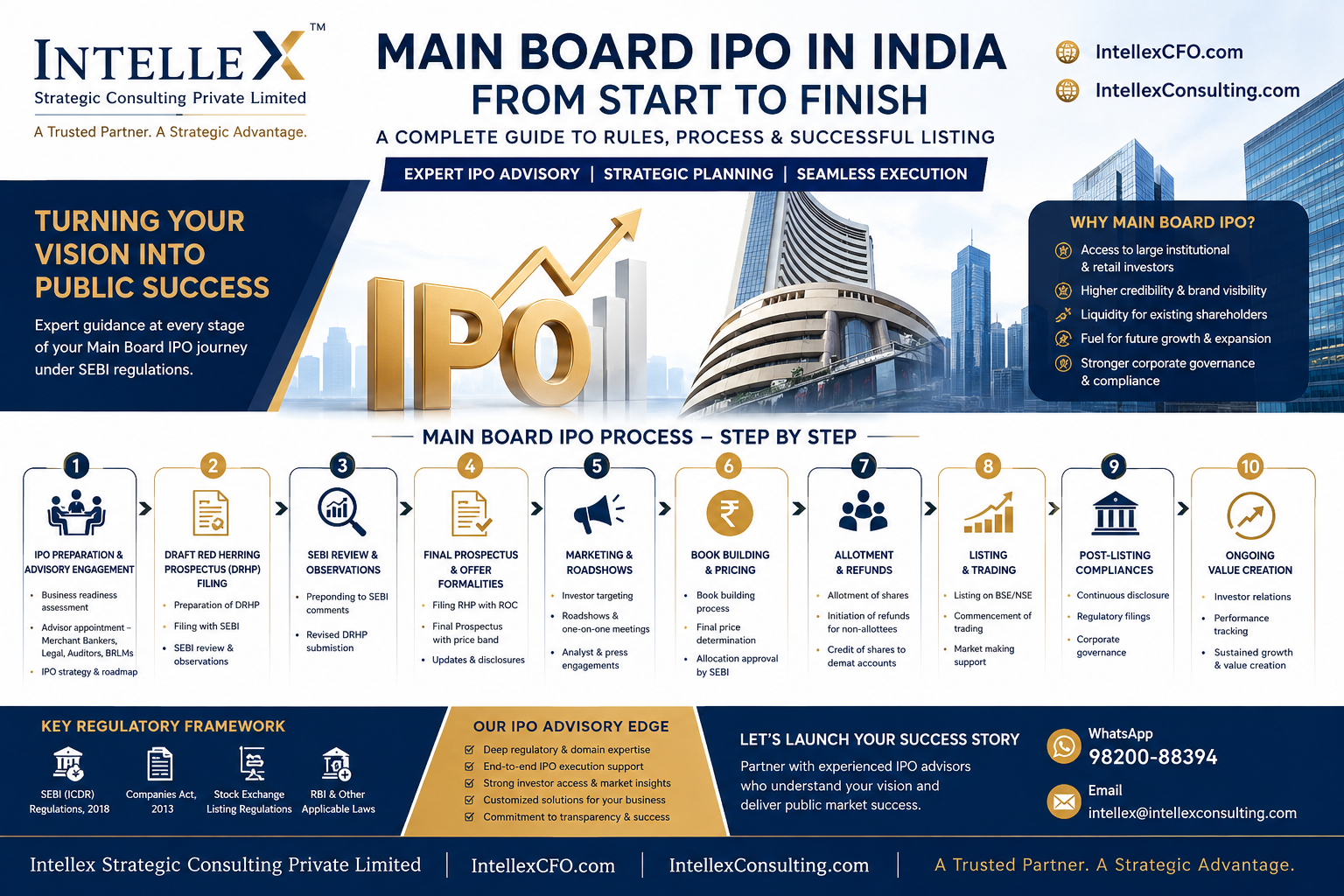
Unlocking Main Board IPO Success in India: Comprehensive Guide for Companies & Investors | SEBI Rules, Process, Timelines, Legalities + Expert IPO Advisory Tips.
Learn everything about Main Board IPO in India — from eligibility and SEBI regulations to detailed step-by-step IPO process, timeline, listing rules, investor implications, FAQs, and how Intellex Strategic Consulting Pvt. Ltd. can support your IPO journey from start to finish.
Introduction
Initial Public Offerings (IPOs) are among the most transformative milestones for companies. An IPO isn’t just a financing event — it marks a company’s transition from a private entity to a publicly traded enterprise, opening doors to capital markets, institutional credibility, and exponential growth opportunities.
In India, a Main Board IPO — listing on the Bombay Stock Exchange (BSE) or National Stock Exchange (NSE) — is governed by stringent regulatory frameworks primarily under the Securities and Exchange Board of India (SEBI) and the ICDR Regulations. Successfully navigating this process requires strategic planning, legal compliance, rigorous disclosures, and excellent financial structuring.
This detailed guide walks you through every stage of a Main Board IPO in India, from eligibility criteria and regulatory standards to the nuances of drafting the offer document, pricing, allotment, and listing. We also explain the valuable role of professional IPO advisory — and how Intellex Strategic Consulting Private Limited can be your trusted partner throughout.
What is a Main Board IPO?
A Main Board IPO refers to the public issue and listing of a company’s equity shares on the primary segments of India’s major stock exchanges — BSE and NSE.
Unlike SME or start-up funding platforms, Main Board IPOs are designed for matured companies with robust financials, strong governance, and proven growth prospects. Main Board listings offer wider liquidity and greater investor participation.
Eligibility and procedural requirements are significantly more stringent than those for SME or other “junior” exchange platforms, underscoring the importance of preparation.
Mandatory Eligibility Criteria: Meeting SEBI & Exchange Norms
To qualify for a Main Board IPO in India, a company must satisfy SEBI’s Issue of Capital and Disclosure Requirements (ICDR) Regulations and additional listing requirements from NSE/BSE.
1. Operational History & Track Record
- Minimum 3 years of continuous operations with audited financials.
2. Profitability & Financial Health
There are two distinct routes:
A. Profitability Route (Traditional Norm)
- Net Tangible Assets ≥ ₹3 crore in each of the last 3 financial years.
- Minimum aggregate pre-tax profit of ₹15 crore in any 3 out of last 5 years.
- Positive audited net worth in each of those years.
B. QIB Route (For Fast-Growers Without Profit Track Record)
- If a company doesn’t meet profitability norms, it can pursue the IPO via the Qualified Institutional Buyer (QIB) route:
– At least 75% of the net offer reserved for QIBs.
– Post-issue market cap must meet higher thresholds.
3. Paid-up Capital & Market Capitalisation
- Post-issue paid-up capital ≥ ₹10 crore.
- Post-issue market capitalisation ≥ ₹25 crore at the time of listing.
4. Other Critical Conditions
- All promoters and directors, and the company itself, must not be SEBI-debarred or wilful defaulters.
- All shares must be in dematerialised form before filing.
- No outstanding convertible securities or rights that could affect share capital without proper disclosures.
Step-by-Step Main Board IPO Process
Stage 1: IPO Preparation & Advisory Engagement
Companies must first appoint key stakeholders:
- Merchant Bankers (Lead Managers)
- Legal Counsels
- Auditors
- Registrars & BRLMs
- IPO Advisory Partners (e.g., Intellex Strategic Consulting)
This team conducts initial due diligence, refines business strategies, financial projections, and identifies corporate governance improvements.
Tip: Partnering with experienced IPO advisory professionals like Intellex can significantly improve planning, regulatory readiness, and investor communication. Contact: WhatsApp +91 98200-88394 | Email: intellex@intellexconsulting.com
Stage 2: Draft Red Herring Prospectus (DRHP) Filing
The company prepares the Draft Red Herring Prospectus (DRHP) — a comprehensive disclosure document that includes:
- Business overview
- Financial performance
- Risk factors
- Management structure
- Use of IPO funds
The DRHP is then filed with SEBI for review and observation.
Stage 3: SEBI Review & Observations
After submission, SEBI reviews the DRHP for completeness and compliance. SEBI issues comments that the issuer must address. This process may involve multiple iterations.
Once cleared, SEBI issues an Observation Letter, permitting the company to proceed to the next stage.
Stage 4: Final Prospectus & Offer Formalities
Post SEBI approval, the company finalises the Red Herring Prospectus (RHP) — with the issue price range and updated disclosures — and files it with the Registrar of Companies (RoC).
This is also when:
- Stock exchange listing applications are filed.
- Registrar and transfer agents prepare for investor processing.
Stage 5: Marketing & Roadshows
MANDATORY Investor roadshows are conducted to generate interest in the IPO. These can include:
- Virtual and in-person presentations for institutional investors
- Analyst briefings and press engagements
- Retail investor awareness sessions
The goal is to build demand and ensure a successful subscription across investor categories.
Stage 6: Book Building & Pricing
In most Main Board IPOs, pricing is determined through book-building:
- A price band is fixed.
- Investors submit bids across price points within the band.
- Based on demand and investor mix, final pricing is decided just before the offer closes.
Payment via ASBA: SEBI mandates all bids to be made through Application Supported by Blocked Amount (ASBA), which ensures investor funds are blocked but not debited unless shares are allotted.
Stage 7: Allotment & Refunds
- Shares are allotted based on defined category quotas (retail, HNIs, QIBs).
- Super-oversubscription leads to proportional allocation or lotteries in some cases.
- Refunds are automatically processed for unallotted portions.
Stage 8: Listing & Trading
Finally:
- Shares are credited to investors’ Demat accounts.
- The company gets listed on BSE/NSE.
- Trading begins, marking the culmination of an IPO journey.
The listing day price movement often reflects market sentiment, and companies often host investor calls to discuss future strategy.
Post-IPO Obligations
After listing, companies must adhere to:
- SEBI’s Listing Obligations and Disclosure Requirements (LODR)
- Quarterly and annual reporting
- Corporate governance norms
- Minimum public shareholding requirements
- Insider trading disclosures
SEBI also periodically updates regulations around disclosures and governance — for example, a draft LODR review paper is expected soon on disclosure and governance improvements.
Why Main Board IPOs Matter
A Main Board listing gives companies:
- Access to deep capital markets
- Brand visibility and wider investor trust
- Ability to unlock valuation and attract strategic investors
- Better corporate governance disciplines
- Long-term growth capital
However, it also demands rigorous compliance, ongoing disclosures, and investor engagement.
Common FAQs
Q1. What is the difference between Main Board and SME IPO?
Main Board IPOs target larger, established companies with stringent eligibility criteria. SMEs have lighter requirements but smaller capital raises.
Q2. Can loss-making companies list?
Only via the QIB route with conditions as per SEBI ICDR.
Q3. What are promoter lock-in norms?
Promoter shareholding is typically locked in for 18 months to 3 years based on issue specifics.
Intellex Strategic Consulting — Your IPO Partner
Embarking on an IPO is a crucial strategic phase. Adequate advisory support makes all the difference between a successful listing and avoidable regulatory setbacks.
Intellex Strategic Consulting Private Limited (IntellexCFO.com & IntellexConsulting.com) offers:
- End-to-end IPO Advisory & Management
- SEBI compliance & documentation support
- DRHP drafting & review
- Roadshow & investor engagement strategy
- Valuation optimization & pricing guidance
- Post-listing support
Contact Intellex Today:
📱 WhatsApp: +91 98200-88394
📧 Email: intellex@intellexconsulting.com
Whether you’re preparing your first IPO or scaling your public market presence, expert guidance can help you navigate this transformative journey.
Conclusion
A Main Board IPO in India is a rigorous yet rewarding pathway for companies aspiring to unlock capital market potential. With evolving SEBI norms and competitive market conditions, meticulous planning, stringent compliance, and expert advisory support are indispensable.
This guide offers a deep dive into every stage of the IPO lifecycle — from eligibility to listing — designed for CFOs, promoters, investors, and financial professionals alike.
For personalised IPO strategy, timeline planning, and execution support, Intellex Strategic Consulting stands ready to guide your success.
Intellex Strategic Consulting Pvt Ltd
More Featured Articles:
SME IPO in India: A Comprehensive Guide for Growing Businesses Looking to Go Public
Loans Takeover proposals with enhancement of Banking limits for MSME Sector Companies

4 thoughts on “Unlocking Main Board IPO Success in India: Comprehensive Guide for Companies & Investors | SEBI Rules, Process, Timelines, Legalities + Expert IPO Advisory Tips.”