Form 157 Under the Income-tax Act, 2025: Tax Clearance Requirement for Leaving India – Not Applicable to Every Traveller.
Form 157 under the Income-tax Act, 2025 has raised concerns about mandatory tax clearance before foreign travel. Learn who actually needs Form 157, the legal provisions, CBDT guidelines, exceptions, and implications for taxpayers leaving India.
Form 157: Tax Clearance Requirement for Leaving India – Not for Every Traveller
Introduction
The notification of Form 157 under the Income-tax Act, 2025 has generated considerable discussion among taxpayers, professionals, and business communities. Many individuals have mistakenly assumed that every person travelling abroad will now be required to obtain an income-tax clearance certificate before departing from India.
Such concerns, however, are largely unfounded.
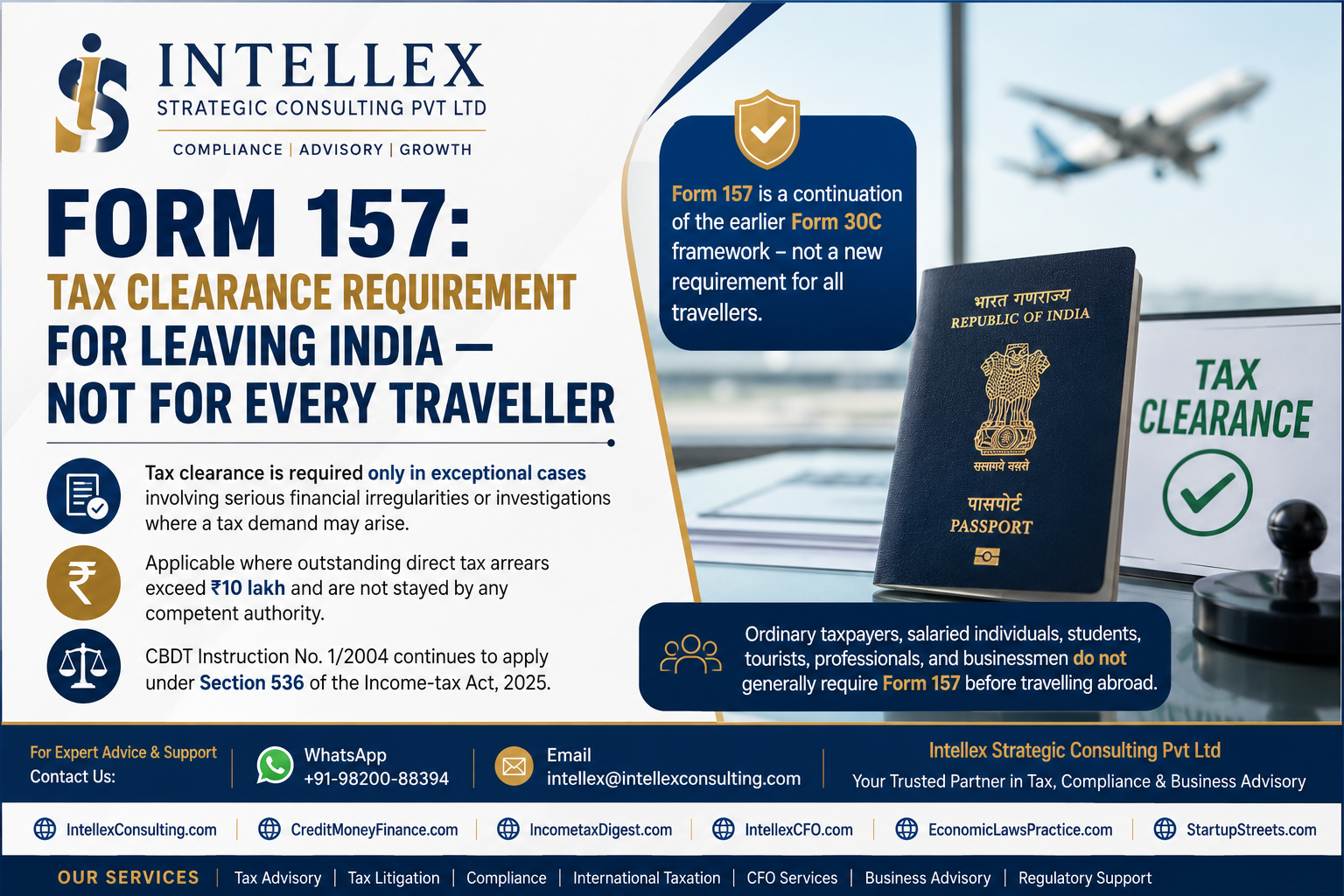
The legal framework governing Form 157 reveals that the requirement is highly restricted and applies only in specific circumstances involving tax investigations or significant outstanding tax liabilities. Ordinary taxpayers, salaried employees, students, tourists, professionals, and businesspersons travelling abroad are generally unaffected by these provisions.
Understanding the true scope of Form 157 is essential to avoid unnecessary confusion and ensure compliance where genuinely required.
Legal Framework of Form 157
Form 157 has been prescribed under:
- Section 420(4) of the Income-tax Act, 2025
- Rule 228 of the Income-tax Rules, 2026
The form is intended to facilitate the issuance of a Tax Clearance Certificate (TCC) in cases where tax authorities consider such certification necessary before an individual leaves India.
The objective is not to create a universal travel compliance requirement but rather to safeguard revenue interests in exceptional cases involving potential tax risks.
Why Has Form 157 Created Confusion?
Historically, provisions relating to tax clearance before foreign travel have existed under Indian tax laws for several decades.
However, the introduction of a new form under the new Income-tax regime led many observers to believe that tax authorities had expanded the requirement to cover all outbound travellers.
Social media discussions, incomplete interpretations, and fragmented reporting further amplified these concerns.
A careful reading of the law, however, demonstrates that Form 157 merely continues an existing framework that was already present under the earlier Income-tax Act, 1961.
CBDT Clarification: Tax Clearance Is Required Only in Exceptional Cases
The most important guidance on this subject comes from CBDT Instruction No. 1/2004 dated 5 February 2004.
The Central Board of Direct Taxes clarified that tax clearance should be sought only in exceptional circumstances.
According to the instruction, tax clearance is required primarily in the following situations:
1. Persons Involved in Serious Financial Irregularities
Tax clearance may be required where:
- An individual is involved in significant financial irregularities;
- The person’s presence is required in connection with investigations under direct tax laws;
- Authorities believe that a substantial tax demand may arise following such investigation.
This category typically covers cases involving:
- Tax evasion investigations;
- Search and seizure proceedings;
- Undisclosed income inquiries;
- Benami or layered financial transactions;
- Serious revenue-risk matters.
The objective is to prevent situations where a taxpayer leaves India while critical investigations remain pending.
2. Persons Having Large Outstanding Tax Arrears
Tax clearance may also be required where:
- Outstanding direct tax dues exceed ₹10 lakh; and
- Such dues have not been stayed by any competent authority.
In such cases, tax authorities may seek safeguards before permitting international departure.
The provision is intended to address revenue recovery concerns and prevent avoidance of tax liabilities through overseas relocation or prolonged absence from India.
Continuity Under the Income-tax Act, 2025
A significant legal provision supporting the continued applicability of the CBDT instruction is found in:
Section 536 – Repeal and Savings
Section 536 provides that:
Circulars, instructions, notifications, and directions issued under the repealed Income-tax Act, 1961 shall continue to remain in force to the extent they are not inconsistent with the provisions of the new Income-tax Act, 2025.
As a result, CBDT Instruction No. 1/2004 continues to guide the implementation of tax clearance requirements under the new law.
Therefore, the introduction of Form 157 should not be viewed as a substantive expansion of the tax clearance regime.
Instead, it represents an administrative continuation of an existing framework.
Who Does NOT Need Form 157?
For the vast majority of individuals travelling abroad, Form 157 is irrelevant.
The following categories generally do not require tax clearance before leaving India:
Salaried Employees
Employees travelling abroad for:
- Business meetings;
- Conferences;
- Training programs;
- Personal vacations;
- Family visits;
are ordinarily not required to obtain Form 157.
Business Owners and Entrepreneurs
Routine international business travel does not trigger tax clearance requirements unless the individual falls within one of the exceptional categories identified by CBDT.
Students
Students travelling overseas for:
- Higher education;
- Research programs;
- Exchange programs;
- Internships;
are not required to obtain tax clearance certificates merely because they are leaving India.
Tourists
Individuals travelling for leisure, tourism, pilgrimage, or personal reasons are not covered by the requirement.
Professionals
Doctors, lawyers, consultants, chartered accountants, engineers, and other professionals travelling internationally in the ordinary course of their profession generally do not require Form 157.
NRIs and Overseas Travellers
Regular travel by Non-Resident Indians and frequent international travellers is unaffected unless specific tax-related concerns exist.
Practical Scenarios
Scenario 1: Salaried Executive Travelling to Singapore
A salaried executive travelling to Singapore for a corporate conference has no significant outstanding tax liabilities and is not under investigation.
Form 157 is not required.
Scenario 2: Student Leaving for Higher Studies
A student admitted to a university abroad plans to relocate for education purposes.
Form 157 is not required.
Scenario 3: Taxpayer with Outstanding Demand of ₹15 Lakh
An individual has undisputed tax arrears exceeding ₹10 lakh and no stay order has been obtained.
Tax authorities may require a tax clearance certificate depending on the facts and circumstances.
Form 157 may become relevant.
Scenario 4: Person Under Serious Tax Investigation
A taxpayer is subject to an ongoing investigation involving substantial alleged tax evasion.
Authorities believe a significant tax demand may arise.
Form 157 may be required before departure from India.
Relationship Between Form 157 and Earlier Form 30C
Under the Income-tax Act, 1961, similar tax clearance procedures existed through Form 30C.
The new Form 157 effectively serves the same administrative purpose under the Income-tax Act, 2025.
The transition reflects legislative restructuring rather than a policy shift.
Key similarities include:
- Revenue protection objective;
- Focus on high-risk taxpayers;
- Limited applicability;
- Investigation-related safeguards;
- Outstanding tax demand considerations.
Thus, taxpayers should view Form 157 as a continuation rather than a new compliance burden.
Key Takeaways
- Form 157 is prescribed under Section 420(4) of the Income-tax Act, 2025 and Rule 228 of the Income-tax Rules, 2026.
- The form relates to obtaining a Tax Clearance Certificate in specified circumstances.
- It is not mandatory for every person travelling abroad.
- CBDT Instruction No. 1/2004 limits the requirement to exceptional cases.
- Tax clearance generally applies where:
- Serious tax investigations are pending; or
- Outstanding direct tax arrears exceed ₹10 lakh and remain unstayed.
- Section 536 of the Income-tax Act, 2025 preserves earlier CBDT instructions.
- Salaried employees, students, tourists, professionals, and ordinary business travellers are generally outside the scope of the requirement.
- Form 157 substantially replaces the earlier Form 30C framework rather than creating a new compliance regime.
Conclusion
The introduction of Form 157 under the Income-tax Act, 2025 should not be interpreted as a universal requirement for all international travellers. The legal framework, supported by CBDT Instruction No. 1/2004 and the savings provisions contained in Section 536 of the new Act, clearly demonstrates that tax clearance certificates are intended only for exceptional cases involving substantial tax exposure, pending investigations, or significant outstanding tax liabilities.
For ordinary taxpayers—including salaried individuals, students, entrepreneurs, professionals, tourists, and business travellers—foreign travel continues without any requirement to obtain Form 157 or a tax clearance certificate.
In substance, Form 157 merely modernizes and continues the earlier tax clearance mechanism that existed through Form 30C under the Income-tax Act, 1961, ensuring continuity rather than creating a new compliance burden.
Professional Assistance
For advisory, compliance support, tax litigation assistance, international tax matters, tax clearance issues, income-tax assessments, search proceedings, appeals, and regulatory advisory services, businesses and individuals may consult:
Intellex Strategic Consulting Pvt. Ltd.
WhatsApp: +91-98200-88394
Email: intellex@intellexconsulting.com
Websites:
- IntellexConsulting.com
- CreditMoneyFinance.com
- IncometaxDigest.com
- IntellexCFO.com
- EconomicLawsPractice.com
- StartupStreets.com
Intellex Strategic Consulting Pvt. Ltd. provides comprehensive taxation, regulatory, compliance, corporate advisory, CFO services, and business consulting solutions for startups, SMEs, corporates, NRIs, and high-net-worth individuals across India and globally.
More Featured Articles:
Ultimate Guide to Singapore Company Registration 2026: Rules, Costs, and Compliance.
The Ultimate Guide to Company Registration in Dubai 2026: Benefits, Compliance, and Costs.
How Businesses in the UAE Can Stay Ahead of Compliance Demands in 2026.
PAN Rules 2026: Major Changes in Quoting, Reporting & Compliance Every Taxpayer Must Know.
Funding & Investment Options to Grow India’s Real Estate & Allied Businesses