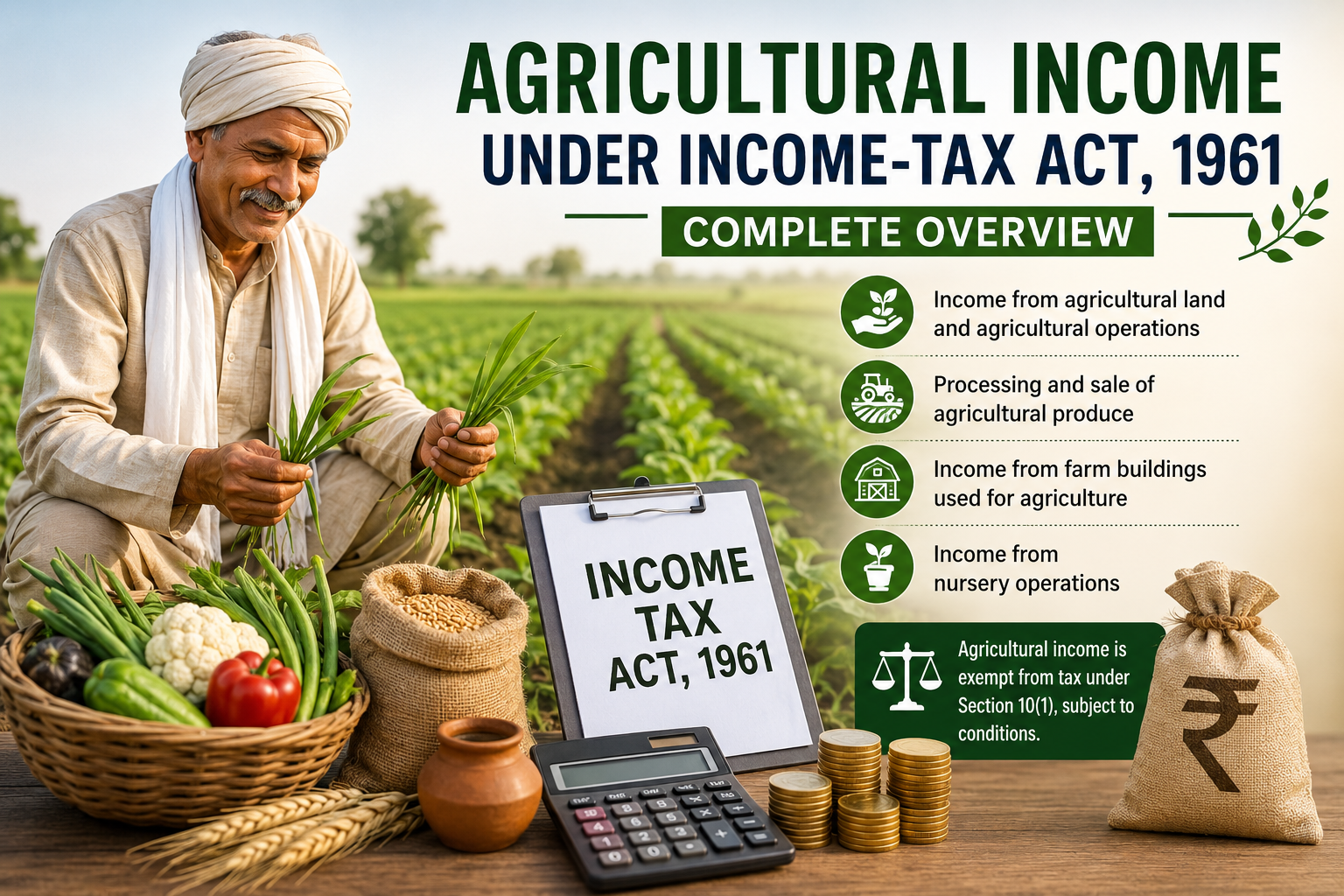
Agricultural Income under the Income-tax Act, 1961 – Complete Overview, Taxability, Exemptions, Judicial Principles & Compliance Guide.
Comprehensive guide on Agricultural Income under the Income-tax Act, 1961 covering meaning, exemptions, Section 2(1A), tax treatment, partial integration, judicial rulings, compliance requirements, GST implications, and practical taxation issues for farmers, agri-businesses, startups, and landowners in India.
Agricultural Income under the Income-tax Act, 1961 – Complete Overview
Introduction
Agriculture has always occupied a central place in the Indian economy. Recognising the importance of farming and rural livelihoods, the Indian taxation system grants special treatment to agricultural income under the Income-tax Act, 1961.
Agricultural income is specifically exempt from tax under Section 10(1) of the Income-tax Act, subject to fulfillment of prescribed conditions. However, determining whether a particular income qualifies as “agricultural income” often becomes a matter of legal interpretation and practical scrutiny.
Over the years, courts and tax authorities have examined numerous disputes involving plantation income, nursery operations, farmhouses, processing activities, dairy farming, poultry farming, and sale of agricultural land. Therefore, understanding the exact meaning, scope, and limitations of agricultural income is essential for farmers, landowners, agri-businesses, startups, investors, and tax professionals.
This article provides a comprehensive analysis of agricultural income under the Income-tax Act, 1961 including statutory provisions, judicial principles, exemptions, tax implications, practical examples, and compliance requirements.
Constitutional Background of Agricultural Income
Under the Constitution of India:
- The power to levy tax on agricultural income belongs exclusively to State Governments.
- The Central Government cannot levy income tax on agricultural income except for rate purposes in certain cases.
Accordingly:
- Agricultural income is exempt under the central Income-tax Act.
- States may impose agricultural income tax separately (certain states historically had such laws for plantations and estates).
Statutory Definition of Agricultural Income
Agricultural income is defined under Section 2(1A) of the Income-tax Act, 1961.
Broadly, agricultural income includes:
- Rent or revenue from agricultural land
- Income from agricultural operations
- Income from processing agricultural produce
- Income from sale of agricultural produce
- Income from farm buildings
- Income from nursery operations
The exemption is available under Section 10(1).
Meaning of Agriculture
The Income-tax Act does not specifically define the term “agriculture.” Therefore, courts have interpreted its meaning through judicial precedents.
The landmark Supreme Court judgment in:
CIT v. Raja Benoy Kumar Sahas Roy
laid down the fundamental principles of agriculture.
According to the judgment:
Agriculture involves:
- Basic operations on land
- Human skill and labour
- Cultivation activities
- Subsequent operations connected with crop growth and preservation
Basic Agricultural Operations
These include:
- Tilling of land
- Ploughing
- Sowing of seeds
- Planting saplings
- Irrigation
- Weeding
- Soil preparation
Subsequent Agricultural Operations
These include:
- Protection of crops
- Harvesting
- Cutting
- Pruning
- Preservation
- Processing necessary to make produce marketable
Essential Conditions for Agricultural Income
For income to qualify as agricultural income:
1. Existence of Agricultural Land
The income must arise from land situated in India.
2. Land Must Be Used for Agricultural Purposes
The land should actually be used for cultivation or farming activities.
3. Human Effort Must Exist
Agricultural operations require human skill and labour.
4. Nexus with Agricultural Operations
The income must have direct connection with agricultural activities.
Agricultural Income Components
1. Rent or Revenue from Agricultural Land
[Section 2(1A)(a)]
Income qualifies as agricultural income when:
- It is derived from agricultural land situated in India
- The land is used for agricultural purposes
- The recipient has interest in the land
Examples
- Rent from agricultural land
- Crop-sharing income
- Revenue received from cultivators
- Lease income from farming land
Important Point
Capital gains arising from sale of agricultural land are generally not agricultural income.
However:
- Rural agricultural land may qualify as non-capital asset under Section 2(14)
- Urban agricultural land may attract capital gains tax
2. Income from Agricultural Operations
[Section 2(1A)(b)(i)]
This covers income arising from:
- Cultivation
- Crop production
- Farming activities
Examples
- Wheat cultivation
- Rice farming
- Sugarcane cultivation
- Vegetable farming
- Fruit orchards
The cultivator must perform basic agricultural operations.
Merely trading in agricultural produce does not qualify.
3. Income from Processing Agricultural Produce
[Section 2(1A)(b)(ii)]
Processing income qualifies only if:
- Processing is undertaken by cultivator or rent receiver
- Processing is necessary to make produce marketable
Examples
- Drying coffee beans
- Removing husk from paddy
- Ginning cotton
- Curing tobacco
If excessive manufacturing is involved, income may become partly business income.
4. Income from Sale of Agricultural Produce
[Section 2(1A)(b)(iii)]
Income from sale of produce qualifies if:
- Produce is grown by cultivator
- Only ordinary processing is done
Examples
- Sale of grains
- Sale of vegetables
- Sale of fruits
- Sale of flowers
5. Income from Farm Buildings
[Section 2(1A)(c)]
Income from farm buildings is agricultural income if:
- Building is on or near agricultural land
- Used for agricultural operations
- Occupied by cultivator or receiver of agricultural income
Eligible Buildings
- Farmhouses
- Storehouses
- Cattle sheds
- Tool storage areas
6. Nursery Operations
[Explanation 3 to Section 2(1A)]
Income from saplings or seedlings grown in a nursery is agricultural income irrespective of whether:
- Land is used for agriculture
- Pots or trays are used
Examples
- Commercial plant nurseries
- Sapling businesses
- Ornamental plant nurseries
Income Not Treated as Agricultural Income
Certain activities are commonly misunderstood as agricultural income but are taxable.
1. Dairy Farming
Milk production is not agriculture.
2. Poultry Farming
Poultry activities are business income.
3. Fisheries
Fish farming is taxable business income.
4. Bee Keeping
Income from apiculture is not agricultural income.
5. Sale of Forest Trees
Naturally grown forest trees are generally not agricultural income.
6. Trading in Agricultural Produce
Buying and reselling produce without cultivation is business income.
7. Manufacturing Activities
Industrial processing beyond ordinary marketability may become taxable.
Composite Agricultural Income
Certain businesses involve both:
- Agricultural operations
- Manufacturing/business operations
In such cases, income is apportioned between:
- Agricultural income
- Business income
Examples
- Tea business
- Coffee growing and curing
- Rubber plantations
Tax Treatment of Tea, Coffee and Rubber
Tea Income
Under Rule 8:
- 60% treated as agricultural income
- 40% treated as business income
Coffee Income
Coffee grown and cured:
- 75% agricultural
- 25% business
Coffee grown, cured, roasted and grounded:
- 60% agricultural
- 40% business
Rubber Income
Under Rule 7A:
- 65% agricultural
- 35% business
Partial Integration of Agricultural Income
Although agricultural income is exempt, it may be considered for determining tax rate in certain cases.
Partial Integration Applies When:
1. Net agricultural income exceeds ₹5,000
AND
2. Non-agricultural income exceeds:
- Basic exemption limit
Purpose of Partial Integration
This prevents taxpayers from:
- Artificially reducing tax liability
- Using agricultural income to enter lower tax slabs
Steps in Partial Integration
Step 1
Compute tax on:
- Agricultural income + non-agricultural income
Step 2
Compute tax on:
- Agricultural income + basic exemption limit
Step 3
Difference between Step 1 and Step 2 is tax liability.
Example of Partial Integration
Suppose:
- Agricultural income = ₹6,00,000
- Salary income = ₹8,00,000
Tax is calculated by:
- Adding both incomes
- Determining applicable slab
- Reducing tax attributable to exemption threshold
This increases effective tax rate on non-agricultural income.
Agricultural Land and Capital Gains
Agricultural land classification is extremely important.
Rural Agricultural Land
Rural agricultural land is not treated as capital asset if situated outside specified municipal limits.
Hence:
- Capital gains tax may not apply.
Urban Agricultural Land
Urban agricultural land is capital asset.
Therefore:
- Sale may attract capital gains tax.
Judicial Principles on Agricultural Income
1. Basic Agricultural Operations Are Essential
In:
CIT v. Raja Benoy Kumar Sahas Roy
The Supreme Court held:
- Human effort and cultivation are essential.
2. Nursery Income Is Agricultural Income
Courts recognised nursery activities as agricultural income, later specifically clarified by statute.
3. Spontaneous Forest Growth Not Agriculture
Income from naturally grown trees without cultivation is not agricultural income.
4. Processing Must Be Limited
Only ordinary processing required to make produce marketable qualifies.
Excessive manufacturing leads to taxable business income.
Agricultural Income and GST
Agricultural activities enjoy significant relief under GST law.
Generally:
- Sale of fresh agricultural produce is exempt.
- Services relating to cultivation are exempt.
However:
- Processed foods
- Packaged branded products
- Agri-processing businesses
may attract GST.
Businesses must carefully examine:
- Nature of produce
- Extent of processing
- Packaging and branding
Agricultural Income and Tax Planning Risks
Tax authorities closely scrutinise:
- Large agricultural income disclosures
- Cash-intensive agricultural transactions
- Artificial agricultural claims
- Bogus land ownership structures
Improper claims may lead to:
- Reassessment
- Penalty
- Prosecution
- Benami transaction implications
Documentation Required for Agricultural Income
Taxpayers should maintain:
- Land ownership records
- Crop cultivation details
- Sale invoices
- Mandi receipts
- Labour payment records
- Irrigation bills
- Fertilizer purchase records
- Agricultural loan documents
- Produce transportation records
Proper documentation is critical during scrutiny proceedings.
Agricultural Income for Companies and LLPs
Companies can also earn agricultural income.
Examples:
- Plantation companies
- Agri-business entities
- Nursery companies
However:
- Non-agricultural components remain taxable.
- Apportionment rules may apply.
Agricultural Income and Startups
Modern agri-tech startups must carefully analyse:
- Whether activities constitute agriculture
- Whether technology services are taxable
- Whether processing changes tax character
Areas requiring careful evaluation:
- Hydroponics
- Vertical farming
- Controlled environment agriculture
- Contract farming
- Precision agriculture
- Agri marketplaces
Important Compliance Considerations
Filing of Income Tax Return
Even exempt agricultural income may require disclosure in ITR forms.
Books and Records
Maintain proper evidence for:
- Land ownership
- Crop production
- Revenue generation
TDS Implications
Certain agricultural transactions may still involve:
- TDS on contractual activities
- Labour payments
- Professional services
Frequently Asked Questions (FAQs)
Is agricultural income fully exempt from income tax?
Yes, genuine agricultural income is exempt under Section 10(1), subject to conditions.
Is sale of agricultural land exempt?
Depends on whether land is rural or urban agricultural land.
Is nursery income agricultural income?
Yes, as per Explanation 3 to Section 2(1A).
Is dairy farming agricultural income?
No. Dairy income is business income.
Is poultry farming agricultural income?
No. It is taxable business income.
Is income from tea plantations fully exempt?
No. Tea income is partly agricultural and partly business income.
Can agricultural income trigger higher tax rate?
Yes, through partial integration.
Practical Challenges in Agricultural Income Cases
Common litigation areas include:
- Bogus agricultural income claims
- Classification disputes
- Land usage verification
- Processing vs manufacturing distinction
- Capital gains on agricultural land
- Cash transaction scrutiny
High-net-worth individuals and closely held businesses must exercise particular caution.
Emerging Trends in Agricultural Taxation
The agriculture sector is rapidly evolving with:
- Agri-tech platforms
- Smart farming
- Drone-based agriculture
- Hydroponics
- Organic farming
- Export-oriented agriculture
Tax authorities may increasingly examine:
- Digital agri businesses
- Cross-border agri income
- Subsidy treatment
- ESG-linked agricultural structures
Proper structuring and tax advisory support have become increasingly important.
Conclusion
Agricultural income enjoys a privileged position under the Indian taxation framework. However, exemption is available only where genuine agricultural operations exist and statutory conditions are satisfied.
The distinction between:
- Agriculture and business
- Processing and manufacturing
- Rural and urban land
- Agricultural and commercial activities
has enormous tax implications.
With increased scrutiny by tax authorities and growing complexity in agri-business models, taxpayers must ensure:
- Proper documentation
- Correct classification
- Accurate reporting
- Strong legal compliance
Professional guidance becomes essential particularly for:
- Large landowners
- Agri-business companies
- Plantation businesses
- Agri-tech startups
- High-value agricultural transactions
How Intellex Strategic Consulting Pvt Ltd Can Help
Intellex Strategic Consulting Pvt Ltd provides specialised advisory, structuring, taxation, and compliance support in relation to:
- Agricultural income tax advisory
- Agricultural land transactions
- Tax structuring for agri-businesses
- Capital gains planning
- GST implications on agricultural activities
- Agri-tech business structuring
- Income-tax litigation support
- Tax documentation and scrutiny assistance
- Farm business compliance
- Plantation taxation advisory
Contact Details
- WhatsApp: +91-98200-88394
- Email:
- Websites:
More Featured Articles:
PAN Rules 2026: Major Changes in Quoting, Reporting & Compliance Every Taxpayer Must Know.
Major GST Compliance Overhaul Effective April 2026: What Businesses Must Act On in May.
How Businesses in the UAE Can Stay Ahead of Compliance Demands in 2026.
Funding & Investment Options to Grow India’s Real Estate & Allied Businesses


One thought on “Agricultural Income under the Income-tax Act, 1961 – Complete Overview, Taxability, Exemptions, Judicial Principles & Compliance Guide.”