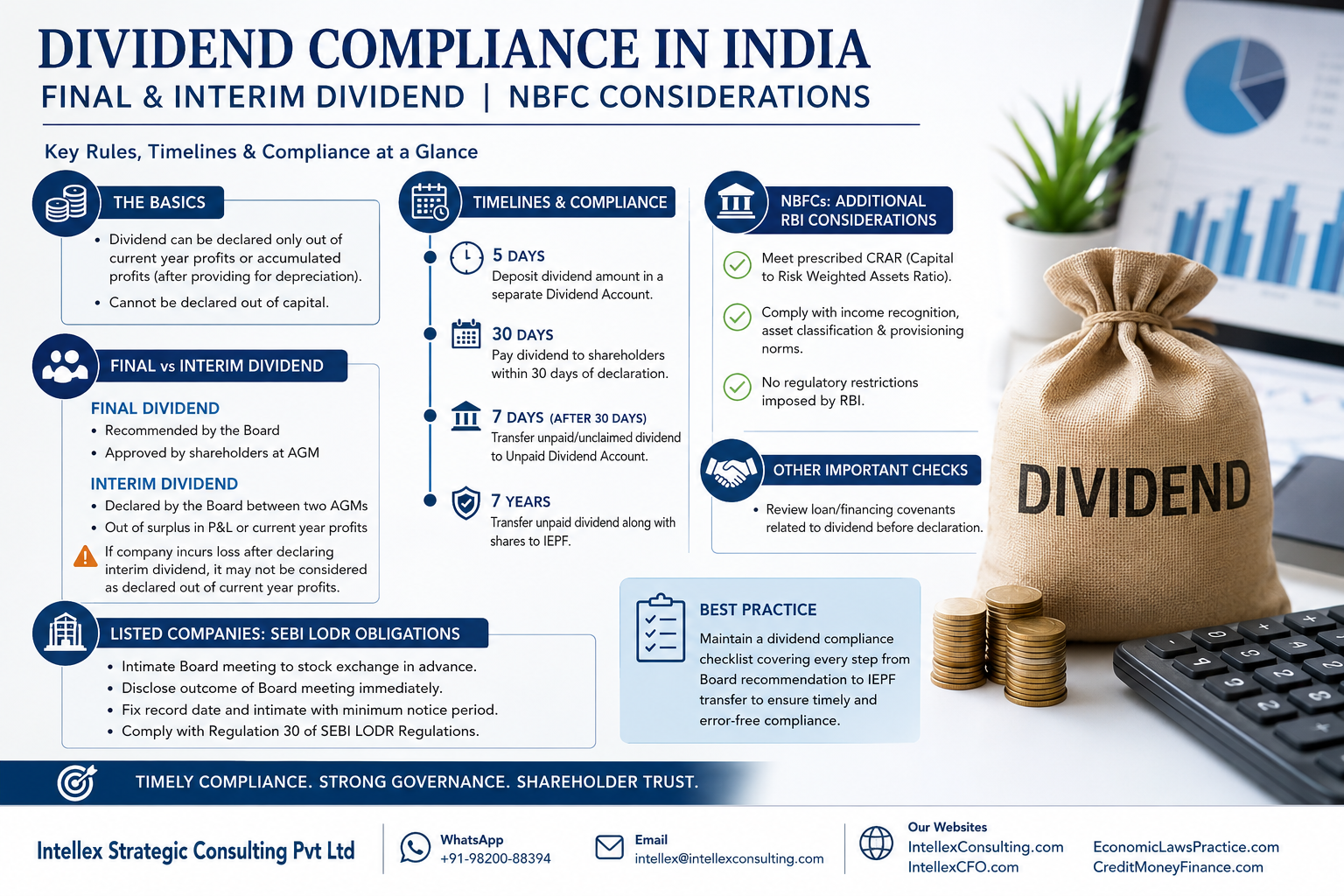
Dividend Compliance in India: Complete Guide to Final & Interim Dividend (Including NBFC Regulations).
Comprehensive guide on dividend declaration in India under Companies Act 2013, SEBI LODR, and RBI norms for NBFCs. Learn rules for interim dividend, timelines, compliance, and IEPF requirements.
📘 All You Should Know About Dividend – Including Interim Dividend – and Special Considerations for NBFCs
Dividend remains one of the most fundamental mechanisms through which companies reward shareholders. However, behind this seemingly simple concept lies a detailed legal and regulatory framework involving the Companies Act, SEBI regulations, and RBI guidelines (for NBFCs).
Let’s break this down in a structured and practical manner.
🔹 Understanding Dividend: The Core Principle
Under the Companies Act 2013, dividend can be declared only:
- Out of current year profits, or
- From accumulated profits (reserves) of previous years
- After providing for depreciation
🚫 Key Rule:
Dividend cannot be declared out of capital. This is a foundational compliance principle.
🔹 Final vs Interim Dividend
✅ Final Dividend
- Recommended by the Board of Directors
- Approved by shareholders at the Annual General Meeting (AGM)
- Cannot exceed the amount recommended by the Board
✅ Interim Dividend
- Declared directly by the Board of Directors
- Can be declared between two AGMs
- Paid out of:
- Current year profits, or
- Surplus in Profit & Loss Account
⚠️ Critical Insight (Often Missed)
If the company incurs losses after declaring interim dividend, the earlier declaration may be questioned as not being supported by adequate current-year profits.
👉 This makes timing and profit estimation extremely critical.
🔹 Dividend Compliance Timeline (Critical Checklist)
Once dividend is declared, strict timelines kick in:
⏱️ Step-by-Step Compliance
- Separate Bank Account
- Deposit dividend amount within 5 days
- Must be used only for dividend payments
- Payment to Shareholders
- Within 30 days of declaration
- Unpaid Dividend Transfer
- Transfer to Unpaid Dividend Account within 7 days after 30 days
- IEPF Transfer (Long-Term Compliance)
- After 7 years, transfer:
- Unpaid dividend
- Corresponding shares
- After 7 years, transfer:
👉 This goes to the Investor Education and Protection Fund (IEPF)
📌 This area requires strong tracking systems and reconciliation processes.
🔹 Listed Companies: SEBI LODR Obligations
For listed entities, compliance extends beyond the Companies Act.
Under SEBI LODR Regulations, companies must:
📢 Key Requirements
- Prior Intimation of Board Meeting
- Inform stock exchange in advance
- Immediate Disclosure
- Declare outcome (including dividend) post-meeting
- Record Date Declaration
- Must be intimated with prescribed notice period
👉 Non-compliance here can trigger penalties and reputational risks.
🔹 NBFCs: Additional RBI Compliance Layer
If your company is a Non-Banking Financial Company (NBFC), dividend declaration is not just a Companies Act matter.
It is also governed by the Reserve Bank of India (RBI).
✅ RBI Conditions for Dividend Declaration
Before declaring dividend, NBFCs must ensure:
1. Capital Adequacy
- Must meet prescribed CRAR (Capital to Risk Weighted Assets Ratio)
2. Prudential Norms Compliance
- Income recognition
- Asset classification
- Provisioning norms
3. No Regulatory Restrictions
- RBI should not have imposed any restrictions on dividend payout
⚠️ Why RBI Conditions Matter
The RBI’s objective is clear:
👉 Prevent NBFCs from:
- Weakening their capital base
- Compromising financial stability
- Endangering depositor/creditor interests
🔁 Dual Compliance for Listed NBFCs
Listed NBFCs must comply with:
- Companies Act
- SEBI LODR
- RBI Guidelines
👉 Missing even one layer can lead to serious compliance failures.
🔹 Additional Practical Consideration: Loan Covenants
Often overlooked:
📌 Companies may have loan agreements restricting dividend payouts.
- Lenders may impose:
- Profit thresholds
- Debt-equity ratios
- Approval requirements
👉 Always review financing documents before declaring dividend.
🔹 Why Dividend Compliance Needs a Systematic Approach
Dividend compliance looks simple but it is process-heavy and timeline-driven.
🔍 Key Risk Areas
- Missing deposit timelines
- Incorrect interim dividend decisions
- Failure in IEPF tracking
- Non-compliance with SEBI disclosures
- Ignoring RBI conditions (NBFCs)
✅ Recommended Best Practice
Create a Dividend Compliance Checklist covering:
- Board processes
- Profit validation
- Banking timelines
- Regulatory filings
- IEPF tracking
- NBFC eligibility checks
👉 This ensures zero leakage in compliance.
🏢 How We Can Help
Intellex Strategic Consulting Pvt Ltd provides end-to-end advisory and compliance support for dividend planning, corporate law compliance, and NBFC regulatory frameworks.
📞 WhatsApp: +91-98200-88394
📧 Email: intellex@intellexconsulting.com
🌐 Websites:
- IntellexConsulting.com
- IntellexCFO.com
- EconomicLawsPractice.com
- CreditMoneyFinance.com
📌 Final Thought
Dividend is not just a financial decision – it is a regulated corporate action requiring coordination across legal, finance, and compliance teams.
A structured approach ensures:
✔ Regulatory compliance
✔ Shareholder trust
✔ Financial stability
Intellex Strategic Consulting Pvt Ltd
MORE FEATURED POSTS:
Ultimate Guide to Singapore Company Registration 2026: Rules, Costs, and Compliance.
The Ultimate Guide to Company Registration in Dubai 2026: Benefits, Compliance, and Costs.
ECB Rules Changed Big Time in 2026: What Indian Businesses Must Know to Unlock Global Funding.



4 thoughts on “Dividend Compliance in India: Complete Guide to Final & Interim Dividend (Including NBFC Regulations).”