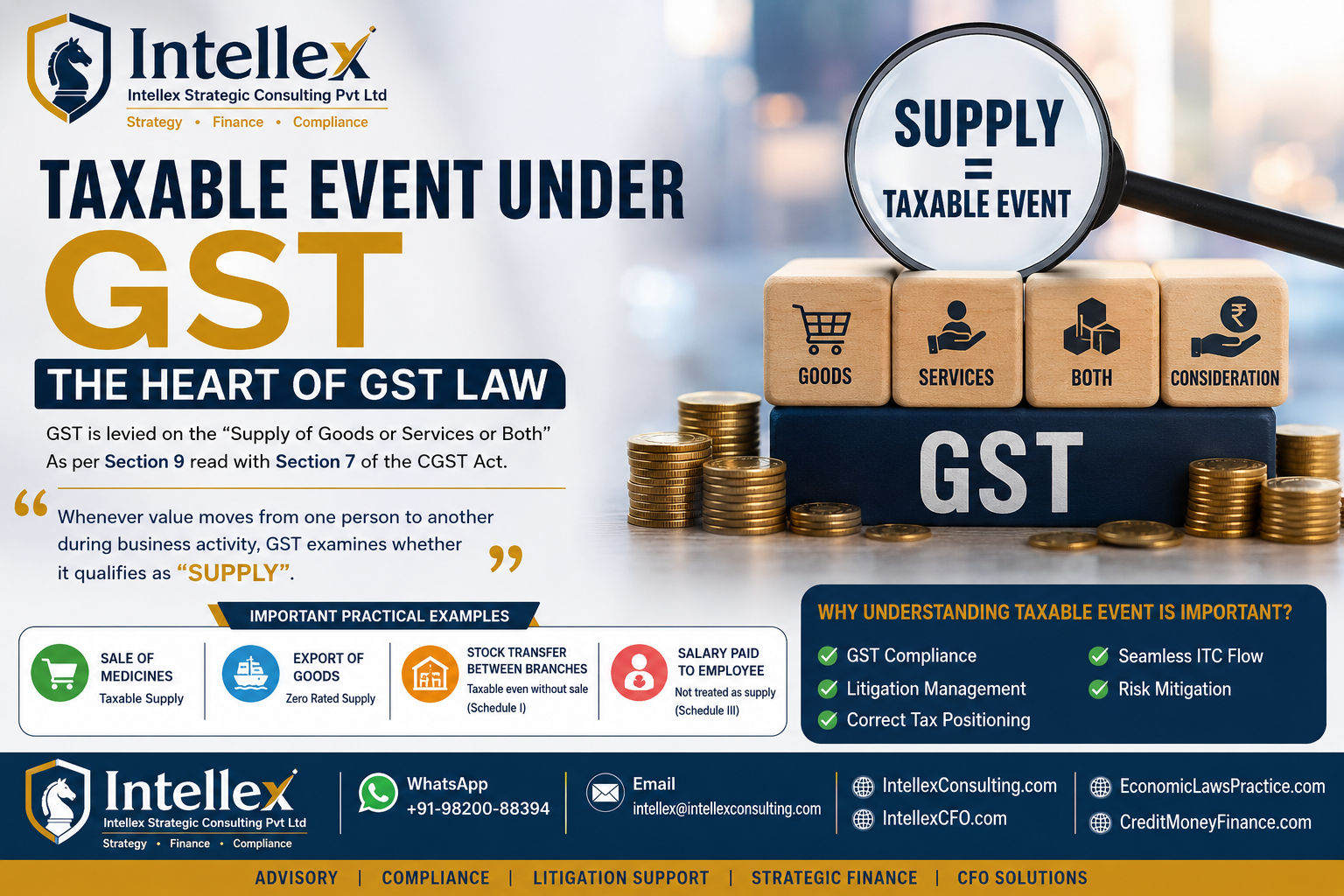
Taxable Event Under GST: Understanding “Supply” – The Heart of GST Law in India.
Understand the concept of “Taxable Event” under GST and why “Supply” is the backbone of India’s GST framework. Learn how GST applies to branch transfers, employee recoveries, exports, corporate guarantees, free samples, related party transactions, and more with practical insights, legal provisions, compliance strategies, and litigation perspectives.
TAXABLE EVENT UNDER GST – THE HEART OF GST LAW
India’s indirect tax system underwent one of the most significant transformations in its economic history with the introduction of the Goods and Services Tax (GST) on 1st July 2017. The shift was not merely procedural or administrative , it fundamentally changed the very basis on which indirect taxes are levied.
At the core of this transformation lies one critical legal and commercial concept:
“TAXABLE EVENT”
Every taxation system requires a trigger point — a legally identifiable event upon which the Government obtains the authority to levy and collect tax.
Under GST, this trigger is known as:
“SUPPLY”
The concept appears simple on the surface, but in reality, it is one of the most litigated, interpreted, and practically significant aspects of GST law.
Understanding the taxable event is therefore not just an academic exercise — it is essential for businesses, CFOs, tax professionals, startups, multinational groups, and compliance teams.
What is a Taxable Event?
A taxable event is the occurrence or activity that gives the Government the legal authority to impose tax.
Without the occurrence of the taxable event, no tax liability can arise.
In simple terms:
No taxable event = No tax.
Every indirect tax system across the world identifies a specific activity or event that triggers taxation.
For example:
| Tax Regime | Taxable Event |
|---|---|
| Excise Duty | Manufacture |
| VAT / CST | Sale of Goods |
| Service Tax | Provision of Service |
| Customs Duty | Import / Export |
| GST | Supply |
GST consolidated multiple indirect taxes into one integrated taxation framework by replacing multiple taxable events with a single unified concept.
That concept is:
SUPPLY
Pre-GST Era – Multiple Taxable Events Created Chaos
Before GST, India had a fragmented indirect tax structure where different laws taxed different commercial activities.
1. Excise Duty – Manufacture
Central Excise Duty was levied when goods were manufactured.
The taxable event was:
Manufacture
Even if goods were not sold, excise duty could arise merely upon manufacture.
This created enormous disputes on:
- What constitutes manufacture?
- Whether repacking amounts to manufacture?
- Whether labeling amounts to manufacture?
- Whether assembly constitutes manufacture?
Thousands of litigations emerged around interpretation.
2. VAT / CST – Sale of Goods
VAT and CST were imposed on sale transactions.
The taxable event was:
Sale
This created disputes regarding:
- Transfer of property in goods
- Inter-state vs intra-state sale
- Composite contracts
- Works contracts
- Deemed sales
3. Service Tax – Provision of Service
Service tax applied on provision of taxable services.
The taxable event was:
Rendering of Service
This gave rise to endless disputes on:
- Whether an activity is service or goods?
- Whether reimbursement is taxable?
- Whether software is goods or service?
- Whether royalty is service?
Problems Under the Old Tax Regime
The multiple taxable-event structure created several practical and legal problems.
Cascading Taxation
Taxes were levied on taxes due to broken credit chains.
Example:
- Excise on manufacture
- VAT on sale value including excise
- Service tax without seamless set-off
This increased business costs.
Classification Disputes
Businesses constantly faced disputes over:
- Goods vs services
- Works contract classification
- Composite supply issues
- Manufacturing vs trading
Double Taxation
Several transactions were taxed under multiple laws simultaneously.
For example:
- Software
- Restaurant services
- Leasing transactions
- Works contracts
Massive Litigation
A substantial portion of indirect tax litigation revolved around determining the correct taxable event.
GST sought to eliminate these complexities through one unified concept:
SUPPLY
GST Changed the Entire Foundation of Indirect Taxation
GST replaced multiple taxable events with a single transaction-based approach.
The legal basis comes from:
- Section 9 of the CGST Act
- Read with Section 7 of the CGST Act
Section 9 provides that GST is levied on:
Supply of Goods or Services or Both
Section 7 defines what constitutes “Supply”.
Thus, GST no longer depends merely on:
❌ Manufacture
❌ Sale
❌ Rendering of Service
Instead, the focus shifted to:
Whether a “Supply” exists.
This is the backbone of GST law.
What is “Supply” Under GST?
Section 7 of the CGST Act gives a broad and inclusive definition of supply.
Supply includes:
- Sale
- Transfer
- Barter
- Exchange
- License
- Rental
- Lease
- Disposal
Made or agreed to be made:
- For consideration
- In the course or furtherance of business
The definition is intentionally wide.
Why?
Because GST intends to tax economic value movement across the supply chain.
GST Focuses on Economic Transactions
GST examines whether economic value moves from one person to another.
If yes, GST evaluates:
✔ Whether supply exists
✔ Whether it is taxable
✔ Whether exempt
✔ Which state gets revenue
✔ Time of supply
✔ Place of supply
✔ Valuation
✔ Input tax credit eligibility
This transaction-centric system makes GST fundamentally different from the earlier tax regime.
Key Ingredients of Supply
For a transaction to qualify as supply, the following factors are generally examined:
1. Existence of Goods or Services
There must be goods, services, or both.
2. Consideration
Usually, supply involves consideration.
However, GST also taxes certain transactions without consideration under Schedule I.
3. Business Nexus
The activity should generally occur in the course or furtherance of business.
4. Taxability
Even if supply exists, GST may still not apply if:
- Exempted
- Zero-rated
- Non-taxable
- Covered under Schedule III
Schedule I – Supply Without Consideration
One of the most revolutionary concepts under GST is taxation of certain transactions even without sale consideration.
This significantly widened the tax base.
Examples include:
- Branch transfers between states
- Related party transactions
- Distinct person transactions
- Certain principal-agent transactions
This is why GST is not dependent merely on “sale”.
Practical Examples of Taxable Event Under GST
1. Sale of Medicines
A pharmaceutical distributor sells medicines to a retailer.
This qualifies as:
Taxable Supply
GST applies because:
- Goods are supplied
- Consideration exists
- Business activity exists
2. Export of Goods
Exports are treated as:
Zero Rated Supply
Supply exists, but tax burden is neutralized through refund mechanisms.
This promotes global competitiveness.
3. Branch Transfer Between States
Suppose a company transfers stock from Maharashtra branch to Karnataka branch.
Even though:
- Ownership remains same
- No external sale exists
GST still applies because branches in different states are treated as distinct persons.
This falls under Schedule I.
4. Salary Paid to Employees
Services provided by employee to employer in course of employment are covered under Schedule III.
Hence:
Not Treated as Supply
Therefore:
- No GST on salary
This distinction is critically important.
Why “Supply” is the Most Litigated Concept Under GST
Almost every major GST dispute starts with one question:
“Whether the transaction qualifies as Supply?”
This single question impacts thousands of crores of tax exposure across industries.
Major Areas of GST Litigation Around Supply
1. Employee Recoveries
Common disputes:
- Notice pay recovery
- Canteen recoveries
- Transportation recovery
- Insurance recovery
Question:
- Is employer providing service?
- Or merely recovering cost?
Different advance rulings and judicial forums have taken varying views.
2. Corporate Guarantees
GST authorities increasingly examine whether corporate guarantees provided to subsidiaries constitute taxable supply.
This has become a major litigation area for corporate groups.
3. Cross Charge and ISD
Multi-location entities face disputes regarding:
- Employee cost allocation
- Shared services
- HO to branch services
Key issue:
- Whether support activities amount to supply?
4. Free Samples
Businesses distribute:
- Promotional goods
- Physician samples
- Marketing kits
Question:
- Whether free distribution constitutes supply?
This directly affects:
- GST liability
- Input tax credit reversals
5. Related Party Transactions
Transactions between related parties receive heightened scrutiny because GST law taxes certain related-party activities even without consideration.
Time of Supply – When Does GST Become Payable?
Once supply exists, GST law determines:
Time of Supply
This establishes when tax liability arises.
Generally linked to:
- Invoice date
- Payment date
- Provision of service
- Receipt of goods
Time of supply is critical for:
- Interest liability
- Compliance
- Return filing
- Revenue recognition
Place of Supply – Which State Gets Revenue?
GST is destination-based taxation.
Thus, determining:
Place of Supply
is crucial.
This decides:
- CGST + SGST applicability
- IGST applicability
- State revenue allocation
Incorrect place-of-supply determination can lead to:
- Double taxation
- Wrong tax payment
- Denial of ITC
- Interest exposure
Valuation Under GST
After determining supply, GST evaluates:
Taxable Value
Valuation disputes arise regarding:
- Discounts
- Subsidies
- Reimbursements
- Related party pricing
- Employee recoveries
Impact of Taxable Event on Input Tax Credit (ITC)
The concept of supply also governs ITC availability.
ITC chain functions properly only when:
- Valid taxable supply exists
- Proper documentation exists
- Compliance conditions are fulfilled
Incorrect interpretation of supply can result in:
- ITC denial
- Interest
- Penalty
- Litigation
GST as a Destination-Based Consumption Tax
GST fundamentally changed India’s taxation philosophy.
Earlier taxes focused on:
- Manufacturing origin
- Sales location
GST focuses on:
Consumption destination
Revenue ultimately accrues to the state where goods/services are consumed.
This makes GST a:
Destination-Based Taxation System
Importance of Understanding Taxable Event in Practical Business
The concept of taxable event affects almost every business decision.
Critical Areas Impacted
GST Compliance
Proper classification and reporting depend on identifying supply correctly.
Litigation Management
Most GST notices begin with interpretation of supply.
Contract Drafting
Commercial agreements must evaluate GST implications.
Business Structuring
Inter-branch and related-party arrangements require GST analysis.
Risk Mitigation
Wrong tax positions may lead to:
- Interest
- Penalties
- Investigations
Seamless ITC Flow
Incorrect determination affects credit chain efficiency.
Important Judicial and Interpretational Trends
GST law continues to evolve through:
- Circulars
- Advance rulings
- High Court judgments
- Supreme Court decisions
Courts increasingly analyze:
- Substance over form
- Economic reality
- Commercial intention
- Presence of consideration
- Business nexus
Businesses must therefore continuously monitor legal developments.
Key Takeaway – Supply is the Backbone of GST
The GST regime unified India’s indirect tax structure by replacing fragmented taxable events with one central concept:
SUPPLY = TAXABLE EVENT
This concept governs:
- Taxability
- Valuation
- Compliance
- Place of supply
- ITC
- Litigation
- Revenue allocation
Understanding taxable event is therefore not optional.
It is the foundation of:
- GST implementation
- Compliance strategy
- Tax planning
- Litigation defense
- Corporate structuring
Conclusion
The introduction of GST transformed India’s indirect taxation from a fragmented multi-tax structure into an integrated transaction-based system centered around one core principle:
“SUPPLY”
This single concept now determines:
- Whether GST applies
- When tax becomes payable
- Which state earns revenue
- Whether ITC is available
- Whether exemption exists
In practical GST implementation, understanding the taxable event is indispensable for every business.
Whether dealing with:
- Employee recoveries
- Cross charges
- Branch transfers
- Corporate guarantees
- Related-party transactions
- Free samples
- Exports
the foundational question always remains:
“Does this transaction qualify as SUPPLY?”
The answer to this question defines the entire GST consequence.
Therefore, knowledge of taxable event is not merely theoretical — it is the very heart of practical GST law in India.
How Intellex Strategic Consulting Pvt Ltd Can Help
Intellex Strategic Consulting Pvt Ltd provides specialized advisory and compliance support in:
- GST Advisory & Litigation Support
- GST Health Checks & Risk Reviews
- Cross Charge & ISD Structuring
- GST on Employee Recoveries
- GST on Corporate Guarantees
- GST Due Diligence
- GST Notices & Departmental Representation
- Input Tax Credit Optimization
- Transaction Structuring under GST
- FEMA, RBI & Regulatory Advisory
- CFO & Strategic Finance Solutions
Contact Details
- WhatsApp: +91-98200-88394
- Email: intellex@intellexconsulting.com
Websites:
Intellex Strategic Consulting Pvt Ltd
More Featured Posts:
ESOP Compliance in India: A Complete Guide for Compliance Professionals (2026 Edition).
Post Office Tax Compliance 2026: Key Changes, SFT Reporting & Practical Impact on Investors.
Ultimate Guide to Singapore Company Registration 2026: Rules, Costs, and Compliance.
The Ultimate Guide to Company Registration in Dubai 2026: Benefits, Compliance, and Costs.
Funding & Investment Options to Grow India’s Real Estate & Allied Businesses
3 thoughts on “Taxable Event Under GST: Understanding “Supply” – The Heart of GST Law in India.”