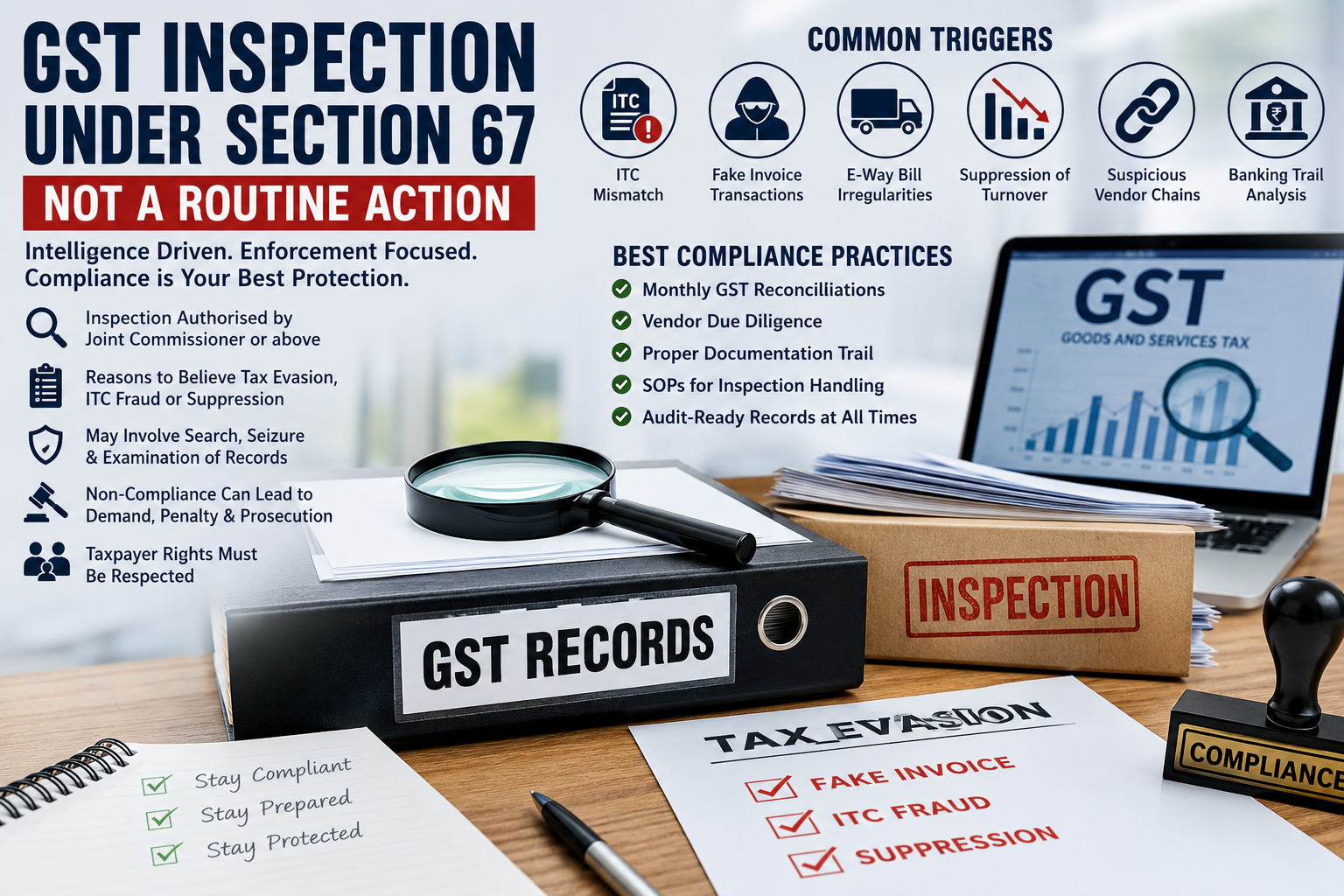
GST Inspection Under Section 67 of the CGST Act: Complete Guide for Businesses on Search, Seizure, Compliance Risks & Legal Safeguards.
Understand GST Inspection under Section 67 of the CGST Act, 2017 – including powers of GST authorities, inspection triggers, search and seizure procedures, taxpayer rights, penalties, compliance strategies, and best practices for businesses to avoid GST litigation and enforcement action.
GST Inspection Under Section 67 -A Powerful Enforcement Tool Under GST Law
In the evolving GST compliance ecosystem, businesses across India are witnessing increased scrutiny from tax authorities through data analytics, AI-driven intelligence systems, banking trail examinations, and inter-departmental information sharing. One of the most serious enforcement mechanisms available to GST authorities under the Central Goods and Services Tax Act, 2017 is the power of Inspection, Search and Seizure under Section 67.
Unlike routine assessments, audits, or departmental scrutiny proceedings, GST inspection is not a standard compliance exercise. It is an intelligence-driven enforcement action initiated when tax authorities possess “reasons to believe” that significant violations of GST law may have occurred.
For businesses, promoters, CFOs, tax heads, finance teams, and compliance professionals, understanding the legal framework, procedural safeguards, taxpayer rights, and practical implications of Section 67 has become critically important.
Legal Framework of GST Inspection Under Section 67
Under Section 67 of the CGST Act, 2017, an officer not below the rank of Joint Commissioner may authorize inspection proceedings if there are sufficient grounds to believe that a taxable person has:
- Suppressed taxable transactions
- Evaded payment of GST
- Claimed excess or fraudulent Input Tax Credit (ITC)
- Violated provisions of the GST law
- Concealed goods liable for confiscation
- Suppressed or manipulated books of accounts and records
The law empowers authorities not only to inspect premises and records but also, in serious cases, conduct search and seizure operations.
GST inspection proceedings may extend to:
- Registered office premises
- Factory premises
- Warehouses
- Branch offices
- Godowns
- Transport vehicles
- Business computers and servers
- Digital accounting systems
- E-mail and electronic data records
The proceedings are highly sensitive and often arise from intelligence-based investigations.
Who Can Authorise GST Inspection?
The power to authorize inspection cannot be exercised casually.
Under the law:
- Only an officer not below the rank of Joint Commissioner can authorize the proceedings.
- Such authorization must be based on a legally sustainable “reason to believe.”
- The authorized officer may empower subordinate officers to carry out inspection, search, or seizure actions.
The phrase “reason to believe” has significant legal importance. Courts have repeatedly held that the belief must be based on tangible material and not on mere suspicion, conjecture, or arbitrary assumptions.
Difference Between GST Audit and GST Inspection
One of the most misunderstood areas in GST enforcement is the distinction between audit and inspection.
| GST Audit | GST Inspection |
|---|---|
| Compliance-oriented | Enforcement-oriented |
| Generally scheduled | Often surprise-based |
| Focus on verification | Focus on detection |
| Conducted routinely | Triggered by suspicion/intelligence |
| Lower enforcement intensity | High enforcement intensity |
| Usually document-driven | May involve physical search and seizure |
Businesses must understand that inspection proceedings are treated far more seriously by the authorities and may lead to tax demands, penalties, arrest proceedings, or prosecution in extreme cases.
Common Triggers for GST Inspection
Modern GST enforcement heavily relies on technology and data analytics. Authorities increasingly use artificial intelligence systems and data integration tools to identify suspicious patterns.
Some common triggers include:
1. Input Tax Credit (ITC) Mismatch
Mismatch between:
- GSTR-2B
- GSTR-3B
- Supplier returns
- E-invoice data
is one of the biggest red flags.
2. Fake Invoice Transactions
Authorities aggressively investigate:
- Circular trading
- Non-existent suppliers
- Bogus invoice chains
- Paper entities
- Shell company structures
3. Suppression of Turnover
Differences between:
- GST returns
- Income tax filings
- E-way bills
- Banking transactions
- Financial statements
can trigger enforcement action.
4. E-Way Bill Irregularities
Authorities monitor:
- Movement without invoices
- Vehicle duplication
- Quantity mismatches
- Expired e-way bills
- Unusual logistics patterns
5. Banking Trail Analysis
Large cash deposits, suspicious transfers, or unexplained banking activity may lead to deeper GST investigation.
6. Vendor Chain Intelligence
If any vendor in the chain is identified as suspicious, associated businesses may also come under scrutiny.
7. Inter-Departmental Intelligence Sharing
Data may be shared between:
- GST Department
- Income Tax Department
- Enforcement Directorate
- DGGI
- Customs Authorities
- MCA databases
- Financial Intelligence Units
Powers of GST Authorities During Inspection
During inspection proceedings, officers may:
- Enter business premises
- Verify stock
- Examine books of accounts
- Inspect computers and electronic systems
- Review invoices and records
- Conduct search operations
- Seize goods/documents
- Record statements
- Take copies of electronic data
- Verify transport and warehousing activities
In severe cases, officers may also:
- Freeze goods
- Detain conveyances
- Initiate confiscation proceedings
- Recommend prosecution
Search and Seizure Under GST
Where authorities believe that goods or documents are concealed, search and seizure provisions may be invoked.
Search
A search operation may involve:
- Physical examination of premises
- Inspection of storage facilities
- Digital data review
- Examination of laptops, servers, hard disks, and accounting systems
Seizure
Authorities may seize:
- Books of accounts
- Invoices
- Hard drives
- Mobile devices
- Goods liable for confiscation
- Electronic records
However, the law also imposes procedural safeguards and limitations on authorities.
Taxpayer Rights During GST Inspection
Even during enforcement proceedings, taxpayers retain important legal rights.
1. Right to Verify Authorization
Businesses can request:
- Identity proof of officers
- Copy of authorization
- Official designation details
2. Right to Seizure Memo and Inventory
If documents or goods are seized, authorities must provide:
- Proper inventory
- Panchnama
- Seizure memo
- Acknowledgment
3. Right to Copies of Seized Records
Taxpayers may obtain copies of documents required for ongoing business operations.
4. Protection Against Coercive Statements
Statements should be:
- Voluntary
- Free from coercion
- Factually accurate
Businesses should avoid speculative or emotional responses during questioning.
5. Right to Professional Assistance
Although legal representatives may not always be allowed during recording of statements, businesses can seek professional legal and tax support immediately after proceedings.
Consequences of GST Inspection
GST inspection can lead to serious legal and financial implications.
Possible consequences include:
- GST tax demands
- Interest liability
- Monetary penalties
- Blocking of ITC
- Cancellation of GST registration
- Confiscation of goods
- Prosecution proceedings
- Arrest in serious fraud cases
- Attachment of bank accounts
- Litigation before appellate forums
In large fraud matters, authorities may invoke provisions relating to:
- Fraudulent availment of ITC
- Fake invoicing
- Wilful suppression
- Tax evasion conspiracies
Increasing Role of AI and Data Analytics in GST Enforcement
India’s GST ecosystem is rapidly evolving into a technology-driven enforcement framework.
Authorities today use:
- AI-powered anomaly detection
- GSTN data analytics
- PAN-level profiling
- E-way bill intelligence
- Banking data integration
- MCA and income-tax database mapping
- Geo-tagging analytics
- E-invoice validation systems
- Vendor risk profiling
This means businesses can no longer rely on isolated compliance management.
Data consistency across all financial and tax systems has become essential.
Best Compliance Practices to Reduce GST Inspection Risk
Businesses must proactively strengthen compliance systems to mitigate enforcement risks.
1. Monthly GST Reconciliation
Ensure regular reconciliation between:
- GSTR-1
- GSTR-3B
- GSTR-2B
- E-way bills
- Books of accounts
2. Vendor Due Diligence
Conduct periodic checks on:
- GST registration validity
- Return filing history
- Business authenticity
- Invoice genuineness
3. Strong Documentation Trail
Maintain:
- Purchase records
- Transport documents
- E-way bills
- Agreements
- Payment records
- Inventory registers
4. SOP for Inspection Handling
Businesses should establish internal protocols for:
- Officer interaction
- Document sharing
- Legal escalation
- Data backup
- Employee communication
5. Audit-Ready Record Maintenance
Records should be:
- Organized
- Accessible
- Digitally backed up
- Consistent across departments
6. Internal GST Health Checks
Periodic GST risk reviews and mock investigations can identify vulnerabilities before authorities do.
Importance of Professional Representation During GST Enforcement
GST inspection proceedings often involve:
- Technical legal interpretation
- Financial data analysis
- ITC validation
- Digital evidence review
- Litigation strategy
Professional representation becomes critical to:
- Protect taxpayer rights
- Ensure procedural compliance
- Minimize unnecessary exposure
- Prepare factual submissions
- Handle departmental communications
- Manage litigation risks
Conclusion
GST inspection under Section 67 is not a routine departmental exercise — it is a serious enforcement proceeding with potentially significant legal, financial, and reputational consequences.
In today’s highly interconnected tax ecosystem, authorities are increasingly using advanced analytics, AI-driven intelligence, and cross-platform data verification to identify inconsistencies and suspected evasion patterns.
For businesses, GST compliance is no longer limited to timely return filing. It now requires:
- Continuous reconciliation
- Robust internal controls
- Vendor verification
- Documentation discipline
- Real-time data consistency
- Strategic legal preparedness
Organizations that proactively build strong compliance frameworks are significantly better positioned to manage regulatory scrutiny and avoid disruptive enforcement action.
How Intellex Strategic Consulting Pvt Ltd Can Assist
Intellex Strategic Consulting Pvt Ltd provides specialized advisory and litigation support services relating to:
- GST inspections and investigations
- GST search and seizure proceedings
- GST litigation support
- GST reconciliations and compliance reviews
- Vendor due diligence
- Risk assessment and internal controls
- GST health checks
- Tax dispute management
- CFO advisory and compliance structuring
Contact Details
- WhatsApp: +91-98200-88394
- Email: intellex@intellexconsulting.com
Intellex Strategic Consulting Pvt Ltd
More featured articles;
GST Notice Threshold Proposal: A Game-Changer for Taxpayers and MSMEs in India.
ESOP Compliance in India: A Complete Guide for Compliance Professionals (2026 Edition).
Ultimate Guide to Singapore Company Registration 2026: Rules, Costs, and Compliance.
The Ultimate Guide to Company Registration in Dubai 2026: Benefits, Compliance, and Costs.

6 thoughts on “GST Inspection Under Section 67 of the CGST Act: Complete Guide for Businesses on Search, Seizure, Compliance Risks & Legal Safeguards.”