GST Record Maintenance Compliance in India: Complete Guide for Businesses to Avoid Penalties & Stay Audit-Ready (2026 Update)
Ensure 100% GST compliance with proper record maintenance. Learn mandatory GST record-keeping rules, documentation requirements, penalties, and expert advisory support from Intellex Strategic Consulting Pvt Ltd.
GST Records Maintenance: A Complete Compliance Guide for Indian Businesses
In today’s evolving regulatory landscape, maintaining proper records under the Goods and Services Tax (GST) regime is not just a statutory obligation—it is a critical business necessity. Non-compliance can lead to heavy penalties, litigation, and disruption in operations.
Whether you are a manufacturer, trader, service provider, or startup, understanding GST record maintenance requirements is essential to remain compliant and audit-ready.
Why GST Record Maintenance is Crucial
Proper maintenance of records ensures:
- Seamless GST audits and assessments
- Accurate Input Tax Credit (ITC) claims
- Transparency in financial transactions
- Reduced risk of penalties and notices
- Smooth business operations and scalability
Businesses that fail to maintain proper documentation often face scrutiny from tax authorities, leading to financial and reputational risks.
Key Records to be Maintained Under GST
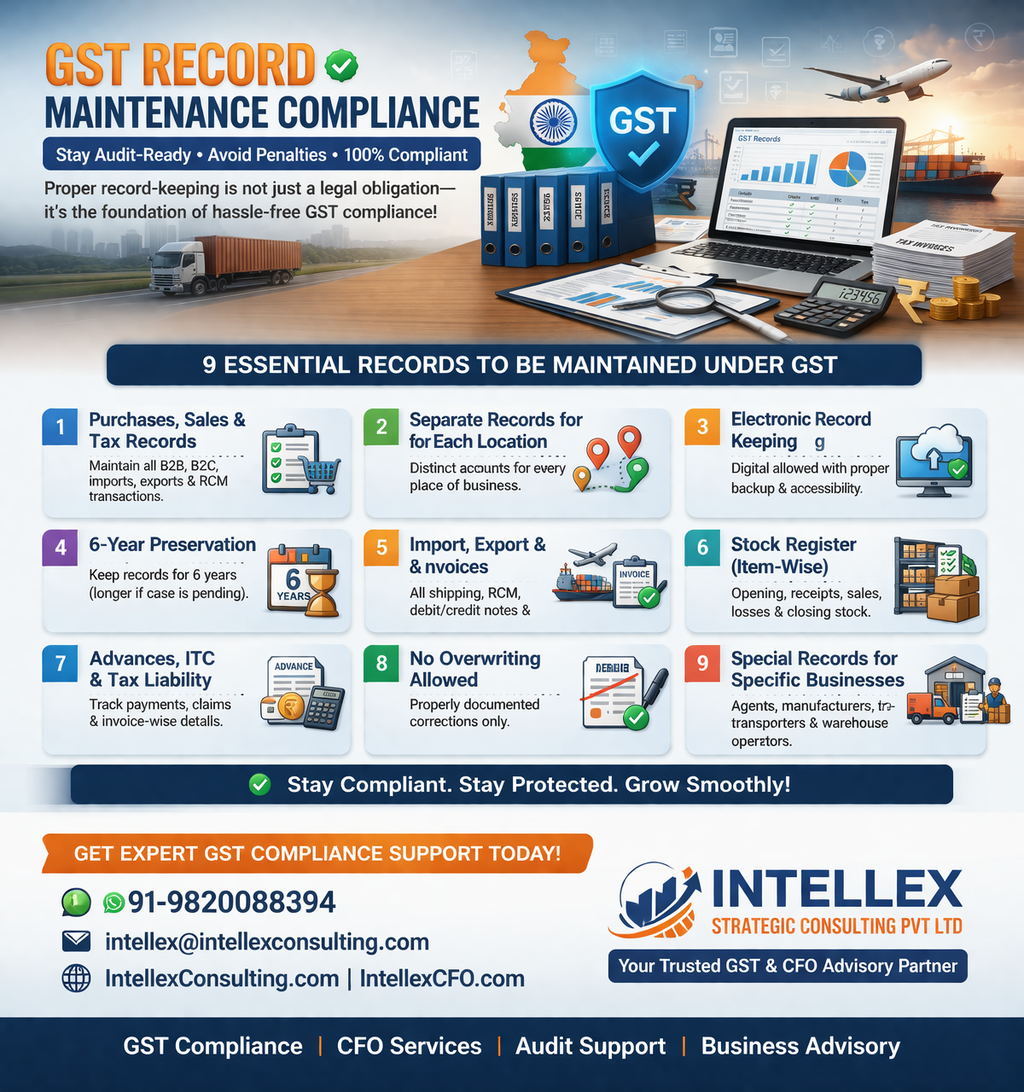
1. Mandatory Books of Accounts
Every registered taxpayer must maintain accurate and updated records of:
- Purchases and sales
- Stock details
- Input Tax Credit (ITC) availed
- Output tax liability and payments
These records must be available at the principal place of business.
2. Records for Multiple Locations
If a business operates from multiple locations:
- Separate records must be maintained for each registered place
- Additional places mentioned in GST registration must also maintain proper documentation
3. Electronic Record Keeping
GST law permits digital record maintenance, provided:
- Proper backups are maintained
- Data is easily accessible for verification
- Systems are secure and tamper-proof
Digital compliance is increasingly becoming the preferred approach for modern businesses.
4. Preservation of Records
- Records must be retained for a minimum of 6 years
- In case of litigation, appeals, or investigations, records must be preserved until final resolution
5. Transaction-Specific Documentation
Businesses must maintain detailed records of:
- Imports and exports
- Reverse Charge Mechanism (RCM) transactions
- Tax invoices, debit notes, credit notes
- Delivery challans and vouchers
6. Stock Register Requirements
A proper stock register should include:
- Opening balance
- Purchases and receipts
- Sales and outward supplies
- Losses, damages, or wastage
- Closing stock
Maintaining item-wise stock records is mandatory.
7. Financial & Tax Records
Accurate records must be maintained for:
- Advances received and paid
- Tax liabilities and payments
- Input Tax Credit claimed
- Invoice-wise transaction details
8. No Overwriting Policy
- Manual corrections must be properly documented
- Digital records should maintain audit trails
- Transparency and traceability are critical
9. Special Category Records
Certain businesses must maintain additional records, including:
- Agents
- Manufacturers
- Service providers
- Transporters
- Warehouse operators
These records vary depending on the nature of operations and industry-specific compliance requirements.
Common Mistakes Businesses Must Avoid
- Incomplete or missing invoices
- Incorrect ITC claims
- Non-maintenance of stock registers
- Lack of reconciliation between GST returns and books
- Poor documentation of RCM transactions
- No backup for electronic records
Avoiding these errors can significantly reduce compliance risks.
Penalties for Non-Compliance
Failure to maintain proper GST records can lead to:
- Monetary penalties
- Disallowance of Input Tax Credit
- Increased scrutiny and audits
- Legal proceedings and notices
Being proactive in compliance is always more cost-effective than dealing with penalties.
How Professional GST Advisory Can Help
Given the complexity of GST regulations, professional guidance ensures:
- End-to-end compliance management
- Accurate record-keeping systems
- GST audit readiness
- Risk mitigation and advisory
- Process automation and digital transformation
Why Choose Intellex Strategic Consulting Pvt Ltd?
At Intellex Strategic Consulting Private Limited, we specialize in:
- GST compliance and advisory
- CFO and financial consulting services
- Audit preparedness and documentation support
- Process optimization for scalable growth
We help businesses not just comply—but thrive.
Final Thoughts
GST compliance is not just about filing returns—it begins with maintaining accurate and complete records. Businesses that invest in proper documentation systems today will benefit from smoother operations, better financial control, and long-term growth.
Get Expert Assistance Today
Avoid costly mistakes and ensure 100% GST compliance with expert support.
📞 Mobile / WhatsApp: 91-9820088394
📧 Email: intellex@intellexconsulting.com
🌐 Websites: IntellexConsulting.com | IntellexCFO.com
Team – Intellex Strategic Consulting Pvt Ltd
More Featured Articles:
Startup India Registration: Unlocking Tax Benefits and Growth
Tax Loss Harvesting: A Strategic Guide to Reducing Capital Gains Tax.
Loans Takeover proposals with enhancement of Banking limits for MSME Sector Companies
Understanding Section 194T: New TDS Obligations for Partnership Firms and LLPs.
13 thoughts on “GST Record Maintenance Compliance in India: Complete Guide for Businesses to Avoid Penalties & Stay Audit-Ready (2026 Update)”