E-Way Bill Limit Under GST: When is an E-Way Bill Mandatory in India?
Understand the E-Way Bill limit under GST in India, including inter-state and intra-state thresholds, export rules, exemptions, penalties, and state-wise applicability. Complete GST compliance guide for businesses, transporters, exporters, and traders in 2026.
E-Way Bill Limit Under GST: When is it Mandatory?
The E-Way Bill system is one of the most significant compliance mechanisms introduced under the Goods and Services Tax (GST) framework in India. Designed to track the movement of goods and reduce tax evasion, the E-Way Bill ensures transparency in transportation transactions across the country.
For businesses involved in manufacturing, trading, logistics, exports, wholesale distribution, or e-commerce operations, understanding the applicability and threshold limits of E-Way Bills is essential for avoiding penalties and ensuring seamless transportation of goods.
This detailed guide explains when an E-Way Bill becomes mandatory, the applicable limits for inter-state and intra-state transportation, exemptions, penalties, and important compliance considerations for businesses in India.
What is an E-Way Bill Under GST?
An E-Way Bill (Electronic Way Bill) is an electronically generated document required for the movement of goods valued above a prescribed limit under GST regulations.
It contains details such as:
- GSTIN of supplier and recipient
- Invoice or challan number
- Value of goods
- HSN code
- Transporter details
- Vehicle number
- Place of dispatch and delivery
The E-Way Bill system is governed under Rule 138 of the CGST Rules, 2017.
The objective is to:
- Prevent tax evasion
- Track movement of goods
- Streamline logistics operations
- Improve GST compliance
- Reduce check-post delays
When is an E-Way Bill Mandatory?
1. Inter-State Movement of Goods
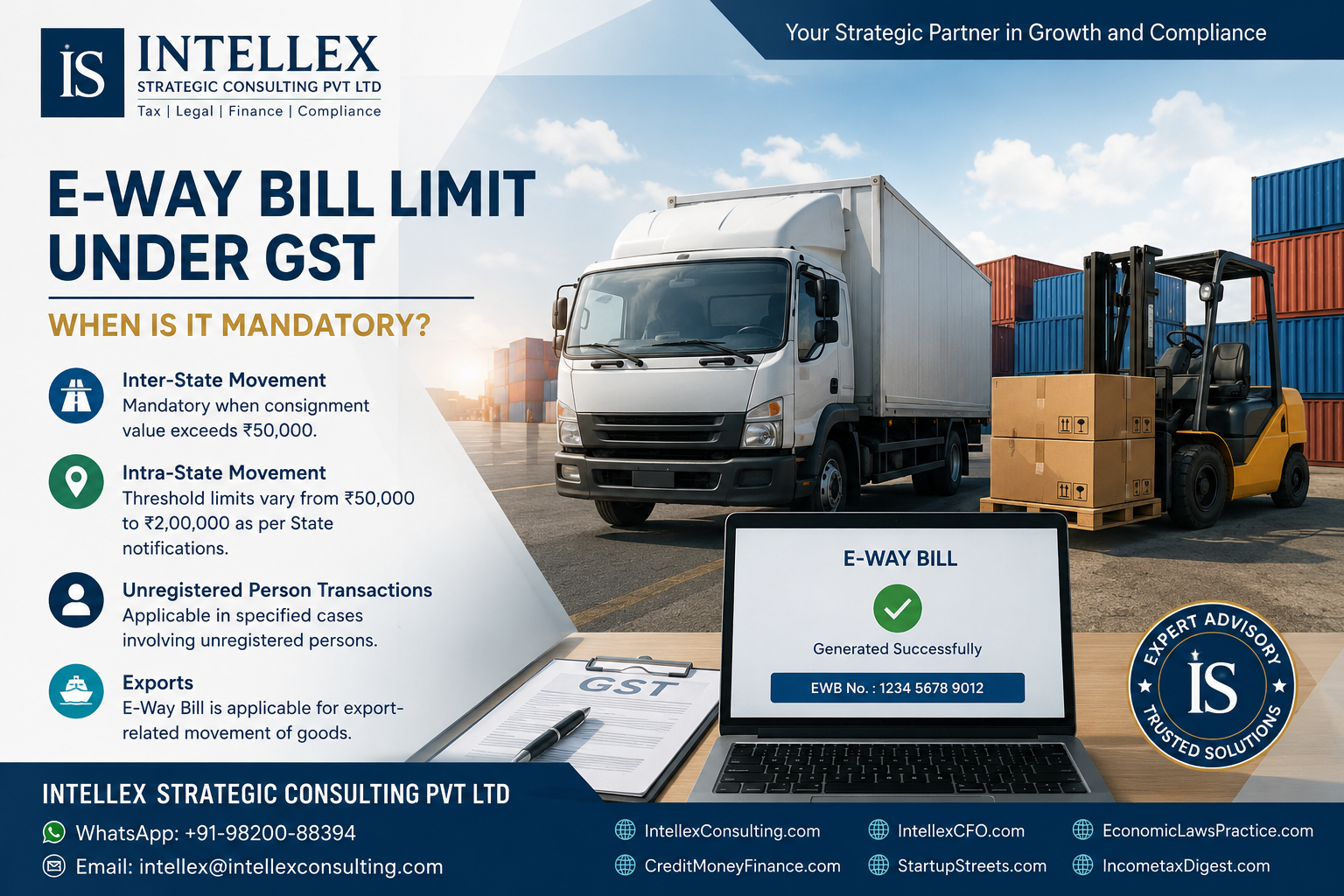
An E-Way Bill is generally mandatory when goods are transported from one state to another and the consignment value exceeds ₹50,000.
Applicable Scenarios
- Sale transactions
- Branch transfers
- Stock transfers
- Job work movement
- Supply to unregistered persons
- Return of goods
- Exhibition or demo movement
Example
If a Mumbai-based company dispatches goods worth ₹75,000 to Gujarat, an E-Way Bill must be generated before transportation begins.
2. Intra-State Movement of Goods
For movement within the same state, E-Way Bill limits vary depending on state government notifications.
Different states have prescribed different threshold limits.
State-Wise Intra-State E-Way Bill Limits
| State | Threshold Limit |
|---|---|
| Maharashtra | ₹1,00,000 |
| Delhi | ₹1,00,000 |
| Rajasthan | ₹2,00,000 (within city limits in certain cases) |
| West Bengal | ₹50,000 |
| Most Other States | ₹50,000 |
Businesses must regularly verify updated notifications issued by their respective state GST departments.
E-Way Bill Applicability for Unregistered Persons
An E-Way Bill may also be applicable in certain cases involving unregistered persons.
Situations Include:
- Supply by unregistered persons to registered taxpayers
- Movement initiated by a registered recipient
- Transport through third-party logistics providers
In many cases, the registered recipient becomes responsible for compliance.
Is E-Way Bill Required for Exports?
Yes. E-Way Bills are applicable for export consignments as well.
The E-Way Bill is generally generated:
- From the supplier’s location to the port, airport, ICD, or customs station
- Along with shipping bill and export invoice details
Export Documentation Usually Includes:
- Tax Invoice
- Shipping Bill
- Bill of Export
- Delivery Challan
- Transport Documents
- E-Way Bill
Exporters must ensure consistency between GST documents and customs records.
Situations Where E-Way Bill is Mandatory Even Below ₹50,000
In certain special situations, an E-Way Bill may still be required irrespective of consignment value.
Examples Include:
- Inter-state job work
- Handicraft goods transported inter-state by exempted persons
- Certain notified goods categories
Businesses should carefully review GST notifications applicable to their industry.
Who is Responsible for Generating the E-Way Bill?
The responsibility depends on the nature of movement.
Supplier
When transportation is arranged by the supplier.
Recipient
When transportation is arranged by the buyer.
Transporter
When neither supplier nor recipient generates the E-Way Bill despite applicability.
Validity Period of E-Way Bill
The validity depends on the travel distance.
| Distance | Validity |
|---|---|
| Up to 200 km | 1 day |
| Every additional 200 km | Additional 1 day |
For over-dimensional cargo, separate rules apply.
Documents Required During Transportation
The transporter should carry:
- Invoice/Bill of Supply/Delivery Challan
- E-Way Bill copy or EBN number
- Transporter ID
- Vehicle documents
Authorities may verify goods in transit during inspections.
Common Exemptions from E-Way Bill Requirement
Certain goods and movements are exempt from E-Way Bill compliance.
Examples Include:
- Fresh fruits and vegetables
- Milk products
- Meat and fish
- LPG for household use
- Currency
- Jewellery (subject to state-specific rules)
- Movement within notified exempt areas
- Non-motorized transport
Exemptions vary by notification and state-specific rules.
Penalty for Non-Compliance
Failure to generate an E-Way Bill can lead to severe consequences.
Possible Penalties Include:
- Penalty of ₹10,000 or tax sought to be evaded, whichever is higher
- Detention or seizure of goods and vehicle
- Delayed delivery and business disruption
- Litigation and departmental scrutiny
GST officers may intercept vehicles and inspect documentation.
Common Mistakes Businesses Should Avoid
1. Incorrect Invoice Value
Mismatch between invoice and E-Way Bill values can trigger notices.
2. Wrong Vehicle Number
Vehicle details must be updated promptly during transshipment.
3. Expired E-Way Bills
Businesses should monitor validity periods carefully.
4. Incorrect HSN Codes
Classification errors may attract GST disputes.
5. Ignoring State-Specific Rules
Different intra-state thresholds can create compliance risks.
Practical Compliance Tips for Businesses
Maintain Automated ERP Integration
Integrating GST software with ERP systems reduces manual errors.
Verify State Notifications Regularly
Thresholds and exemptions may change periodically.
Train Logistics Teams
Transporters and dispatch teams should understand documentation requirements.
Maintain Proper Records
Retain invoices, transport receipts, and E-Way Bills for audit purposes.
Conduct Internal GST Reviews
Periodic compliance checks help prevent penalties.
Impact of E-Way Bill System on Businesses
The E-Way Bill mechanism has significantly improved supply chain transparency across India.
Positive Outcomes Include:
- Reduced tax evasion
- Faster movement of goods
- Better logistics tracking
- Digital compliance ecosystem
- Improved GST reporting accuracy
However, businesses must remain vigilant regarding documentation and procedural compliance.
Future of E-Way Bill Compliance in India
With increasing digitization under GST, authorities are expected to further integrate:
- FASTag systems
- RFID tracking
- AI-based analytics
- Real-time transporter validation
- Automated invoice matching
Businesses adopting technology-driven compliance systems will benefit from smoother operations and reduced litigation risks.
Conclusion:
The E-Way Bill system has become an essential pillar of GST compliance in India. While the standard threshold for inter-state transportation remains ₹50,000, intra-state limits differ from state to state and require careful monitoring.
Businesses engaged in manufacturing, trading, logistics, exports, and distribution must ensure timely E-Way Bill generation, proper documentation, and adherence to GST regulations to avoid penalties and operational disruptions.
As GST compliance continues to evolve, proactive planning and expert advisory support are crucial for sustainable business operations.
Professional GST Advisory & Compliance Support
Businesses seeking assistance with:
- GST Registration
- E-Way Bill Compliance
- GST Audits
- GST Litigation
- Export GST Advisory
- Transport & Logistics Compliance
- Input Tax Credit Reviews
- GST Return Filing
- CFO Advisory Services
- Startup Tax Structuring
can connect with:
Contact Details
- WhatsApp: +91-98200-88394
- Email: intellex@intellexconsulting.com
Group Websites
- Intellex Consulting
- Intellex CFO
- Economic Laws Practice Resources
- Credit Money Finance
- Startup Streets
- Income Tax Digest
Intellex Strategic Consulting Pvt Ltd
More Featured Posts:
ESOP Compliance in India: A Complete Guide for Compliance Professionals (2026 Edition).
Post Office Tax Compliance 2026: Key Changes, SFT Reporting & Practical Impact on Investors.
RBI FLA Return 2026: Compliance Challenges for GIFT IFSC Entities Under FEMA Explained.
SME IPO in India: A Comprehensive Guide for Growing Businesses Looking to Go Public