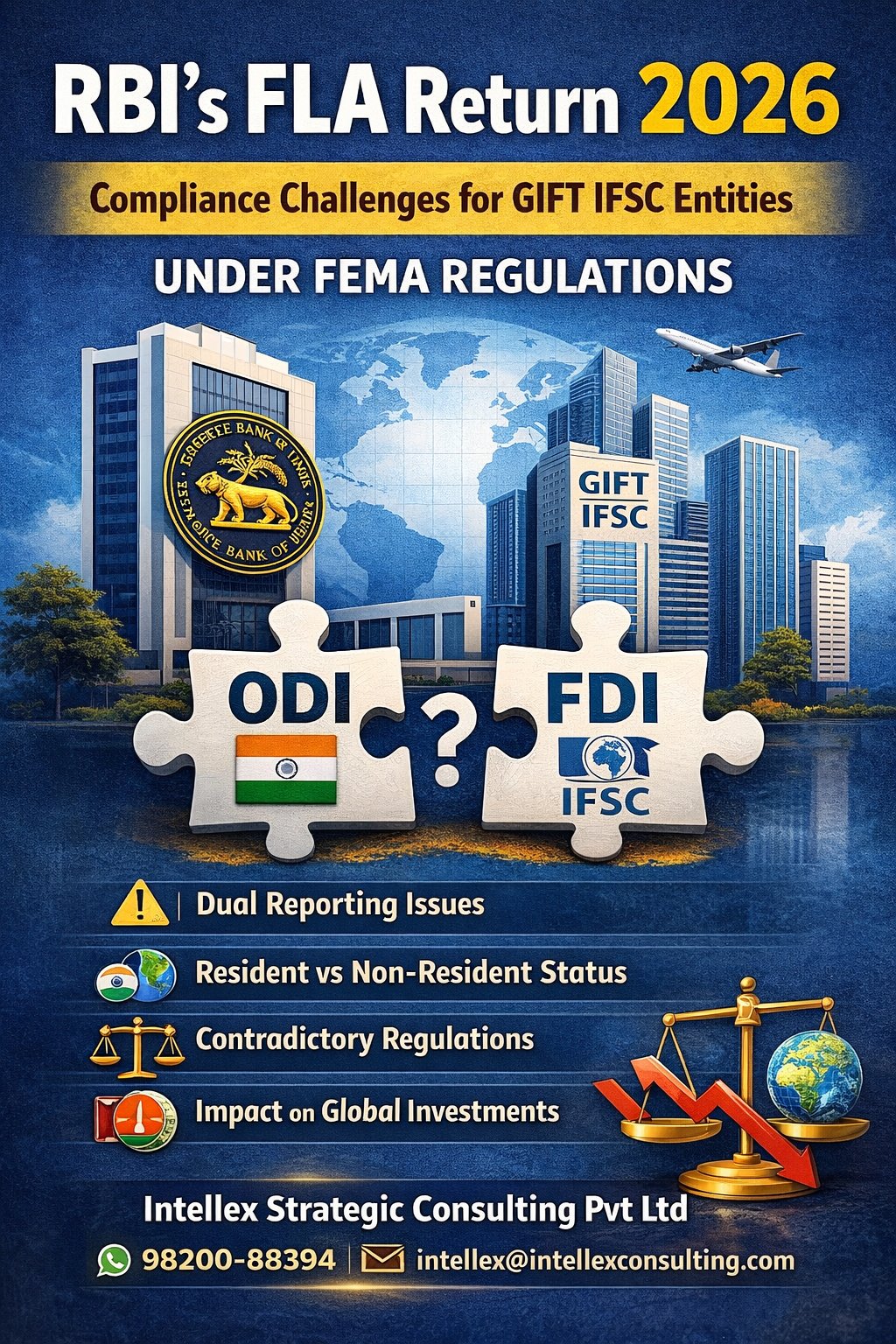
RBI FLA Return 2026: Compliance Challenges for GIFT IFSC Entities Under FEMA Explained.
RBI’s latest FAQs on FLA Return 2026 create compliance ambiguity for GIFT IFSC entities under FEMA. Explore key issues, ODI vs FDI paradox, and regulatory implications.
RBI’s FLA Return Framework: A Critical Compliance Requirement
As the financial year 2025–26 concludes, Indian businesses with foreign exposure must prepare to meet a key regulatory obligation: filing the Annual Return on Foreign Liabilities and Assets (FLA) with the Reserve Bank of India.
Under the Foreign Exchange Management Act, 1999 (FEMA), any Indian company or LLP that has received Foreign Direct Investment (FDI) or made Overseas Direct Investment (ODI) is required to file the FLA return by 15 July 2026.
Failure to comply may result in penalties and regulatory action, making it a critical compliance checkpoint for corporates, especially those with cross-border financial exposure.
Recent RBI FAQs: Clarity or Confusion?
On 25 March 2026, the RBI issued updated FAQs on FLA reporting. While intended to simplify compliance, certain clarifications—particularly concerning entities operating in GIFT City under the IFSC regime—have introduced significant ambiguity.
The FAQs assert that:
- IFSC entities must file FLA returns if they have foreign investments
- Subsidiaries in IFSC receiving foreign investments are subject to FLA reporting
- Investments between Indian entities and IFSC entities must be reported by both parties
At first glance, these appear straightforward. However, a deeper regulatory analysis reveals serious inconsistencies.
The Core Issue: Dual Legal Identity of IFSC Entities
Under FEMA regulations governing IFSC:
- Entities operating in IFSC are treated as “persons resident outside India”
- Yet, under Indian company law, they remain Indian entities
This dual classification creates a structural contradiction in compliance interpretation.
For example:
- Under Overseas Investment Rules, IFSC entities are treated as foreign entities
- Under FLA reporting expectations, the same entities are treated as Indian recipients of FDI
This raises a fundamental question:
Can an entity be both foreign and Indian simultaneously for the same transaction?
ODI vs FDI Paradox: A Regulatory Contradiction
One of the most pressing challenges emerging from the FAQs is the ODI vs FDI paradox:
- When an Indian company invests in an IFSC entity, it is treated as ODI (investment into a foreign entity)
- However, the IFSC entity is expected to report the same investment as FDI received
This creates:
- Circular reporting obligations
- Conflicting classification of the same transaction
- Increased compliance risk for both parties
Such contradictions undermine the consistency of India’s foreign investment framework.
Key Compliance Challenges for GIFT IFSC Entities
Professionals and businesses operating within IFSC must now navigate several unresolved issues:
1. Reporting Inconsistency
Dual reporting of the same transaction as ODI and FDI raises legal and logical concerns.
2. FIRC Issuance Uncertainty
There is ambiguity on whether IFSC banking units will issue Foreign Inward Remittance Certificates for domestic-origin investments.
3. Classification of Global Investments
Investments from jurisdictions like Singapore, UAE, or Mauritius need clearer classification under FLA reporting.
4. Treatment of Investment Vehicles
Alternative Investment Funds (AIFs) and pooled vehicles in IFSC lack clear guidance on FLA obligations.
5. Policy Conflict
India’s “onshoring offshore” vision for IFSC may be impacted by increased compliance complexity.
Macroeconomic Implications
Beyond compliance, these ambiguities may have broader consequences:
- Distortion in Balance of Payments (BoP) data
- Misrepresentation of foreign exchange reserves
- Reduced attractiveness of IFSC as a global financial hub
The lack of clarity could discourage international investors, counteracting the very purpose of establishing IFSC.
Regulatory Gap: Need for Immediate Clarification
The current situation highlights a significant regulatory gap:
- The FEMA Non-Debt Instrument (NDI) Rules do not adequately address IFSC-specific scenarios
- Overseas Investment Rules recognize IFSC as foreign entities, but alignment is missing across frameworks
There is an urgent need for:
- Clear amendments to FEMA regulations
- Harmonized definitions across ODI and FDI frameworks
- Practical guidance from RBI for consistent reporting
Conclusion: A Compliance Landscape in Transition
The RBI’s attempt to broaden the scope of FLA reporting is well-intentioned. However, without a nuanced framework addressing the unique legal status of IFSC entities, it has created more questions than answers.
Until regulatory clarity emerges, companies must adopt a cautious and well-documented approach to FLA compliance, particularly when dealing with IFSC structures.
For Professional Assistance
For expert guidance on FLA filing, FEMA compliance, and IFSC regulatory matters, you may reach out to:
Intellex Strategic Consulting Pvt Ltd
📞 WhatsApp: 98200-88394
📧 Email: intellex@intellexconsulting.com
Our team provides end-to-end advisory and compliance support to help businesses navigate complex regulatory frameworks with confidence.
Team: Intellex Strategic Consulting Pvt Ltd
More Featured Articles:
Selling Property in India as an NRI – Here’s Your Complete Tax & FEMA Guide!
The Future of Indian Real Estate: Key Recommendations to Strengthen RERA in 2026
Judicial Summary: Interest and Late Fees under GST.
Why MSMEs Trust Us With Their Most Critical Financial Decisions
Ultimate Guide to Singapore Company Registration 2026: Rules, Costs, and Compliance.
The Ultimate Guide to Company Registration in Dubai 2026: Benefits, Compliance, and Costs.
Board Advisory Services: A Strategic Blueprint for Governance, Growth, and Long-Term Value Creation.
SME IPO in India 2025: Complete Guide for Investors & Growing Businesses



6 thoughts on “RBI FLA Return 2026: Compliance Challenges for GIFT IFSC Entities Under FEMA Explained.”