Benchmarking Related Party Transactions (RPT): Why Going Beyond Arm’s Length Certification is Critical for Robust Corporate Governance
Discover why arm’s length certification alone is not enough for Related Party Transactions (RPT). Learn how benchmarking, valuation, and transfer pricing strengthen compliance and governance.
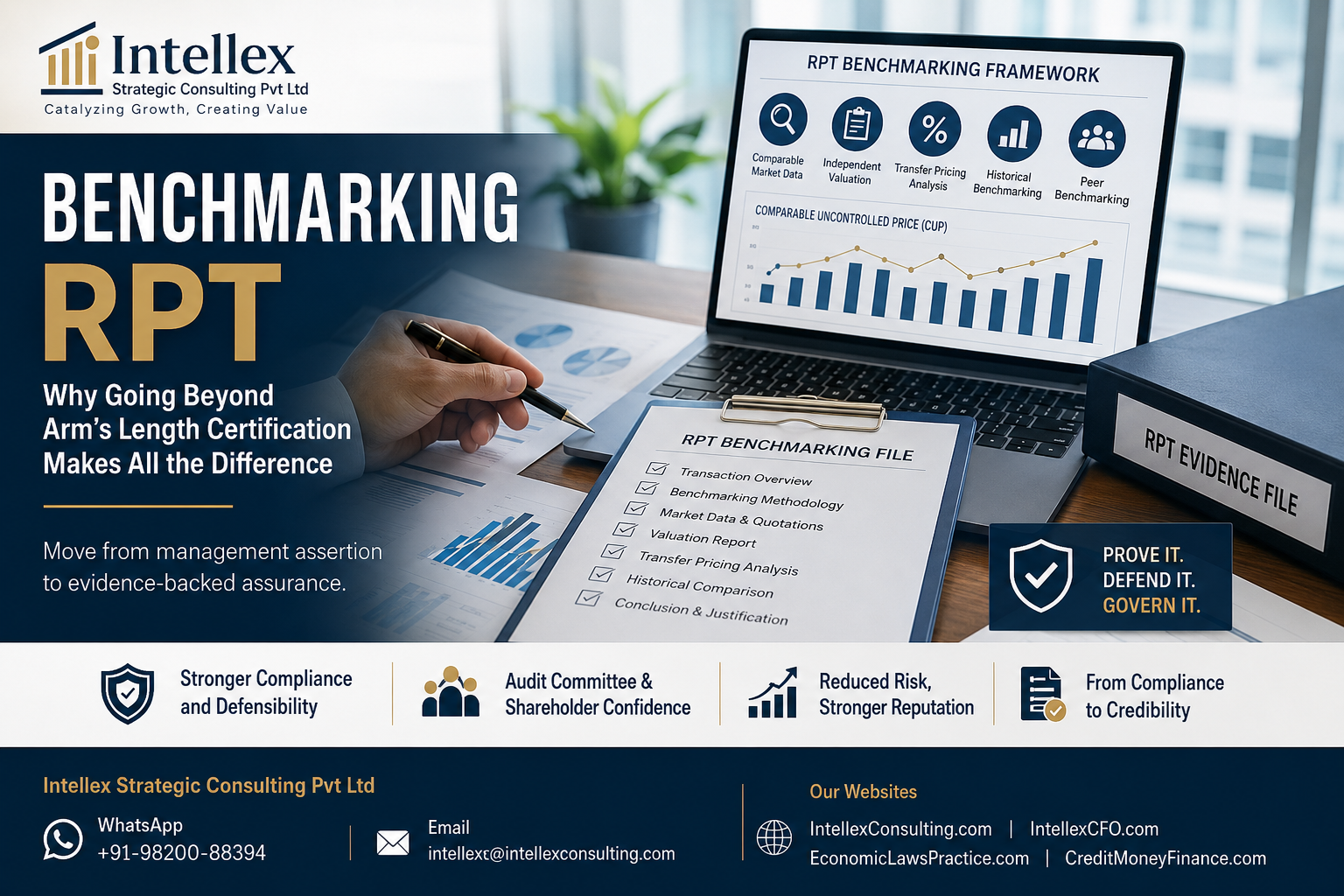
Benchmarking RPT – Why Going Beyond Arm’s Length Certification Makes All the Difference
Most companies approach Related Party Transaction (RPT) compliance with a single question:
Is the transaction at arm’s length?
It is absolutely the right starting point. But it is not the complete answer.
Stopping at arm’s length certification — often backed only by internal management representation — is where most organisations fall short of true governance excellence. In today’s regulatory and stakeholder environment, substantiation matters as much as conclusion.
This is where RPT benchmarking becomes a powerful differentiator.
Understanding the Arm’s Length Principle and Its Limitations
The arm’s length principle requires that transactions between related parties be conducted as if they were between unrelated parties under similar circumstances.
While conceptually simple, the real challenge lies in:
- Establishing comparability
- Ensuring objective validation
- Creating defensible documentation
In practice, many organisations rely on:
- CFO or management certification
- Internal notes supporting pricing decisions
While necessary, these are not sufficient, especially when transactions are:
- Material in value
- Subject to Audit Committee scrutiny
- Requiring shareholder approval
- Under regulatory lens (e.g., SEBI, Income Tax authorities)
Why Arm’s Length Certification Alone Falls Short
An arm’s length certificate without robust backing raises key risks:
- Regulatory challenge risk
- Audit qualifications or observations
- Shareholder activism concerns
- Reputational exposure
In essence, a certification answers “what” — but stakeholders increasingly demand clarity on “how” and “why”.
What Genuine RPT Benchmarking Looks Like
A mature approach to RPT governance goes beyond assertions and builds evidence-backed benchmarking frameworks.
1. Comparable Market Data (CUP Method)
For transactions involving goods or services:
- What do independent third parties charge?
- Are there comparable uncontrolled transactions?
- Can external quotations or vendor bids be obtained?
This Comparable Uncontrolled Price (CUP) approach is the most direct validation of arm’s length pricing.
2. Independent Valuation
For transactions involving:
- Assets
- Real estate
- Financial instruments
An independent registered valuer’s report provides:
- Objective fair value assessment
- Regulatory defensibility
- Enhanced credibility before Audit Committees
In certain cases, this is not just best practice — it is a legal requirement under Indian regulations.
3. Transfer Pricing Framework
For cross-border RPTs:
- Documentation under the Income-tax Act, 1961 provides structured methodologies
- Methods like:
- Cost Plus Method
- Transactional Net Margin Method (TNMM)
Even for domestic RPTs, applying transfer pricing logic:
- Brings analytical discipline
- Enhances defensibility
4. Historical Benchmarking
A critical but often ignored dimension:
- How do current transaction terms compare with past transactions?
- Are there significant deviations?
If yes, are they:
- Commercially justified?
- Properly documented?
Consistency is a key indicator of fairness.
5. Peer Benchmarking
Looking outward strengthens internal validation:
- What are industry norms?
- How do peer companies structure similar transactions?
- Are pricing and terms aligned with market practice?
This adds contextual credibility beyond internal analysis.
Building a Robust RPT Benchmarking File
Forward-looking organisations create a dedicated benchmarking file for each significant RPT.
A well-structured file includes:
- Transaction overview
- Nature and rationale
- Benchmarking methodology used
- Market data / quotations
- Valuation reports (if applicable)
- Transfer pricing analysis
- Historical comparison
- Final conclusion and justification
This transforms compliance from:
“We believe it is arm’s length”
to
“We can prove it is arm’s length.”
Why This Matters More Than Ever
Regulatory and governance expectations in India are evolving rapidly:
- Increased scrutiny under SEBI (LODR) Regulations
- Stronger Audit Committee oversight
- Enhanced disclosure requirements
- Rising investor expectations
In this environment, documentation is not a formality — it is a shield.
From Compliance to Governance Excellence
Organisations that invest in robust RPT benchmarking achieve:
- Greater Audit Committee confidence
- Stronger regulatory defensibility
- Improved investor trust
- Reduced litigation and compliance risk
Most importantly, they move from minimum compliance to governance leadership.
Conclusion
Yes , asking whether a transaction is at arm’s length is essential.
But stopping there is no longer enough.
True RPT governance lies in demonstrating — with evidence, analysis, and documentation — that the transaction stands up to scrutiny from regulators, auditors, and shareholders alike.
That is the difference between compliance and credibility.
How Intellex Can Help
At Intellex Strategic Consulting Pvt Ltd, we help organisations build robust, defensible, and regulator-ready RPT frameworks, including:
- End-to-end RPT benchmarking documentation
- Independent valuation coordination
- Transfer pricing support
- Audit Committee presentation packs
- Policy design and governance frameworks
Contact Us:
📞 WhatsApp: +91-98200-88394
📧 Email: intellex@intellexconsulting.com
🌐 Websites:
- IntellexConsulting.com
- IntellexCFO.com
- EconomicLawsPractice.com
- CreditMoneyFinance.com
If you’re rethinking your RPT framework, the real question is no longer: “Is it arm’s length?”
But rather: “Can we prove it beyond doubt?”
Intellex Strategic Consulting Pvt Ltd
More Featured Articles:
- ESOP Compliance in India: A Complete Guide for Compliance Professionals (2026 Edition).
- Post Office Tax Compliance 2026: Key Changes, SFT Reporting & Practical Impact on Investors.
- Non-Resident TDS Update from April 1, 2026: Complete Guide to New Rules, Rates & Compliance Under the Income Tax Act, 2025.
- MCA Companies Compliance Facilitation Scheme 2026: Complete Guide to Benefits, Eligibility, and Filing Strategy.
- RBI FLA Return 2026: Compliance Challenges for GIFT IFSC Entities Under FEMA Explained.
- Comprehensive Guide to Taxation of Charitable Trusts in India: Laws, Compliance, Exemptions & Recent Amendments (2026).
- The NBFC 50-50 Test Explained: How to Determine Whether Your Company Qualifies as an NBFC Under RBI Regulations.
- Ultimate Guide to Singapore Company Registration 2026: Rules, Costs, and Compliance.
- ESOP Compliance in India: A Complete Guide for Compliance Professionals (2026 Edition).
- Invoice Discounting in India: Complete Guide to Meaning, Process, Platforms, Benefits & Business Opportunities (2026).
- ECB Rules Changed Big Time in 2026: What Indian Businesses Must Know to Unlock Global Funding.
- Comprehensive Financial & Business Consulting Services in India: Loans, IPOs, Global Funding & Wealth Solutions by Intellex Strategic Consulting.
- Revolutionizing Working Capital: Smart Credit Solutions for Material Purchases & Business Growth.
- Complete Business Setup & Compliance Services in India – Expert Advisory for Startups & Growing Companies.