New RBI E-Mandate Rules 2026: Complete Guide to Digital Recurring Payments Framework for Cards, UPI & PPI.
Comprehensive guide to RBI’s 2026 E-Mandate framework for recurring digital payments via Cards, UPI, and PPIs. Learn rules, limits, compliance requirements, and customer protections.
New RBI Rules: Digital Payments E-Mandate Framework, 2026 – A Complete Compliance Guide
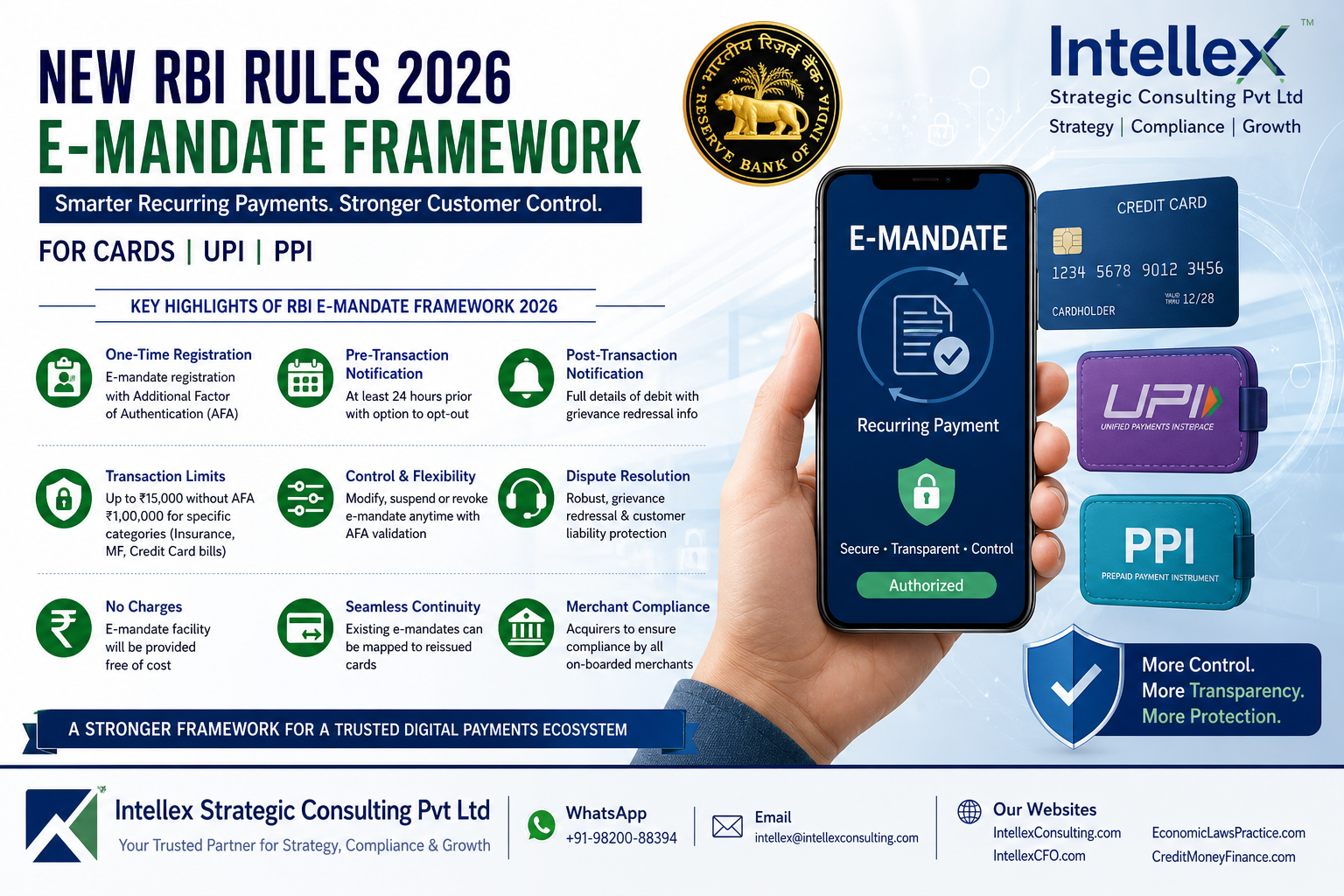
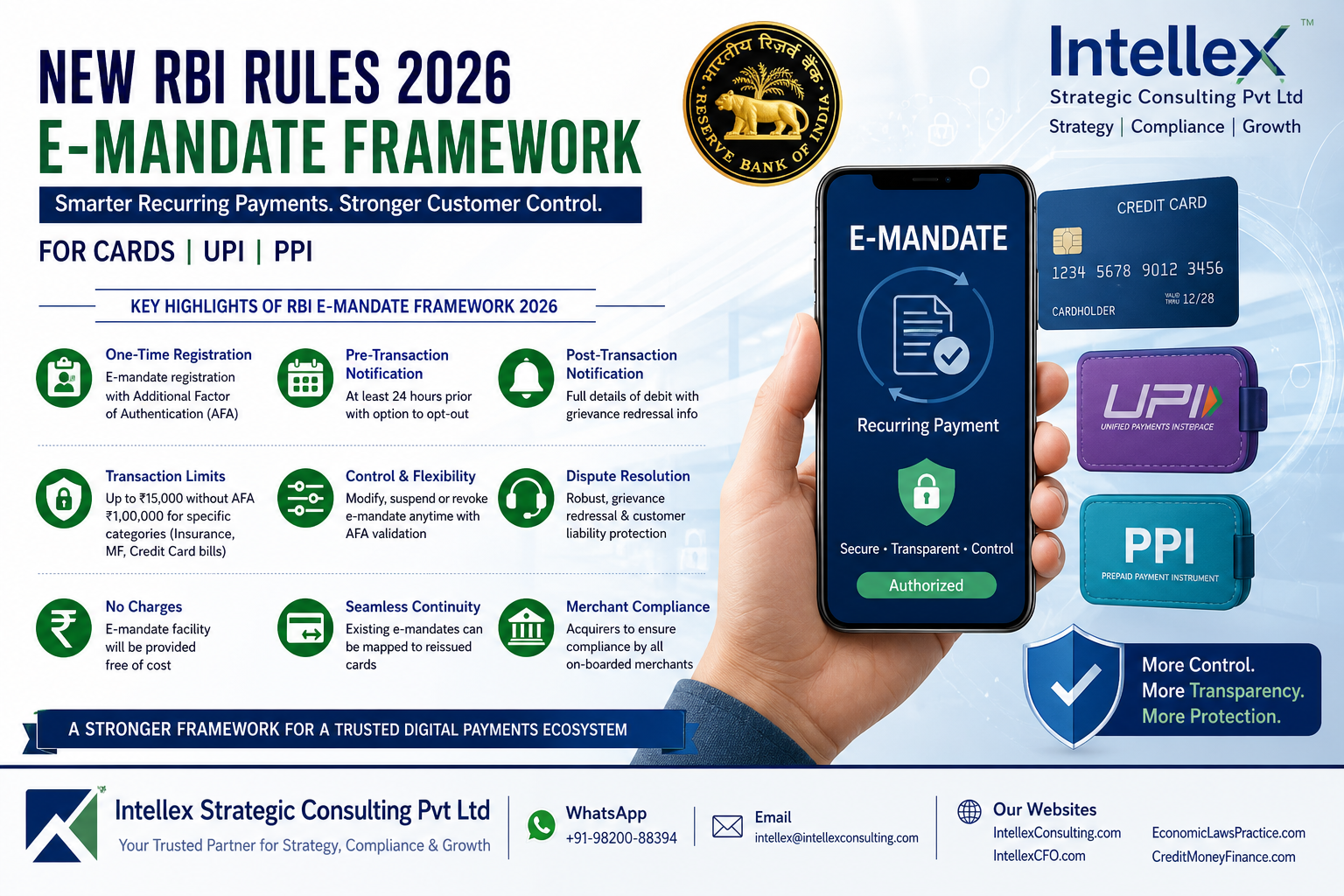
The Reserve Bank of India (RBI) has introduced a comprehensive and consolidated framework for processing recurring digital payments through Cards, Prepaid Payment Instruments (PPI), and UPI. These updated guidelines mark a significant evolution in India’s digital payments ecosystem by enhancing customer control, transparency, and security.
This framework is effective immediately and applies to issuers, acquirers, merchants, and payment aggregators handling automated recurring transactions.
1. Registration and Revocation of E-Mandate
One-Time Registration with AFA
Customers opting for e-mandate must complete a one-time registration process, validated through Additional Factor of Authentication (AFA)—ensuring strong security beyond standard authentication.
Validity and Flexibility
- Every e-mandate must clearly define its validity period
- Customers can:
- Modify the validity
- Withdraw the mandate anytime
- These options must be clearly communicated at the time of registration
Fixed vs Variable Mandates
- Mandates may be:
- Fixed amount, or
- Variable amount (within RBI-prescribed limits)
- For variable mandates:
- Customers can set a maximum transaction cap
Notification Preferences
Customers can choose their preferred mode (SMS, email, etc.) for receiving alerts and can change it anytime.
Modification & Withdrawal
Any changes or cancellation of mandates require AFA validation, ensuring protection against unauthorized changes.
2. Processing of Transactions
First Transaction
- Must undergo AFA authentication
- If processed during registration, AFA can be combined
Subsequent Transactions
- Recurring payments proceed automatically as per mandate instructions
- Not restricted by additional customer-set limits beyond mandate parameters
3. Pre-Transaction Notification (Mandatory Transparency Layer)
Issuers must notify customers at least 24 hours before debit.
Minimum Information Required
- Merchant name
- Transaction amount
- Debit date & time
- E-mandate reference number
- Purpose of debit
Opt-Out Facility
- Customers can:
- Cancel a specific transaction, or
- Revoke the mandate entirely
- Opt-out requires AFA validation
Exceptions
Pre-debit alerts are not required for:
- FASTag auto-replenishment
- National Common Mobility Card (NCMC)
4. Post-Transaction Notification
After each transaction, customers must receive confirmation including:
- Merchant details
- Amount debited
- Date and time
- Transaction & mandate reference numbers
- Reason for debit
- Grievance redressal details
This ensures end-to-end transparency and auditability.
5. Transaction Limits and AFA Requirements
Standard Limit
- Up to ₹15,000 per transaction → No AFA required
Higher Limit Categories
Certain categories are allowed up to ₹1,00,000 without AFA, including:
- Insurance premiums
- Mutual fund subscriptions
- Credit card bill payments
Transactions exceeding these thresholds require mandatory AFA authentication.
6. Dispute Resolution and Customer Protection
Grievance Redressal Mechanism
Issuers must implement a robust system allowing customers to:
- Lodge complaints
- Track resolution
Customer Liability Protection
RBI’s guidelines on limiting liability for unauthorized transactions apply fully to e-mandate transactions—strengthening consumer confidence.
7. Other Key Provisions
No Charges to Customers
- E-mandate facility must be provided free of cost
Card Reissuance Continuity
- Existing mandates can be mapped to reissued cards, avoiding disruption
Merchant Compliance Responsibility
- Acquirers must ensure merchants adhere to RBI norms
Key Impact of RBI E-Mandate Framework 2026
For Customers
- Greater control over auto-debits
- Enhanced security via AFA
- Improved visibility through notifications
For Businesses & Fintechs
- Mandatory compliance infrastructure upgrades
- Need for robust notification and consent systems
- Increased accountability in recurring billing
For the Payments Ecosystem
- Standardization across Cards, UPI, and PPIs
- Boost in trust and adoption of digital subscriptions
- Reduced fraud and disputes
Compliance Checklist for Businesses
- Implement AFA-enabled mandate registration
- Enable real-time modification & revocation
- Set up automated pre & post transaction alerts
- Integrate opt-out functionality
- Ensure threshold-based AFA triggers
- Maintain audit trails and grievance systems
How Intellex Strategic Consulting Pvt Ltd Can Help
Intellex Strategic Consulting Pvt Ltd provides end-to-end advisory and compliance support for RBI regulations, including digital payments and fintech frameworks.
Our Services Include:
- RBI compliance advisory for fintech & NBFCs
- E-mandate system implementation consulting
- Risk, audit, and governance frameworks
- Regulatory documentation & certification
- Payment ecosystem compliance strategy
📞 WhatsApp: +91-98200-88394
📧 Email: intellex@intellexconsulting.com
🌐 Websites:
- IntellexConsulting.com
- IntellexCFO.com
- EconomicLawsPractice.com
- CreditMoneyFinance.com
Conclusion
The RBI’s 2026 E-Mandate framework is a landmark step in strengthening India’s digital payments ecosystem. By balancing automation convenience with user control and security, the framework sets a new benchmark for recurring transactions globally.
Businesses must act swiftly to ensure compliance, while customers can now enjoy safer, transparent, and fully controllable automated payments.
Intellex Strategic Consulting Pvt Ltd
More Featured Posts:
RBI FLA Return 2026: Compliance Challenges for GIFT IFSC Entities Under FEMA Explained.
GST Notice Threshold Proposal: A Game-Changer for Taxpayers and MSMEs in India.
Tax Loss Harvesting: A Strategic Guide to Reducing Capital Gains Tax.

2 thoughts on “New RBI E-Mandate Rules 2026: Complete Guide to Digital Recurring Payments Framework for Cards, UPI & PPI.”