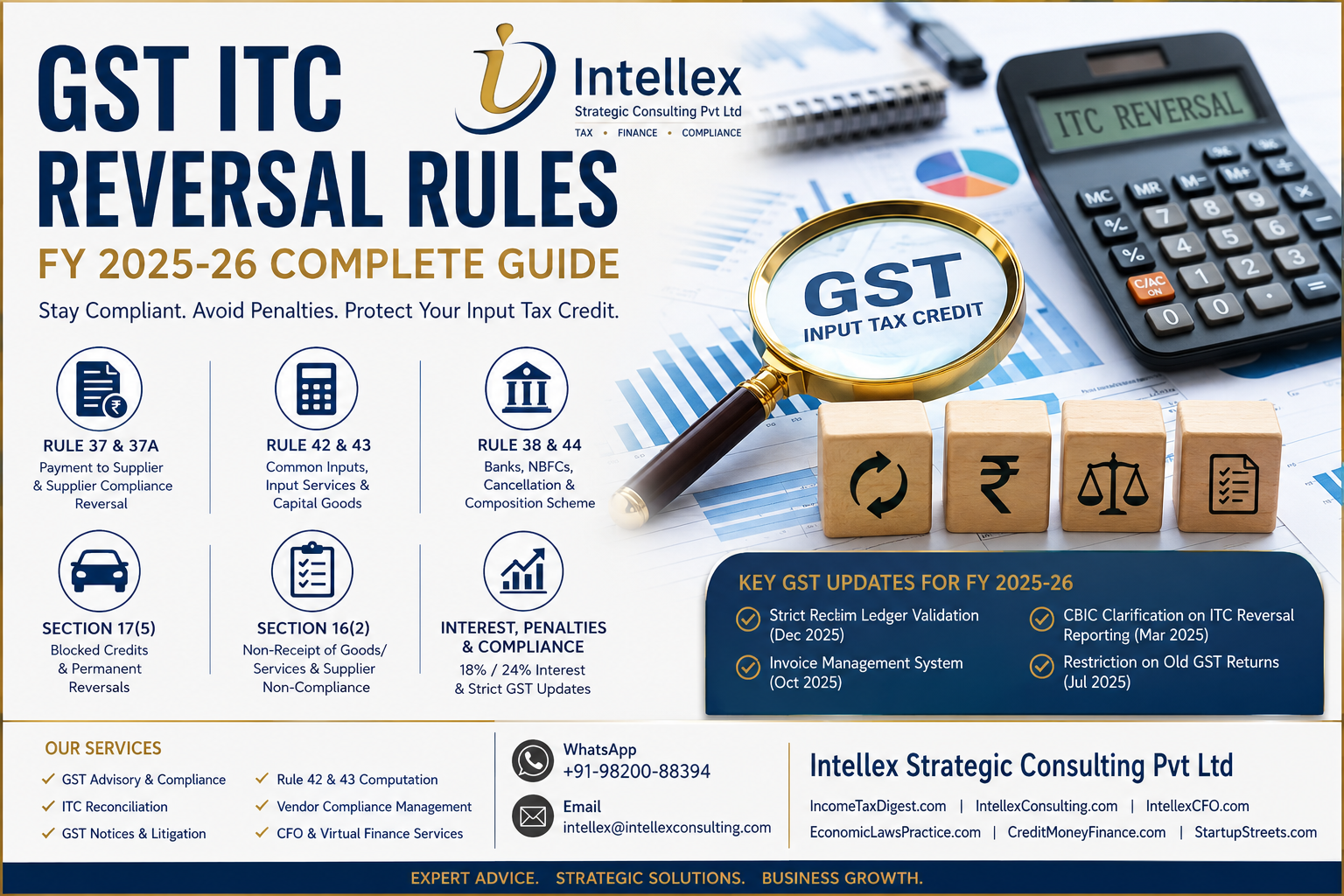
GST ITC Reversal Rules for FY 2025-26: Complete Professional Guide for Businesses, CFOs, Tax Consultants & GST Compliance Teams.
Understanding GST ITC Reversal in India: A Critical Compliance Requirement for FY 2025-26
Comprehensive GST ITC Reversal Guide for FY 2025-26 covering Rule 37, Rule 37A, Rule 42, Rule 43, blocked credits, interest, penalties, GSTR-3B reporting, vendor compliance, GST litigation risks, and latest CBIC updates. Expert GST advisory by Intellex Strategic Consulting Pvt Ltd.
Input Tax Credit (ITC) remains one of the most important benefits available under the Goods and Services Tax (GST) regime in India. However, the GST law also imposes strict conditions regarding the availment, retention, reversal, and reclaim of ITC. Any failure to comply with these provisions can result in substantial financial exposure through interest liabilities, penalties, departmental notices, audits, and litigation.
With increasing automation, AI-based GST scrutiny, Invoice Management System (IMS) implementation, tighter reconciliation mechanisms, and stricter portal validations proposed for FY 2025-26, businesses must adopt a far more disciplined and proactive approach toward ITC management.
This comprehensive professional guide explains all major GST ITC reversal provisions applicable for FY 2025-26, including reversal methodologies, reclaim conditions, reporting requirements, interest implications, penalties, annual reconciliations, and recent compliance updates issued by the GST authorities.
For businesses, CFOs, finance teams, GST consultants, tax managers, and auditors, understanding these provisions is now essential for ensuring litigation-free GST compliance.
What is GST ITC Reversal?
GST Input Tax Credit reversal refers to the process of reversing or paying back ITC already claimed in cases where statutory conditions prescribed under the CGST Act and GST Rules are not fulfilled.
ITC reversal may arise due to several reasons, including:
- Non-payment to vendors within 180 days
- Supplier non-compliance in filing GST returns
- Usage of goods/services for exempt supplies
- Blocked credits under Section 17(5)
- Cancellation of GST registration
- Non-receipt of goods/services
- Common usage of inputs for taxable and exempt supplies
- Capital goods used for mixed purposes
Depending upon the nature of non-compliance, the reversal may either be:
Temporary Reversal
ITC can later be reclaimed upon fulfillment of prescribed conditions.
Permanent Reversal
ITC becomes permanently ineligible and cannot be reclaimed.
Non-compliance may attract:
- Interest at 18% or 24% per annum
- Penalties under Section 122
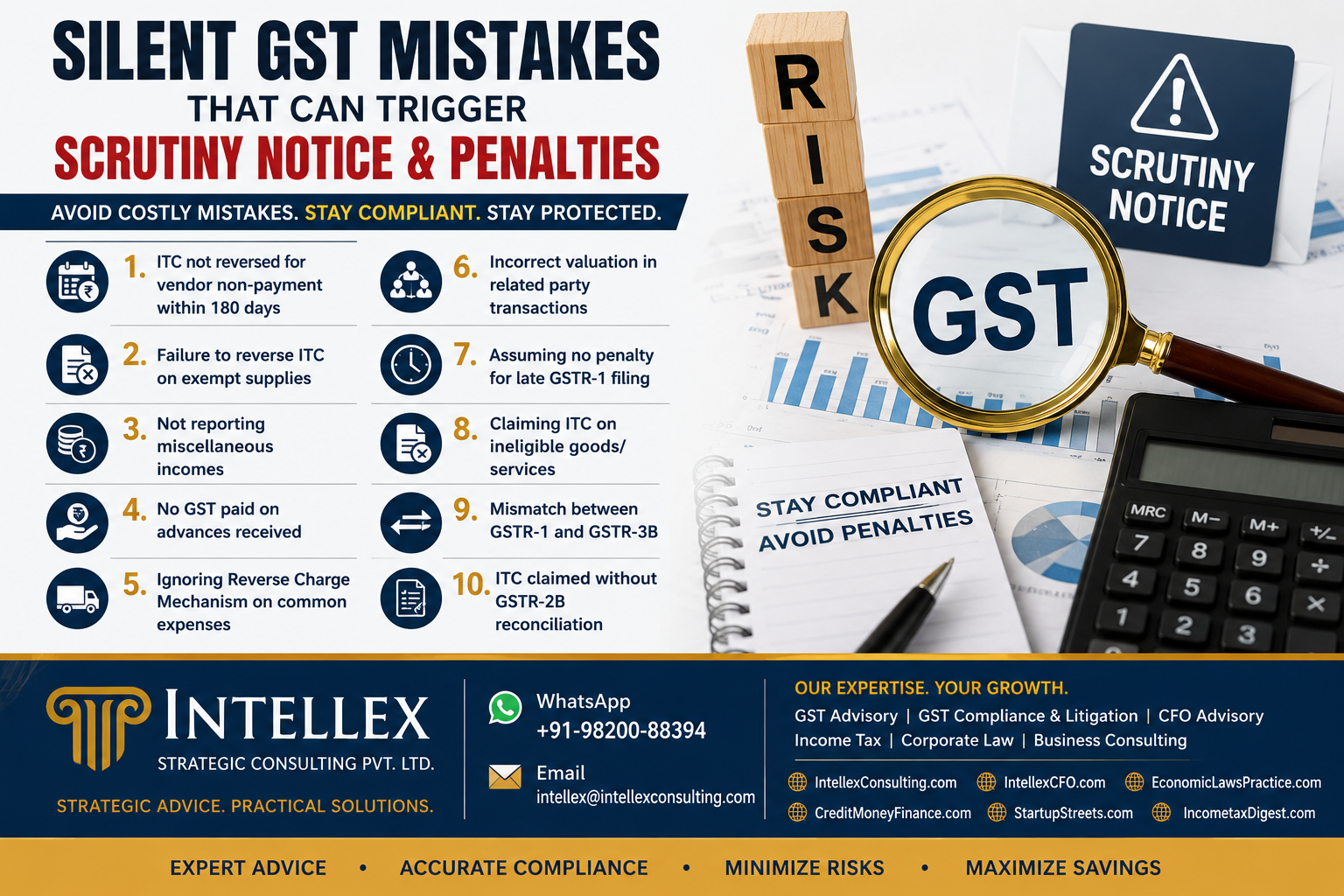
- GST audits and scrutiny proceedings
- Demand notices
- Proceedings under Section 73 or Section 74A
- Blocking of GST return filing
Rule 37 – ITC Reversal for Non-Payment to Supplier Within 180 Days
Legal Provision
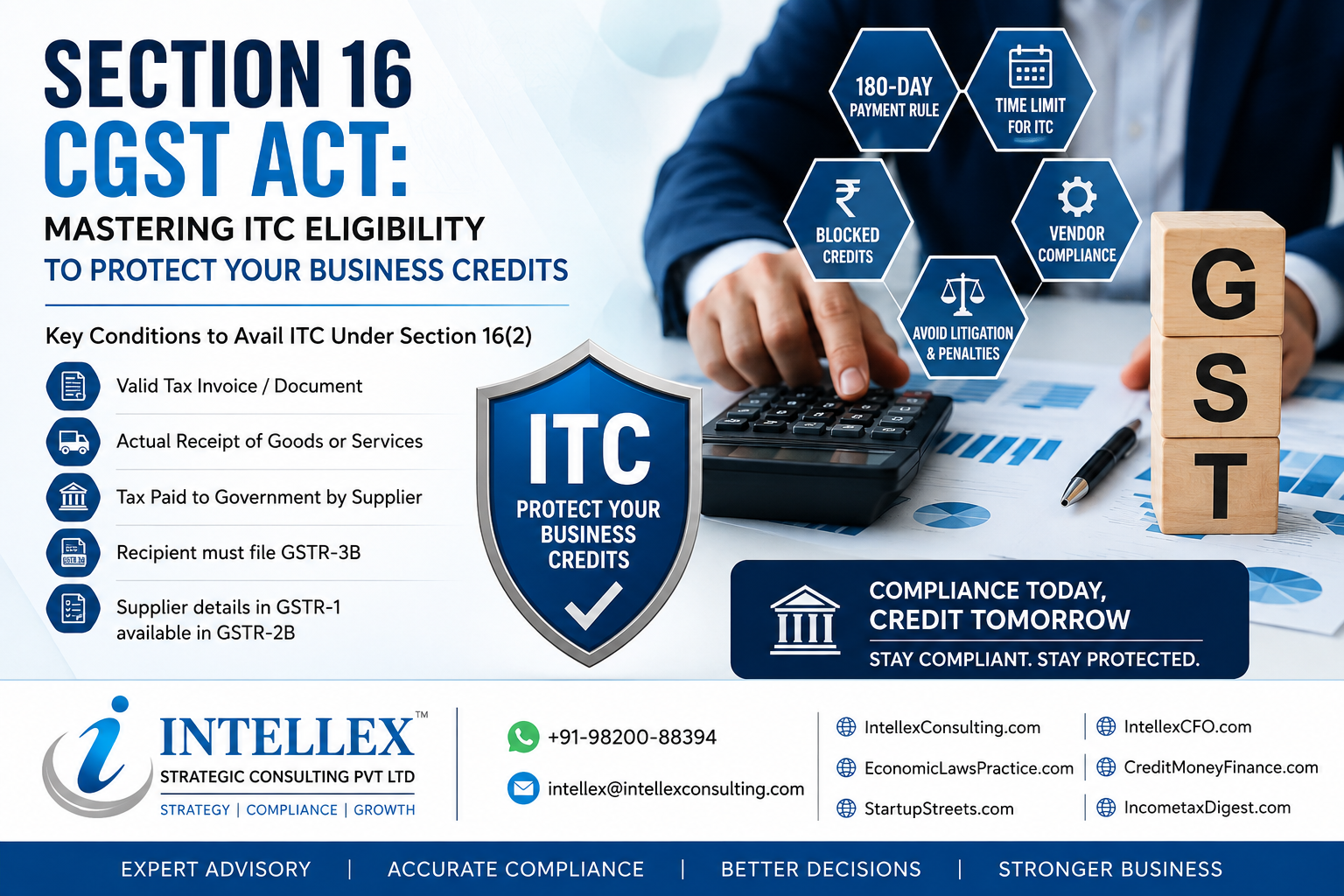
Section 16(2) read with Rule 37 mandates that recipients must make payment to suppliers within 180 days from the invoice date. If payment is not made within this period, the entire ITC availed on such invoice must be reversed.
The payment must include:
- Taxable value
- GST component
Interest Liability
Interest at 18% per annum applies from:
- Date of ITC availment
until - Date of reversal
Reclaim of ITC
Once payment is subsequently made to the supplier, the reversed ITC can be reclaimed.
Reporting Requirements
Temporary reversal must be disclosed in:
- GSTR-3B Table 4(B)(2)
- Reclaim in Table 4(A)(5)
Practical Compliance Recommendations
Businesses should implement:
- Vendor ageing analysis
- Monthly payable reconciliation
- Automated 180-day compliance tracking
- ERP-based vendor payment alerts
Failure to properly monitor vendor payments is one of the leading causes of GST notices during departmental audits.
Rule 37A – ITC Reversal Due to Supplier Non-Compliance
Background
Rule 37A was introduced to tighten GST compliance by linking ITC availability with supplier tax payment compliance.
Even if the supplier uploads invoices in GSTR-1, the recipient may still lose ITC if the supplier fails to file GSTR-3B and deposit the tax liability.
When Reversal Becomes Mandatory
If the supplier:
- Reports invoice in GSTR-1
but - Fails to file GSTR-3B by 30th September of the next financial year,
then the recipient must reverse the ITC by 30th November of the succeeding financial year.
Interest Implications
Interest liability applies for delayed reversal.
Importantly:
- Interest paid at the time of reversal is not refundable even if ITC is later reclaimed.
Reclaim Conditions
ITC can be reclaimed only when:
- Supplier files GSTR-3B
- Tax is deposited
- Invoice appears in GSTR-2B
Reporting Requirements
- GSTR-3B Table 4(B)(2)
- GSTR-9 Table 7A
- Reclaim through GSTR-9 Table 6H
Strategic Risk Management
Businesses should implement:
- Monthly vendor compliance ratings
- GSTR-2B reconciliations
- Vendor risk categorization
- Contractual GST compliance clauses
- Supplier communication mechanisms
Vendor compliance management has now become a core GST governance function for large businesses.
Rule 38 – ITC Reversal for Banks, NBFCs & Financial Institutions
Banks, NBFCs, and financial institutions opting under Section 17(4) are permitted to avail only 50% of eligible ITC every month.
Key Features
- 50% reversal is mandatory
- Permanent reversal
- No reclaim permitted
Reporting
- GSTR-3B Table 4(B)(1)
Compliance Requirements
Organizations should maintain:
- Monthly ITC computation sheets
- Audit documentation
- Internal approvals
- ITC policy frameworks
Financial institutions remain one of the most scrutinized sectors under GST audits due to complex ITC eligibility structures.
Rule 42 – Reversal of Common Input and Input Service Credit
Rule 42 applies where inputs or input services are used commonly for:
- Taxable supplies
- Exempt supplies
- Non-business purposes
This is one of the most technically sensitive areas under GST.
Annual True-Up Requirement
Businesses must perform annual recalculation in:
- September return of next FY
- Filed in October
Outcomes
- Excess reversal → reclaim permitted
- Short reversal → additional reversal with 18% interest
Reporting
- GSTR-3B Table 4(B)(1)
- GSTR-9 Table 7
Professional Best Practices
Maintain:
- Department-wise expense mapping
- GST classification matrix
- Exempt turnover computation sheets
- Internal audit review systems
Improper Rule 42 computation is one of the highest-risk areas during GST departmental assessments.
Rule 43 – ITC Reversal on Capital Goods Used for Mixed Purposes
Rule 43 governs ITC reversal relating to capital goods used for both:
- Taxable supplis
- Exempt/non-business purposes
Unlike Rule 42, reversal is spread over the useful life of the capital asset.
Important Considerations
- Useful life considered: 60 months
- Annual true-up mandatory
- Change in usage triggers fresh recalculation
- Direct reclaim not generally permitted
Reporting
- GSTR-3B Table 4(B)(1)
- GSTR-9 Table 7
Documentation Requirements
Maintain:
- Fixed asset register
- GST asset tagging
- Useful life computation sheets
- Asset usage classification
Capital goods ITC reversals are closely examined during GST audits involving infrastructure-heavy sectors.
Rule 44 – ITC Reversal on Cancellation of Registration or Shift to Composition Scheme
When a taxpayer:
- Cancels GST registration
or - Opts for composition scheme,
ITC attributable to remaining stock and capital goods must be reversed.
Applicable Assets
- Raw materials
- Semi-finished goods
- Finished goods
- Capital goods
Capital Goods Valuation
Reversal is based on:
- Remaining useful life as on day preceding cancellation/composition switch
Reporting
- GSTR-10
Important Compliance Alert
Delayed filing of GSTR-10 may attract substantial late fees since no maximum cap currently applies.
Businesses planning restructuring, mergers, closures, or composition migration must carefully evaluate GST reversal exposure beforehand.
Section 17(5) – Blocked Credits Under GST
Section 17(5) specifies categories where ITC is permanently disallowed.
These are commonly called “Blocked Credits.”
Major Blocked Credits
Motor Vehicles
Motor vehicles with seating capacity up to 13 persons, except specified eligible uses.
Food & Beverages
Restaurant expenses, employee refreshments, and catering.
Outdoor Catering
Except where mandatory under law.
Club Memberships
Gymkhana, clubs, recreational facilities.
Health & Beauty Treatments
Works Contract Services
For construction of immovable property.
Goods Lost, Stolen, Destroyed or Written Off
Gifts & Free Samples
Employee Transportation Facilities
Except where mandated under law.
Interest & Penalties
- Interest at 24% per annum
- Penalty under Section 122
- Fraud cases may attract Section 74A proceedings
Reporting
- GSTR-3B Table 4(B)(1)
Permanent Nature
These credits cannot be reclaimed.
Businesses should implement robust expense coding and ERP controls to prevent accidental availment of blocked credits.
Section 16(2)(b) – Goods or Services Not Received
ITC can only be claimed when goods or services are actually received.
If invoice is received but supply is not received:
- ITC must be temporarily reversed.
Reclaim
Re-availment allowed once:
- Goods/services are actually received
Reporting
- GSTR-3B Table 4(B)(2)
Recommended Controls
Maintain:
- Goods receipt notes (GRNs)
- Service completion certifications
- Inward logistics tracking
- Vendor acknowledgement systems
Section 16(2)(c) – Supplier Has Not Deposited Tax
Where supplier fails to comply with GST obligations and invoices do not reflect in GSTR-2B, ITC becomes vulnerable.
Compliance Requirement
Reverse ITC temporarily until:
- Supplier deposits tax
- Invoice appears in GSTR-2B
Reporting
- GSTR-3B Table 4(B)(2)
Critical Compliance Measures
Businesses should establish:
- Monthly GSTR-2B reconciliation
- Vendor risk dashboards
- Automated mismatch reporting
- Supplier escalation protocols
Vendor-driven GST risks are expected to increase significantly under the FY 2025-26 compliance environment.
GSTR-3B Table 4 – Quick ITC Reversal Reference
Table 4(B)(1) – Permanent Reversals
Includes:
- Section 17(5)
- Rule 42
- Rule 43
- Rule 38
Table 4(B)(2) – Temporary Reversals
Includes:
- Rule 37
- Rule 37A
- Section 16(2)
Table 4(A)(5) – Reclaim of ITC
Used for:
- Re-availment of previously reversed ITC
Accurate disclosure in GSTR-3B is critical to avoid automated GST notices.
Key GST ITC Compliance Updates for FY 2025-26
December 2025 – Strict Reclaim Ledger Validation
GST portal validation is expected to become significantly stricter.
Key Impact
- Negative balance in Electronic Credit Reversal & Reclaimed Statement may not be permitted
- GSTR-3B filing may be blocked until excess ITC reversal is completed
Businesses must maintain accurate reclaim ledgers and monthly reconciliations.
October 2025 – Invoice Management System (IMS)
IMS implementation is expected to substantially change vendor compliance management.
Major Risk
Invoices not accepted or confirmed in IMS may become ineligible for ITC.
Recommended Actions
- Vendor onboarding verification
- Invoice acceptance workflows
- ERP integration
- Vendor communication automation
March 2025 – CBIC Clarification on Permanent Reversals
CBIC instructed taxpayers to:
- Report permanent reversals directly in Table 4(B)(1)
instead of - Reducing eligible ITC figures
Incorrect reporting may increase scrutiny exposure.
July 2025 – Restriction on Filing Old GST Returns
GST returns beyond three years from original due dates may become non-fileable on the GST portal.
Businesses should immediately review:
- Pending GST filings
- Historical reconciliations
- Open litigation periods
Interest Rates Applicable Under GST ITC Reversal Provisions
| Nature of Default | Interest Rate |
|---|---|
| Rule 37 reversals | 18% p.a. |
| Rule 37A reversals | 18% p.a. |
| Rule 42 short reversals | 18% p.a. |
| Section 17(5) blocked credits | 24% p.a. |
| General GST delays/defaults | 18% p.a. |
Practical GST Compliance Strategy for Businesses in FY 2025-26
Given the increasing use of technology-driven GST scrutiny by authorities, businesses should adopt a structured GST governance framework covering:
- Monthly GSTR-2B reconciliation
- Vendor compliance monitoring
- ITC ageing analysis
- ERP automation
- Internal GST audits
- Rule 42 and Rule 43 working papers
- Fixed asset GST mapping
- Vendor risk scoring
- Annual ITC true-up reconciliations
- Litigation preparedness documentation
Organizations failing to strengthen GST governance systems are likely to face increased notices, assessments, and cash flow disruptions.
How Professional GST Advisory Helps Businesses Reduce Risk
GST ITC reversals involve:
- Technical legal interpretation
- Complex reconciliations
- ERP integration
- Vendor compliance management
- Litigation handling
- Annual audit preparedness
Professional advisory support helps businesses:
- Prevent wrongful ITC claims
- Avoid interest and penalties
- Reduce GST litigation exposure
- Improve cash flow management
- Build robust compliance systems
- Handle departmental notices efficiently
Professional GST Advisory & Litigation Support Services
Businesses seeking professional assistance for GST ITC reconciliations, GST audits, GST litigation, vendor compliance management, Rule 42/43 computations, GST notices, and GST advisory services may connect with:
Intellex Strategic Consulting Pvt Ltd
Professional Services Include:
- GST Advisory & Compliance
- GST ITC Reconciliation
- GST Litigation Support
- GST Notices & Assessments
- CFO & Virtual Finance Services
- Startup & Business Structuring
- Tax Planning & Risk Management
- Vendor Compliance Systems
- Financial & Regulatory Advisory
Contact Details
- WhatsApp: +91-98200-88394
- Email: intellex@intellexconsulting.com
Group Platforms
- IncomeTaxDigest.com
- IntellexConsulting.com
- IntellexCFO.com
- EconomicLawsPractice.com
- CreditMoneyFinance.com
- StartupStreets.com
Intellex Strategic Consulting Pvt Ltd
More Featured Posts:
GST on Employee Recoveries Under GST in India: The Emerging Litigation Minefield for Corporates.
Taxable Event Under GST: Understanding “Supply” – The Heart of GST Law in India.
GST Notice Threshold Proposal: A Game-Changer for Taxpayers and MSMEs in India.
Ultimate Guide to Singapore Company Registration 2026: Rules, Costs, and Compliance.
The Ultimate Guide to Company Registration in Dubai 2026: Benefits, Compliance, and Costs.
4 thoughts on “GST ITC Reversal Rules for FY 2025-26: Complete Professional Guide for Businesses, CFOs, Tax Consultants & GST Compliance Teams.”