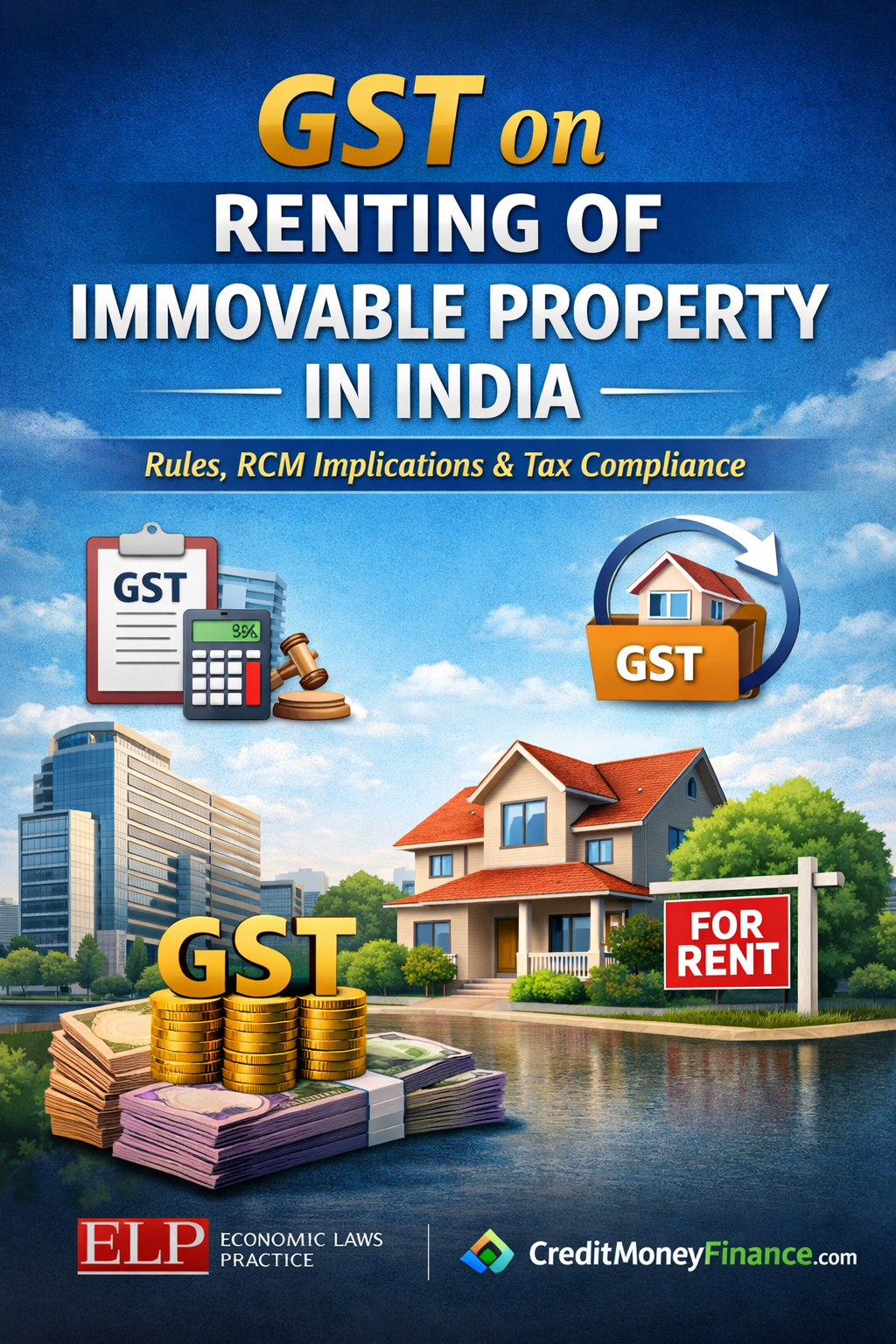
GST on Renting of Immovable Property in India: Latest Rules, RCM Implications & Compliance Guide (2026).
A comprehensive guide on GST applicability on renting of immovable property in India, covering residential vs commercial property, reverse charge mechanism (RCM), place of supply rules, and registration requirements.
1. Introduction
The applicability of Goods and Services Tax (GST) on renting of immovable property continues to be a nuanced and evolving area under Indian indirect tax law. While renting services are generally taxable, the presence of multiple exemptions, coupled with intricate place of supply provisions, often creates interpretational challenges for taxpayers.
Recent regulatory developments, particularly the introduction of the Reverse Charge Mechanism (RCM) on certain residential renting transactions and withdrawal of earlier exemptions, have significantly altered the compliance landscape. As a result, both landlords and tenants must exercise greater diligence in determining their GST obligations.
2. Reverse Charge Mechanism (RCM) on Residential Renting
A major shift was introduced with effect from 18 July 2022, whereby GST liability under the Reverse Charge Mechanism applies to renting of residential property when supplied to a registered person.
Under this framework, the liability to discharge GST is transferred from the supplier (landlord) to the recipient (tenant), subject to the following conditions:
- The landlord may be either registered or unregistered under GST.
- The tenant must be a registered person under GST.
- The rented property must qualify as a residential dwelling.
In such cases, GST at the applicable rate (currently 18%) is payable by the tenant under RCM.
However, an important exception exists. Where the residential property is used for personal purposes, such as residence of a proprietor or partner, the transaction remains outside the ambit of GST. The determining factor, therefore, is the end-use of the property rather than its classification alone.
3. GST on Commercial vs Residential Property
The tax treatment of renting varies significantly depending on whether the property is categorized as commercial or residential, and the purpose for which it is used.
Commercial Property
In the case of commercial properties:
- Where the landlord is registered under GST, renting services attract GST at 18% under the forward charge mechanism.
- Where the landlord is unregistered, GST is not applicable.
- The registration status of the tenant does not impact taxability in this case.
Residential Property
For residential properties, the taxability depends primarily on usage:
- If the property is used for personal residential purposes, no GST is applicable.
- If the property is used for business or commercial purposes and the tenant is a registered person, GST at 18% is payable under RCM.
- Where both landlord and tenant are unregistered, GST provisions do not apply.
This distinction underscores the importance of clearly documenting the intended use of the property in rental agreements.
4. Place of Supply Rules
The place of supply provisions play a critical role in determining the nature of the transaction and the type of tax applicable.
For renting of immovable property, the place of supply is unequivocally the location of the property itself, irrespective of the location of the supplier or recipient.
Accordingly:
- If the property and the recipient are located within the same State, the transaction is treated as an intra-State supply, attracting CGST and SGST.
- If they are located in different States, it qualifies as an inter-State supply, attracting IGST.
A key practical implication arises when the tenant is registered in a State different from where the property is located. In such cases, input tax credit (ITC) availability may be restricted due to State-wise registration constraints, potentially leading to increased tax costs.
5. GST Registration Requirements
Under GST law, inter-State supply of services typically mandates compulsory registration. However, a significant relaxation has been provided for small service providers.
Where the aggregate turnover does not exceed ₹20 lakh in a financial year, service providers are exempt from mandatory registration, even if they are engaged in inter-State supply of services. This benefit is available pursuant to specific notifications issued under the GST framework.
This relaxation is particularly beneficial for individual landlords with limited rental income, reducing their compliance burden.
Conclusion
The applicability of GST on renting of immovable property is determined by a combination of critical factors:
- The nature of the property, whether commercial or residential
- The purpose for which the property is used, personal or business
- The GST registration status of the tenant
The introduction of RCM on residential renting to registered persons has added a layer of complexity, making it essential for taxpayers to carefully evaluate each transaction. Proper classification, clear contractual terms, and a sound understanding of GST provisions are indispensable to ensure compliance and avoid potential disputes.
Team: EconomicLawsPractice.com
More Featured Articles:
Why MSMEs Trust Us With Their Most Critical Financial Decisions
Loans Takeover proposals with enhancement of Banking limits for MSME Sector Companies
Startup India Registration: Unlocking Tax Benefits and Growth

7 thoughts on “GST on Renting of Immovable Property in India: Latest Rules, RCM Implications & Compliance Guide (2026).”