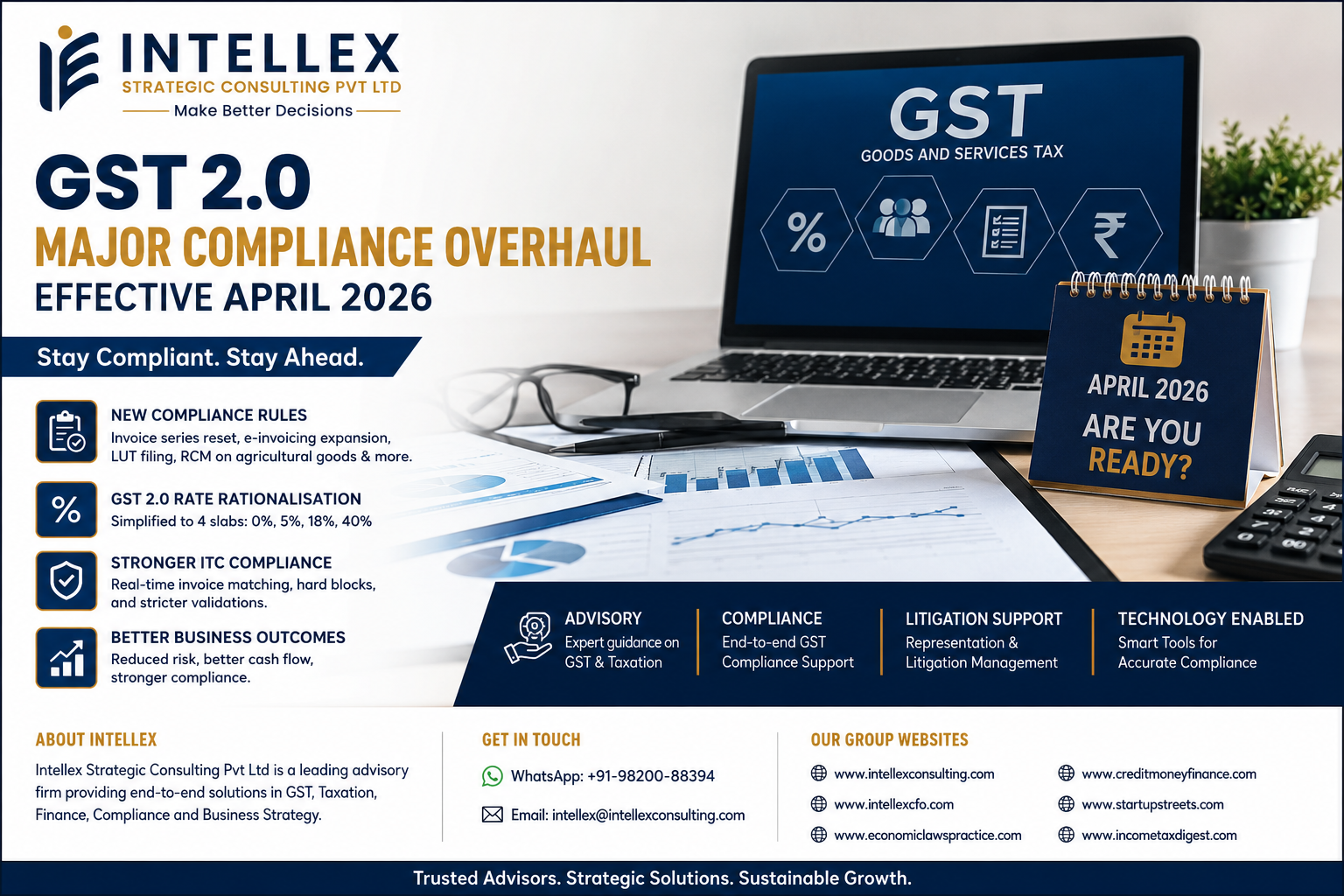
Major GST Compliance Overhaul Effective April 2026: What Businesses Must Act On in May.
GST 2.0 Major Compliance Changes Effective April 2026: Complete Business Action Guide for May 2026
India’s GST regime undergoes a major overhaul from April 2026 with mandatory invoice changes, expanded e-invoicing, GST 2.0 rate rationalisation, RCM updates, IMS compliance, export refund reforms, and stricter ITC rules. Read this detailed business compliance guide for May 2026.
Major GST Compliance Overhaul Effective April 2026: What Businesses Must Act On in May
India’s Goods and Services Tax framework has entered a transformative phase with the implementation of significant reforms effective from April 2026. Popularly being referred to as “GST 2.0,” this overhaul introduces substantial compliance changes, tighter digital controls, revised tax structures, expanded e-invoicing obligations, and stricter Input Tax Credit validation mechanisms.
For businesses across manufacturing, trading, services, exports, startups, e-commerce, logistics, FMCG, agriculture, and retail sectors, May 2026 becomes a critical compliance month. Organizations that fail to adapt quickly may face ITC denials, penalties, litigation exposure, system mismatches, delayed refunds, and cash flow disruptions.
This comprehensive guide explains every major GST amendment effective from April and May 2026 and highlights the urgent actions businesses must undertake immediately.
1. New Invoice Series Mandatory from 1 April 2026
One of the first and most critical compliance changes under GST 2.0 is the mandatory reset of invoice numbering systems from 1 April 2026.
What Has Changed?
All GST registered taxpayers are now required to begin a fresh invoice series for:
- Tax invoices
- Debit notes
- Credit notes
- Revised invoices
The invoice series must:
- Be unique
- Follow sequential numbering
- Avoid duplication
- Match GST portal reporting
Why This Matters
The GST system is now heavily automated with enhanced data analytics and AI-based mismatch detection. Duplicate invoice numbers, gaps in sequences, or inconsistent formats may trigger:
- GST notices
- Return mismatches
- E-invoice rejection
- ITC disputes
- Audit scrutiny
Immediate Action Required
Businesses should:
- Reconfigure ERP and billing software
- Test invoice generation systems
- Ensure branch-wise sequencing consistency
- Train accounting teams
- Verify integration with GSTR-1 reporting
Companies using multiple software systems across locations must ensure centralized invoice governance to avoid duplicate numbering risks.
2. E-Invoicing Expanded to Businesses Above ₹5 Crore Turnover
The government has significantly expanded the scope of mandatory e-invoicing.
New Threshold
Effective April 2026, businesses with Aggregate Annual Turnover (AATO) exceeding ₹5 crore during FY 2025–26 must comply with mandatory e-invoicing.
This marks another major step toward full GST digitization.
Key Compliance Requirements
Affected businesses must:
- Integrate accounting systems with the Invoice Registration Portal (IRP)
- Generate Invoice Reference Numbers (IRN)
- Upload invoices in real time
- Ensure QR code generation
- Synchronize e-invoices with GST returns
Consequences of Non-Compliance
Invoices generated without IRN validation may be treated as invalid invoices.
This may result in:
- Denial of Input Tax Credit to buyers
- Penalties under GST law
- Rejection during audits
- Customer disputes
- Cash flow interruptions
Strategic Business Impact
Mid-sized businesses that previously remained outside e-invoicing must now invest in:
- ERP upgrades
- API integrations
- Compliance automation
- Real-time reconciliation tools
3. LUT Filing for FY 2026–27 Becomes Critical
Exporters and SEZ suppliers must file a fresh Letter of Undertaking (LUT) in Form RFD-11 before issuing export invoices for FY 2026–27.
Who Must File LUT?
Applicable to:
- Exporters of goods
- Exporters of services
- SEZ suppliers
- Businesses exporting without payment of IGST
Major Risk if LUT Is Not Filed
If LUT is not filed on time:
- Exports become taxable
- IGST must be paid upfront
- Refund claims must be filed later
- Working capital gets blocked
For export-oriented businesses, delayed LUT filing can create significant liquidity pressure.
Recommended Action
Businesses should:
- File LUT immediately
- Verify digital signatures
- Maintain export documentation
- Track shipping bill reconciliation
- Review export invoice formats
4. Export Refund Rules Simplified
A major relief has been introduced for exporters.
₹1,000 Minimum Refund Threshold Removed
Earlier, small refund claims below ₹1,000 were not processed efficiently. Effective 1 April 2026, this restriction has been removed.
Business Benefits
Exporters can now:
- Recover even small refund amounts
- Improve working capital efficiency
- Claim accumulated ITC more effectively
Compliance Focus
Businesses must maintain:
- Proper shipping documentation
- LUT copies
- Export invoices
- Foreign remittance records
- GSTR reconciliation
Proper documentation remains essential despite procedural simplification.
5. GST Rate Changes on Beverages Effective 1 May 2026
One of the most commercially sensitive changes under GST 2.0 relates to beverages and food classification.
Categories Affected
Revised GST rates and HSN classifications now apply to:
- Fruit juices
- Milk-based drinks
- Energy beverages
- Caffeinated beverages
- Nutritional drinks
GST Rate Rationalisation
The government has streamlined rates under:
- 5%
- 18%
- 40%
Many products previously falling under the 12% slab may now require reclassification.
Why Businesses Must Review Product Classification Immediately
Incorrect classification can lead to:
- Short tax payment
- Interest liability
- Penalties
- Departmental litigation
- Retrospective demands
Industry Impact
Affected sectors include:
- FMCG
- Food processing
- Dairy
- Beverage manufacturers
- Retail chains
- E-commerce platforms
Businesses must conduct detailed HSN mapping reviews immediately.
6. Invoice Management System (IMS) Introduced
The new Invoice Management System (IMS) is another major pillar of GST digitization.
What Is IMS?
IMS introduces:
- Offline utilities
- Invoice matching tools
- Amendment tracking
- Credit note reconciliation
- Vendor mismatch identification
Purpose of IMS
The objective is to reduce mismatches between:
- GSTR-1
- GSTR-2B
- GSTR-3B
- Books of accounts
Business Benefits
Proper IMS implementation can:
- Reduce notices
- Improve ITC accuracy
- Minimize reconciliation errors
- Detect supplier non-compliance early
Immediate Compliance Requirement
Businesses should:
- Train finance teams
- Establish monthly reconciliation cycles
- Automate vendor matching
- Monitor ITC variances proactively
7. Reverse Charge Mechanism (RCM) on Agricultural Goods
From 13 April 2026, Reverse Charge Mechanism provisions have been expanded to specified agricultural goods.
What Businesses Must Do
Organizations dealing in agricultural procurement must:
- Review inward supplies
- Identify RCM applicable transactions
- Pay GST under reverse charge
- Report correctly in GSTR-3B
Risks of Missing RCM
Failure may result in:
- Tax demand notices
- Interest liability
- Penalties
- ITC complications
This change particularly impacts:
- Agro-processing companies
- Commodity traders
- Food manufacturers
- Agricultural aggregators
GST 2.0 Rate Rationalisation: The New Tax Structure
One of the most significant reforms is the restructuring of GST slabs.
New GST Structure
The revised GST framework broadly moves toward:
- 0%
- 5%
- 18%
- 40%
Key Structural Shift
The 12% slab has largely been removed or merged.
Business Implications
This affects:
- Product pricing
- ERP tax mapping
- Vendor contracts
- Procurement structures
- Consumer pricing strategies
Businesses must review:
- Existing HSN classifications
- Product master databases
- Pricing models
- Tax impact on profitability
Stricter ITC Compliance Under GST 2.0
Input Tax Credit compliance has become significantly stricter under the new framework.
Key Changes
The system now includes:
- Real-time invoice matching
- Hard ITC blocking
- Supplier validation
- Enhanced analytics
- AI-driven compliance checks
Major Business Risk
If suppliers fail to:
- File returns
- Upload invoices
- Pay taxes
Then buyers may lose ITC eligibility.
What Businesses Must Do
Companies should establish:
- Vendor compliance tracking
- Monthly vendor reviews
- Automated reconciliation systems
- Compliance clauses in contracts
Vendor risk management is now a core GST strategy.
Export of Intermediary Services Now Zero-Rated
A major relief has been granted to intermediary service exporters.
What Has Changed?
Export of intermediary services is now treated as:
- Zero-rated supply
- Eligible for Input Tax Credit benefits
Positive Impact
This benefits:
- IT companies
- Consulting firms
- Global sourcing businesses
- Service exporters
- BPO/KPO sectors
This reform improves India’s competitiveness in global service exports.
Practical GST Compliance Checklist for May 2026
1. Reconcile GST Returns Monthly
Ensure reconciliation between:
- GSTR-1
- GSTR-3B
- GSTR-2B
- Books of accounts
2. Upgrade ERP & Billing Systems
Update systems for:
- New invoice series
- Revised GST rates
- E-invoicing
- IMS integration
3. Review Product Classification
Verify HSN classification changes under GST 2.0.
4. Strengthen Vendor Compliance Monitoring
Track supplier return filing and tax payment status regularly.
5. File LUT Immediately
Exporters should avoid delay in LUT filing to preserve working capital.
6. Review RCM Exposure
Assess all inward supplies for reverse charge applicability.
7. Maintain Robust Documentation
Keep organized records for:
- Exports
- ITC
- Refunds
- RCM
- E-invoices
- Vendor compliance
How Businesses Can Prepare for the Future
GST compliance is rapidly evolving from a return filing exercise into a technology-driven governance system.
Businesses must now invest in:
- Compliance automation
- ERP modernization
- Real-time reconciliation
- AI-enabled reporting
- Tax governance frameworks
Companies that proactively adapt will reduce litigation, improve operational efficiency, and strengthen financial controls.
Professional GST Advisory & Compliance Support
Businesses facing challenges in adapting to GST 2.0 may benefit from professional advisory, compliance automation, litigation management, ERP alignment, GST audits, and tax structuring assistance.
Service Provider
Intellex Strategic Consulting Pvt Ltd
WhatsApp: +91-98200-88394
Email: intellex@intellexconsulting.com
Associated Knowledge & Advisory Platforms
- IntellexConsulting.com
- IntellexCFO.com
- EconomicLawsPractice.com
- CreditMoneyFinance.com
- StartupStreets.com
- IncomeTaxDigest.com
Final Thoughts
The April–May 2026 GST overhaul marks one of the most important transitions since the original GST rollout. Businesses that ignore these reforms risk operational disruption, compliance failures, blocked ITC, penalties, and litigation.
The key to successful adaptation lies in:
- Early system upgrades
- Strong reconciliation practices
- Accurate classification
- Vendor compliance management
- Professional advisory support
As GST 2.0 moves India toward a more technology-driven indirect tax ecosystem, proactive compliance will become a major competitive advantage for businesses across sectors.
Intellex Strategic Consulting Pvt Ltd
More Featured Articles:
How Businesses in the UAE Can Stay Ahead of Compliance Demands in 2026.
Startup India Registration: Unlocking Tax Benefits and Growth
4 thoughts on “Major GST Compliance Overhaul Effective April 2026: What Businesses Must Act On in May.”