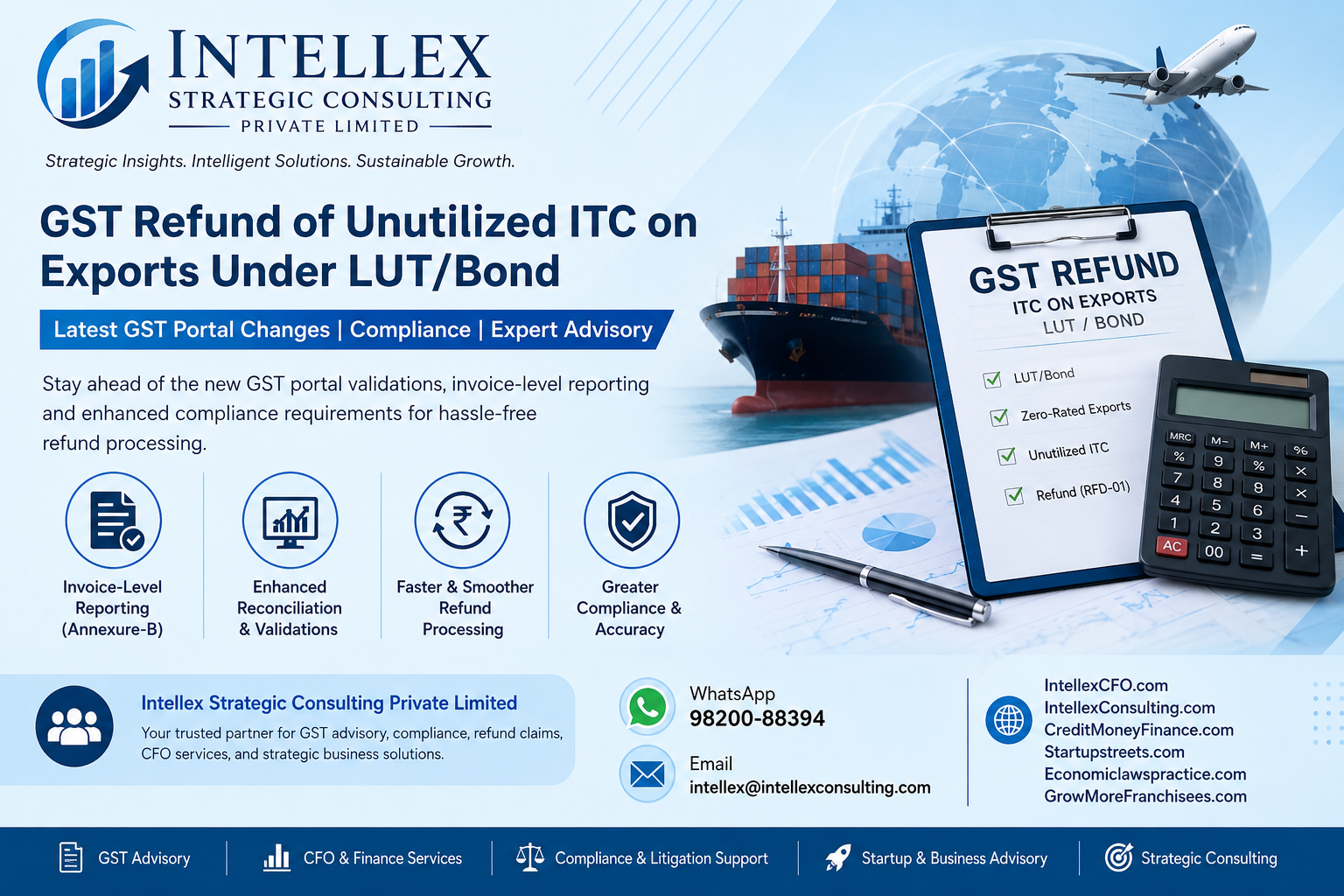
GST Refund of Unutilized Input Tax Credit (ITC) on Exports Under LUT/Bond: Important GST Portal Changes Every Exporter Must Know.
Learn about the latest GST portal changes for refund of unutilized ITC on exports under LUT/Bond. Understand new validations, Annexure-B reporting, reconciliation requirements, and how Intellex Strategic Consulting Private Limited can help businesses secure faster GST refunds.
GST Refund Rules Have Become More Compliance-Driven
India’s export ecosystem has witnessed significant procedural changes in the GST refund process relating to the refund of unutilized Input Tax Credit (ITC) for zero-rated exports made without payment of Integrated GST under a Letter of Undertaking (LUT) or Bond.
Recent enhancements on the GST Portal have introduced stricter validations, invoice-level reporting, and deeper system-driven reconciliations. While these changes are intended to improve transparency and expedite genuine refund claims, they also increase compliance obligations for exporters and businesses claiming large GST refunds.
For exporters, manufacturers, merchant exporters, software companies, service exporters, SEZ suppliers, and businesses with accumulated ITC balances, understanding these changes is critical to avoiding delays, deficiency memos, and refund rejections.
Earlier Position: Greater Flexibility in Claiming GST Refunds
Under Rule 89(4) of the CGST Rules and the applicable GST Circulars, taxpayers enjoyed considerable flexibility while filing refund applications.
For example:
- Maximum Eligible Refund: ₹100 Crore
- Refund Claimed: ₹90 Crore
- Balance ₹10 Crore remained available in the Electronic Credit Ledger (ECL)
This enabled businesses to:
- Manage future GST liabilities efficiently.
- Maintain adequate ITC balances.
- Optimize working capital.
- Plan cash flows strategically.
The flexibility was particularly useful for exporters having continuous domestic GST liabilities.
What Has Changed on the GST Portal?
The GST Portal has now implemented enhanced validations aimed at ensuring greater accuracy and consistency in refund claims.
Some of the major procedural changes include:
1. Mandatory Invoice-Level Reporting
Taxpayers are now required to furnish detailed invoice-wise information through Annexure-B using the prescribed JSON Utility.
This significantly improves transaction-level verification.
2. Enhanced Data Reconciliation
Refund applications are now subjected to automated reconciliation with:
- GSTR-1
- GSTR-2B
- GSTR-3B
- Shipping Bills
- Export General Manifest (EGM)
- Bank Realisation Certificate (BRC)
- Foreign Inward Remittance Certificate (FIRC), wherever applicable
- Electronic Credit Ledger balances
Even minor mismatches may trigger validation errors.
3. Validation of Eligible Refund
The system now computes eligible refund based on statutory formulae and available ITC balances.
Where sufficient ITC exists, taxpayers are generally expected to claim refund closer to the eligible amount.
4. Increased Scrutiny of Partial Refund Claims
Although the law may still permit partial refund claims in appropriate cases, substantial retention of ITC in the Electronic Credit Ledger while seeking refund could invite additional portal validations and departmental scrutiny.
Practical Illustration
Suppose a taxpayer is eligible for a refund of ₹100 Crore.
Earlier:
- Refund claimed: ₹90 Crore
- ITC retained: ₹10 Crore
Current Scenario:
If adequate ITC balance exists, the GST Portal may expect the taxpayer to claim refund substantially closer to the eligible amount.
Retaining large balances may require stronger justification and could result in additional verification before processing.
Impact on Exporters
The latest procedural changes are expected to have a significant impact on GST compliance and cash flow management.
Key implications include:
- Reduced flexibility in retaining Input Tax Credit.
- Increased documentation requirements.
- Greater invoice-level scrutiny.
- More comprehensive reconciliation procedures.
- Enhanced importance of maintaining accurate GST records.
- Potential delays if discrepancies are identified.
- Improved processing of genuine and fully compliant refund claims.
Businesses that fail to reconcile their GST data properly may face deficiency memos, notices, or partial rejection of refund applications.
Best Practices Before Filing GST Refund Application (Form GST RFD-01)
Exporters should undertake a comprehensive review before filing refund claims.
Recommended checklist:
✔ Verify Electronic Credit Ledger balances.
✔ Ensure Annexure-B has been prepared correctly using the latest JSON utility.
✔ Reconcile GSTR-1, GSTR-2B and GSTR-3B.
✔ Match Shipping Bills with Export General Manifest (EGM).
✔ Verify BRC/FIRC wherever applicable.
✔ Ensure LUT for the relevant financial year is valid.
✔ Review future GST liabilities before determining the refund amount.
✔ Conduct a detailed internal reconciliation to identify mismatches in advance.
Proper planning can significantly reduce processing time and improve the chances of successful refund sanction.
Why Professional Assistance Is Now More Important Than Ever
With GST refund processing becoming increasingly technology-driven and compliance-intensive, professional review before filing refund applications has become essential.
Businesses claiming high-value refunds should ensure that every aspect of their application is thoroughly verified, reconciled, and documented to minimise the risk of objections, deficiency memos, and delays.
Professional advisory support can help businesses:
- Prepare accurate refund applications.
- Conduct complete GST reconciliations.
- Review ITC eligibility.
- Manage departmental notices.
- Improve refund processing timelines.
- Develop tax-efficient GST strategies.
How Intellex Strategic Consulting Private Limited Can Help
Intellex Strategic Consulting Private Limited is a leading professional consulting firm offering comprehensive GST, taxation, finance, corporate advisory, and compliance solutions for businesses across India.
Our team assists exporters, manufacturers, service providers, startups, SMEs, and large enterprises in successfully managing GST refund claims, tax compliance, and strategic financial planning.
Our Services Include:
- GST Refund Advisory
- Export GST Compliance
- Input Tax Credit Review
- GST Litigation Support
- GST Registration & Compliance
- Internal GST Health Checks
- CFO & Virtual CFO Services
- Startup Advisory
- Corporate Finance
- Business Restructuring
- Strategic Consulting
Contact Us
Intellex Strategic Consulting Private Limited
📱 WhatsApp: 98200-88394
📧 Email: intellex@intellexconsulting.com
🌐 Websites:
• IntellexCFO.com
• IntellexConsulting.com
• CreditMoneyFinance.com
• Startupstreets.com
• Economiclawspractice.com
• GrowMoreFranchisees.com
Our experienced professionals are committed to helping businesses navigate complex GST regulations while maximizing compliance, improving cash flows, and ensuring smooth refund processing.
Conclusion
The GST refund framework for exports under LUT/Bond has evolved into a far more compliance-driven system with enhanced validations and automated reconciliations. Exporters should proactively strengthen their documentation, reconciliation processes, and refund planning strategies to avoid delays and ensure timely receipt of legitimate refunds.
Partner with Intellex Strategic Consulting Private Limited for expert GST advisory and end-to-end refund support, enabling your business to stay compliant, efficient, and financially optimized.
Intellex Strategic Consulting Pvt Ltd
More Featured Articles:
How Businesses in the UAE Can Stay Ahead of Compliance Demands in 2026.