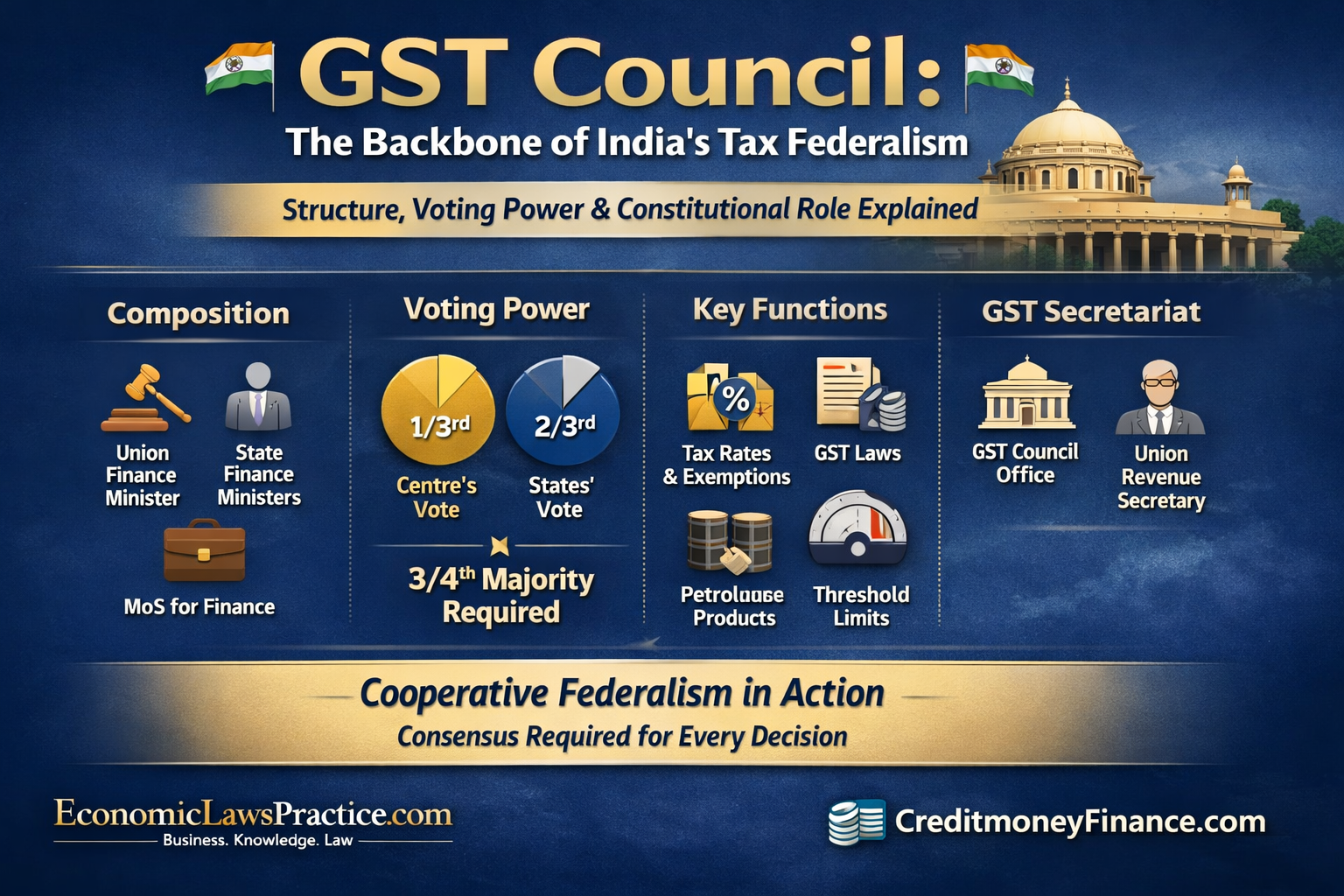
GST Council: The Backbone of India’s Tax Federalism – Structure, Voting Power & Constitutional Role Explained.
Explore the structure, voting mechanism, and constitutional role of India’s GST Council under Article 279A. Understand how it drives cooperative federalism and shapes GST policy across the nation.
Introduction
The GST Council, established under Article 279A of the Constitution of India, stands as the cornerstone of India’s indirect tax regime. It embodies the vision of “One Nation, One Tax” by ensuring uniformity, cooperation, and consensus between the Centre and the States.
This institutional framework represents one of the most significant examples of cooperative federalism in modern fiscal governance.
1. Composition of the GST Council
The GST Council is a joint constitutional body representing both the Union and State Governments.
- Chairperson: Union Finance Minister
- Member: Union Minister of State (Finance/Revenue)
- Members: Finance/Taxation Ministers nominated by each State Government
This inclusive structure ensures that every State has a voice in shaping GST policy, making it a truly federal decision-making platform.
2. Voting Power & Decision-Making Mechanism
The GST Council follows a unique weighted voting system, ensuring balance between the Centre and States.
- Decision Threshold: Minimum 3/4th majority of weighted votes of members present and voting
- Central Government: Holds 1/3rd weightage
- State Governments (collectively): Hold 2/3rd weightage
- Quorum Requirement: At least 50% of total members must be present
Key Insight
This structure ensures that:
- The Centre cannot dominate decisions unilaterally, and
- The States cannot pass decisions without Central support
👉 In effect, consensus is not just preferred — it is structurally enforced.
3. Key Functions & Powers of the GST Council
The Council plays a decisive role in shaping India’s GST framework through its recommendations:
a) Tax Rates & Structure
- निर्धination of GST slabs, floor rates, and special rates
- Emergency rate adjustments (e.g., during natural calamities)
b) Exemptions
- Identification of goods and services exempt from GST
- Periodic rationalisation of exemption lists
c) Legislative Framework
- Recommends Model GST Laws
- Defines principles of levy and Place of Supply rules
d) Threshold Limits
- Fixes turnover limits for GST registration and composition schemes
e) Inclusion of Petroleum Products
- Determines the timeline for bringing petrol, diesel, natural gas, and ATF under GST
4. The Administrative Backbone: GST Council Secretariat
To facilitate its operations, the GST Council is supported by a dedicated Secretariat based in New Delhi.
- Ex-officio Secretary: Union Revenue Secretary
- Permanent Invitee: Chairperson, CBIC (non-voting)
- Staff Composition: Officers on deputation from both Central and State Governments
This administrative mechanism ensures efficient coordination, policy drafting, and implementation support.
5. The Core Objective: Cooperative Federalism in Action
The GST Council exemplifies a delicate balance of fiscal powers, where:
- Neither the Centre nor the States can act independently
- Policy decisions require collaboration and consensus
- A harmonized national market is maintained
It is widely regarded as a global model of fiscal federalism, blending autonomy with unity.
Did You Know?
No decision in the GST Council can be passed without mutual agreement , the 3/4th majority rule effectively gives both the Centre and States a veto-like influence, ensuring balanced governance.
Conclusion
The GST Council is not merely a tax body, it is a constitutional institution that safeguards India’s fiscal unity while respecting federal diversity. Its design ensures that tax policy remains stable, predictable, and inclusive, reinforcing investor confidence and economic integration.
Team: EconomicLawsPractice.com
More Featured Articles:
GSTN Advisory: Key Enhancements in GSTR-3B Reporting (Effective January 2026).
Finance Bill 2026 to Revolutionize GST with Faster Registration and 90% Automatic Refunds
CBIC Clarifies GST Registration Requirements for Warehouses Across States
Ultimate Guide to Singapore Company Registration 2026: Rules, Costs, and Compliance.
One thought on “GST Council: The Backbone of India’s Tax Federalism – Structure, Voting Power & Constitutional Role Explained.”