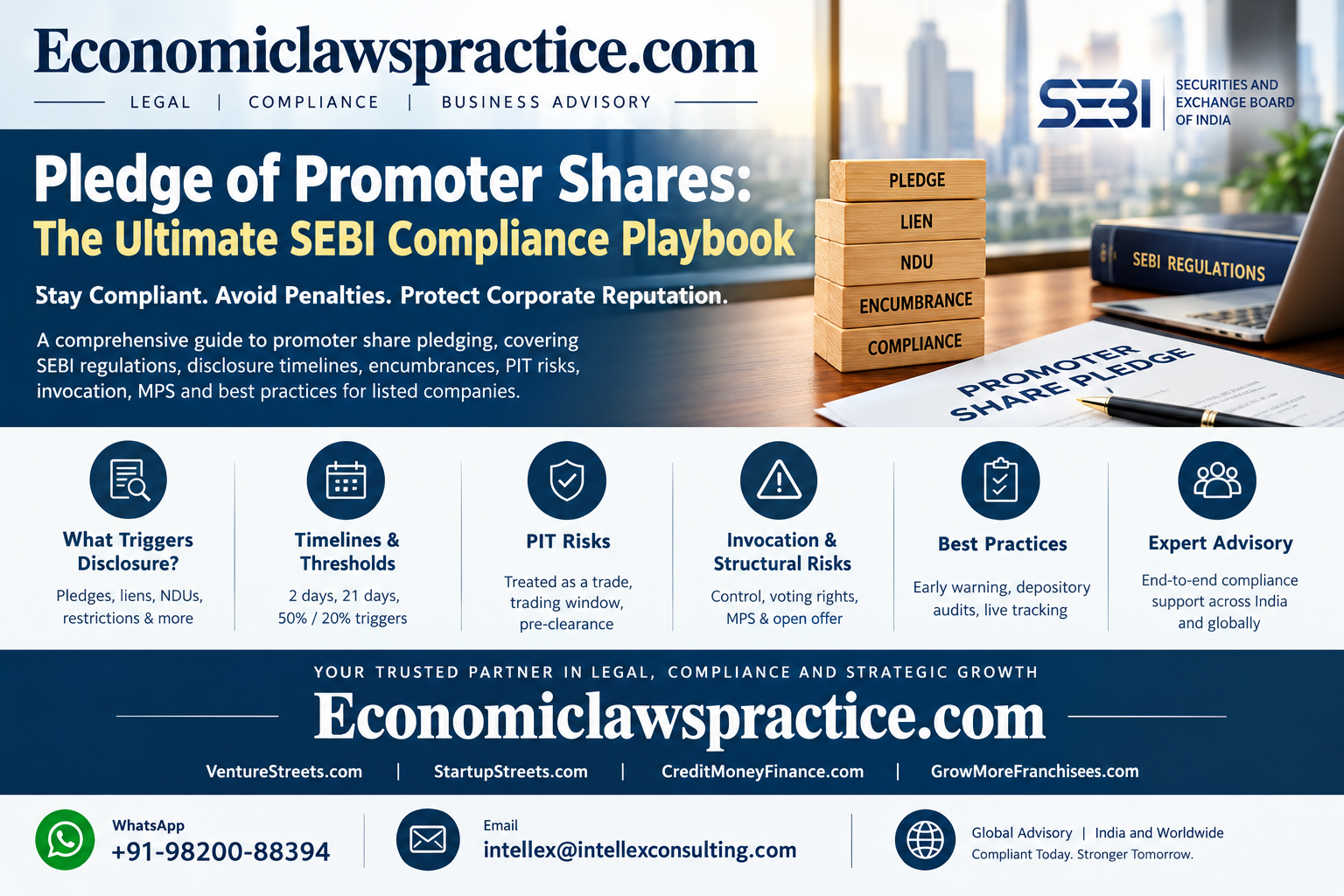
Pledge of Promoter Shares in India: SEBI Compliance, Disclosure Timelines, PIT Risks, Encumbrance Rules & Invocation Guide.
A detailed guide to promoter share pledging compliance under SEBI SAST, LODR and PIT Regulations, covering encumbrances, disclosures, timelines, NDUs, trading-window risks, invocation, MPS and compliance best practices.
Introduction: Why Promoter Share Pledging Is More Than a Financing Transaction
Promoter share pledging is a widely used mechanism for raising finance without immediately selling an equity stake. A promoter may pledge shares to a bank, NBFC, financial institution, debenture trustee or another lender as security for a loan or other financial obligation.
From a financing perspective, the arrangement can appear straightforward:
Promoter shares → Security to lender → Financing obtained
From a listed-company compliance perspective, however, the transaction can create a much broader regulatory chain involving:
- SEBI (Substantial Acquisition of Shares and Takeovers) Regulations, 2011;
- SEBI (Listing Obligations and Disclosure Requirements) Regulations, 2015;
- SEBI (Prohibition of Insider Trading) Regulations, 2015;
- Depositories Act and depository regulations;
- applicable SEBI circulars and disclosure formats;
- stock-exchange filing requirements; and
- potentially, takeover, minimum-public-shareholding and governance consequences.
SEBI’s definition of “encumbrance” is deliberately broad. It covers not merely a conventional pledge but restrictions on free and marketable title, pledges, liens, negative liens, non-disposal undertakings and other arrangements in the nature of an encumbrance.
That is why a sophisticated compliance function should not ask only:
“Has the promoter pledged shares?”
It should ask:
“Has anything been created that restricts the promoter’s ability to freely deal with the shares or creates a risk that a third party may appropriate or sell them?”
1. What Exactly Constitutes an Encumbrance?
Regulation 28(3) of the SAST Regulations provides a broad framework for identifying encumbrances.
The concept encompasses:
1. Traditional pledge
The most familiar structure is a pledge of shares in favour of a lender.
For example:
Promoter owns 20% of the listed company → pledges 5% of the company’s equity to a bank → bank obtains security over those shares.
This is clearly within the regulatory framework.
2. Lien
A lien or similar restriction can also constitute an encumbrance.
The compliance team should therefore examine the substance of the arrangement rather than relying solely on the title used in the agreement.
3. Negative lien
A negative lien may restrict the promoter from creating another security or dealing freely with identified securities.
Such arrangements require careful review.
4. Non-Disposal Undertaking — NDU
An NDU is particularly important because it may exist even where there is no conventional pledge.
SEBI has specifically recognised NDUs as falling within the scope of promoter encumbrance disclosures. SEBI’s framework describes NDUs as undertakings not to transfer or otherwise alienate securities, typically in favour of a lender.
5. Other contractual arrangements
The compliance team should also examine:
- lock-in arrangements;
- escrow arrangements;
- security agreements;
- voting restrictions;
- transfer restrictions;
- non-disposal clauses;
- lender-controlled arrangements;
- covenants restricting transfer; and
- other contractual mechanisms that may effectively encumber shares.
The key principle is substance over nomenclature.
2. The First Compliance Question: What Happened to the Shares?
A compliance team should establish a complete transaction chronology.
For every promoter financing arrangement, record:
| Compliance Point | Information to Capture |
|---|---|
| Promoter | Name of promoter/PAC |
| Security provider | Promoter/entity providing shares |
| Lender/security trustee | Name and legal capacity |
| Shares affected | Number of shares |
| % of promoter holding | Percentage |
| % of total share capital | Percentage |
| Date of creation | Exact date |
| Nature | Pledge/lien/NDU/other |
| Loan amount | Amount secured |
| Purpose | End-use |
| Security cover | Applicable ratio |
| Margin call | Trigger and threshold |
| Invocation rights | Contractual terms |
| Release | Date and number of shares |
| Invocation | Date and number of shares |
| Sale following invocation | Details |
| Disclosures | Date and filing reference |
This becomes particularly important when a lender has contractual rights to invoke securities following a default.
3. Regulation 31 of SAST: The Core Disclosure Mechanism
Promoters of listed companies must pay particular attention to Regulation 31 of the SAST Regulations.
The disclosure framework covers:
- creation of encumbrance;
- invocation of encumbrance; and
- release of encumbrance.
The regulatory framework has evolved over time, so compliance teams should use the currently applicable version of the regulations and prescribed filing formats, rather than relying on older checklists.
SEBI’s regulations database identifies the SAST Regulations as the 2011 regulations, with amendments continuing through December 2025.
Practical compliance principle
Do not treat pledge creation as the only reportable event.
The lifecycle is:
Creation → Modification/continuation where applicable → Invocation → Release → Subsequent sale/transfer
Each event should be independently evaluated.
4. Quick Reference: Important Compliance Timelines
A listed-company compliance calendar should distinguish between promoter-level filings and company-level filings.
Promoter disclosure
For applicable creation, invocation and release events, the promoter’s disclosure obligation under the current Regulation 31 framework should be tracked against the prescribed two-working-day timeline.
Listed-company disclosure
After receiving the promoter’s disclosure, the listed entity must also monitor its corresponding stock-exchange disclosure obligation.
Quarterly shareholding pattern
The listed entity must submit the shareholding pattern within the applicable timeline under Regulation 31 of LODR. SEBI materials describe the quarterly shareholding-pattern requirement as submission within 21 days from the end of the quarter.
Important compliance warning
The existence of automated depository reporting does not mean that the company should abandon its independent compliance controls.
A robust system should reconcile:
Promoter communication + Depository records + RTA data + Stock Exchange filings + SAST disclosure + PIT disclosure
5. The 50% / 20% Enhanced Disclosure Trigger
One of the most important promoter-pledge thresholds is the additional disclosure of the reasons for encumbrance.
Under SEBI’s 2019 framework, detailed reasons are required where combined encumbrance of the promoter and persons acting in concert reaches or exceeds:
Threshold A
50% or more of the promoter/PAC shareholding
OR
Threshold B
20% or more of the company’s total share capital
These are alternative triggers.
In other words, crossing either threshold can activate the additional reasons-for-encumbrance disclosure requirement.
This is an area where compliance teams should maintain a running cumulative calculation, rather than checking the threshold only when a new pledge is created.
Example
Suppose:
- Promoter + PAC holding = 60% of the company.
- Existing encumbrance = 25% of promoter holding.
- New pledge = 30% of promoter holding.
The combined encumbrance becomes 55% of promoter/PAC holding.
The 50% threshold has therefore been crossed and the additional disclosure analysis becomes necessary.
6. Why the Reason for Encumbrance Matters
SEBI’s enhanced disclosure framework is intended to provide investors with greater visibility into why promoter shares have been encumbered.
The disclosure can provide information such as:
- amount of debt;
- purpose of borrowing;
- nature of the lender;
- security arrangement;
- percentage of promoter holding encumbered;
- percentage of total share capital encumbered;
- end use of funds; and
- other relevant details.
This transforms promoter pledging from a purely private financing arrangement into an important market-disclosure event.
7. The Cyquator Media Services Case: A Critical Compliance Lesson
The consequences of overlooking pledge disclosures can be seen in SEBI’s enforcement history.
In February 2026, SEBI issued an adjudication order concerning Cyquator Media Services Private Limited, relating to disclosure failures involving pledged shares of Zee Entertainment Enterprises.
SEBI imposed a monetary penalty in the matter; contemporary reporting states that the penalty was ₹4 lakh and that the case involved failures concerning creation and subsequent invocation of a pledge.
The important compliance lesson is not merely the amount of the penalty.
It is the event lifecycle.
A promoter cannot treat pledge creation and lender invocation as entirely outside its compliance responsibility simply because the lender exercises contractual rights.
Compliance takeaway
A promoter’s compliance framework should be designed to know:
- when the pledge is created;
- when a default occurs;
- when a lender becomes entitled to invoke;
- when invocation actually occurs;
- how many shares are invoked;
- whether shares are subsequently transferred or sold; and
- what disclosures are triggered by each event.
The fact that the lender has operational control over the invocation process does not eliminate the need for the promoter and its advisers to have appropriate monitoring mechanisms.
8. The PIT Regulations: The Hidden Compliance Layer
One of the most frequently overlooked aspects of share pledging is the insider-trading framework.
SEBI’s comprehensive PIT FAQs specifically state that creation, invocation and revocation of a pledge can fall within the concept of trading under the PIT Regulations.
This is critical.
A promoter may think:
“I am not selling shares. I am only pledging them.”
That does not end the PIT analysis.
9. Why the Trading Window Matters
The compliance team must examine the trading-window position and whether the relevant transaction is permissible under the applicable PIT framework.
SEBI’s PIT FAQ provides an important nuance: creation, revocation and invocation of a pledge are not automatically prohibited merely because a trading window is closed. The relevant person may need to establish the applicable circumstances and, where relevant, demonstrate that the transaction was bona fide under the regulatory framework.
Therefore, the simplistic internal rule:
“Pledge = always prohibited during trading-window closure”
can be misleading.
The better compliance rule is:
Pledge transaction = mandatory PIT review before execution.
That review should consider:
- whether the person possesses UPSI;
- trading-window status;
- pre-clearance requirements;
- bona fide circumstances;
- applicable exceptions;
- disclosure obligations; and
- documentation supporting the decision.
10. System-Driven Disclosures Do Not Replace Human Oversight
India’s securities-market infrastructure increasingly relies on technology and depository systems.
SEBI’s February 2026 circular concerning creation/invocation of pledges through the depository system provides for standardised processes and requires the depositories to notify the pledgor and pledgee when invocation occurs, including confirmation that the pledgee has been recorded as beneficial owner under the applicable depository framework.
This is an important development.
However, automation should be treated as a control layer, not a substitute for governance.
A compliance department should still reconcile:
Depository data → Promoter declarations → RTA records → Exchange filings → SAST disclosures → PIT records
Any mismatch should generate an exception alert.
11. What Happens When a Pledge Is Invoked?
Invocation is substantially more consequential than ordinary pledge creation.
Under the depository framework, upon invocation the pledgee is recorded as the beneficial owner, subject to the applicable legal framework and transaction mechanics. SEBI’s February 2026 circular specifically addresses notification of invocation and recording of the pledgee as beneficial owner.
The compliance team therefore needs to immediately assess:
1. Change in beneficial ownership
Who now holds the shares?
2. Voting rights
How does the transaction affect voting rights and control?
3. Promoter holding
What percentage remains with the promoter?
4. Promoter-group position
Does the event change promoter/PAC classification or holdings?
5. SAST implications
Does the lender’s acquisition create a takeover-regulation issue?
6. MPS implications
Does the transaction alter the company’s public/non-public shareholding composition?
12. Does Invocation Automatically Trigger an Open Offer?
Not necessarily.
This is an important area where compliance analysis must be fact-specific.
A lender’s acquisition following pledge invocation can require examination under the SAST framework, including applicable acquisition thresholds and exemptions.
The analysis should consider:
- identity and regulatory status of the lender;
- percentage of voting rights acquired;
- whether the lender is acting independently;
- whether an exemption applies;
- whether shares are subsequently sold;
- acquisition history;
- PAC relationships; and
- other relevant SAST provisions.
Accordingly, a compliance team should not assume either that an open offer is automatically required or that it is automatically exempt.
A specific legal analysis should be completed before or immediately upon invocation.
13. Minimum Public Shareholding — The 25% Check
Listed companies generally need to maintain the applicable minimum public shareholding requirements under Rule 19A of the Securities Contracts (Regulation) Rules and Regulation 38 of LODR. SEBI materials consistently identify 25% as the general minimum public-shareholding requirement for listed companies, subject to applicable exceptions and transitional/special provisions.
Therefore, after an invocation, the company should perform an MPS analysis.
However, the calculation must be based on the actual regulatory classification of the new holder and the specific transaction.
The compliance team should not simply assume:
“Lender received shares = public shareholding increases.”
Nor should it assume the opposite.
The classification of the shareholder under applicable securities laws is critical.
14. The Compliance Dashboard Every Listed Company Should Maintain
A useful promoter-encumbrance dashboard can contain the following fields:
| Field | Monitoring Requirement |
|---|---|
| Promoter/PAC name | Live |
| Total promoter holding | Updated |
| Total encumbered shares | Updated |
| Encumbrance % of promoter holding | Daily/weekly |
| Encumbrance % of total capital | Daily/weekly |
| Lender | Updated |
| Security trustee | Updated |
| Loan amount | Updated |
| Security cover | Updated |
| Margin call level | Monitored |
| Default trigger | Monitored |
| Invocation right | Documented |
| NDU | Yes/No |
| Pledge | Yes/No |
| Lien | Yes/No |
| Release date | Tracked |
| Filing due date | Automated |
| Filing completed | Yes/No |
| Exchange acknowledgement | Recorded |
| PIT review | Completed |
| MPS impact | Reviewed |
| SAST impact | Reviewed |
This transforms pledge compliance from a reactive process into a continuous control system.
15. The Early-Warning System
A sophisticated listed-company compliance department should not learn about promoter financing only when the depository records a transaction.
The promoter group, family office, CFO, treasury team and company-secretarial function should have a defined escalation protocol.
Recommended escalation chain
Term Sheet
↓
Financing Proposal
↓
Security Structure
↓
Compliance Review
↓
PIT Review
↓
Legal Review
↓
Board/Committee approvals where applicable
↓
Depository Execution
↓
Exchange/SAST/PIT disclosures
This can prevent the classic problem:
“We received the information after the transaction had already happened.”
16. Weekly Depository Reconciliation
For companies with significant promoter holdings or frequent promoter financing activity, a periodic reconciliation can be valuable.
The company can compare:
- promoter demat balances;
- pledge balances;
- NDU records;
- depository transaction data;
- RTA records;
- promoter declarations;
- exchange disclosures.
The objective is not merely to identify an incorrect shareholding number.
It is to identify unreported encumbrances before they become regulatory exceptions.
17. Monitor Margin Calls — Not Just Pledges
One of the most important practical improvements is to monitor the financing arrangement itself.
For every promoter financing transaction, the compliance function should understand:
Loan amount
How much has been borrowed?
Security cover
What is the required collateral cover?
Margin-call threshold
At what share price does additional collateral become necessary?
Top-up obligation
Can the promoter be required to provide more shares?
Invocation trigger
Under what circumstances can the lender invoke?
Sale mechanism
Can the lender sell immediately after invocation?
Notice requirement
What notice, if any, must be given?
Cross-default
Can a default under another financing arrangement trigger this pledge?
These provisions may materially affect the risk of sudden promoter-share movements.
18. Promoter Pledge Is Also a Corporate-Governance Signal
From an investor-relations perspective, promoter encumbrance is not merely a statutory filing.
Investors may interpret substantial promoter encumbrance as relevant to:
- promoter liquidity;
- leverage;
- financial stress;
- refinancing requirements;
- control risk;
- potential forced selling;
- share-price volatility; and
- corporate-governance considerations.
That does not mean that every pledge represents financial distress.
Promoters may pledge shares for legitimate purposes such as:
- business expansion;
- acquisition financing;
- working capital;
- capital expenditure;
- refinancing;
- investment in subsidiaries;
- general corporate purposes; or
- other documented financing requirements.
The important principle is transparent disclosure and continuous monitoring.
19. Five Questions Every Compliance Officer Should Ask
Before allowing a promoter-share financing transaction to proceed, ask:
Question 1
Does the arrangement constitute an encumbrance?
Do not restrict the analysis to the word “pledge.”
Question 2
What SAST disclosure is required?
Check creation, invocation, release and reasons-for-encumbrance requirements.
Question 3
What PIT implications arise?
Review UPSI, trading-window status, pre-clearance and applicable exceptions.
Question 4
What happens if the lender invokes?
Assess beneficial ownership, voting rights, SAST, MPS and subsequent-sale implications.
Question 5
Can we prove that we monitored the transaction?
A strong compliance framework should leave a clear audit trail.
20. A Practical Promoter Pledge Compliance Checklist
Before execution:
☐ Identify all promoters and PACs
☐ Review promoter shareholding
☐ Identify all existing encumbrances
☐ Review proposed pledge/NDU/lien
☐ Review financing agreement
☐ Identify lender/security trustee
☐ Calculate combined encumbrance
☐ Test 50% promoter/PAC threshold
☐ Test 20% total-share-capital threshold
☐ Review PIT implications
☐ Check UPSI status
☐ Check trading-window position
☐ Determine required pre-clearances
☐ Determine disclosure forms
☐ Establish filing responsibility
☐ Establish invocation monitoring mechanism
After execution:
☐ Confirm depository creation
☐ Confirm promoter disclosure
☐ Confirm company disclosure
☐ Confirm stock-exchange filing
☐ Update encumbrance register
☐ Update internal dashboard
☐ Update investor-relations records where appropriate
☐ Monitor margin calls
☐ Monitor defaults
☐ Monitor invocation notices
☐ Reconcile depository data
After invocation:
☐ Confirm invocation date
☐ Confirm number of shares invoked
☐ Confirm beneficial-owner change
☐ Evaluate SAST implications
☐ Evaluate MPS implications
☐ Evaluate PIT implications
☐ Complete required disclosures
☐ Monitor subsequent sale/transfer
☐ Preserve complete documentary evidence
21. The Role of Professional Compliance Advisors
Promoter share pledging sits at the intersection of:
Corporate Finance + Securities Law + Corporate Governance + Stock Exchange Compliance + Insider Trading + Depository Operations
This makes it particularly important for listed companies to have a coordinated approach.
A professional advisory team can assist with:
- promoter-pledge compliance reviews;
- SAST disclosure assessment;
- encumbrance analysis;
- NDU and security-document review;
- PIT compliance coordination;
- disclosure calendars;
- promoter-group compliance systems;
- stock-exchange filing support;
- transaction monitoring;
- MPS analysis;
- financing-structure review;
- corporate-governance documentation; and
- compliance-control implementation.
Intellex Strategic Consulting Pvt Ltd — Compliance & Corporate Advisory Support
Intellex Strategic Consulting Pvt Ltd provides professional services and advisory support to businesses in India and internationally.
For listed companies, promoters, promoter groups, family offices, lenders and businesses undertaking strategic financing transactions, Intellex can support the broader commercial and compliance-management process surrounding promoter financing and corporate transactions.
Our approach is focused on helping clients establish:
Better Documentation • Better Monitoring • Better Disclosure Discipline • Better Financial Governance
Whether a business is evaluating promoter-backed financing, structured funding, corporate expansion, acquisition opportunities or other strategic transactions, having a coordinated professional advisory framework can help management identify regulatory and execution issues at an early stage.
Connect with Intellex Strategic Consulting Pvt Ltd
WhatsApp: 91-98200-88394
Email: intellex@intellexconsulting.com
Websites:
VentureStreets.com
StartupStreets.com
CreditMoneyFinance.com
GrowMoreFranchisees.com
Conclusion: Treat Promoter Pledging as a Continuous Compliance Process
Promoter share pledging should never be treated as a one-time filing exercise.
The real compliance lifecycle is:
Financing Proposal → Encumbrance Assessment → PIT Review → Execution → Disclosure → Monitoring → Margin Calls → Invocation → Ownership Analysis → MPS/SAST Review → Subsequent Sale/Release
The regulatory framework is deliberately broad because the economic effect of an encumbrance can arise through arrangements that do not carry the label “pledge.”
SEBI’s enforcement activity, including the Cyquator Media Services matter, demonstrates why listed-company compliance teams need systems that capture both creation and subsequent invocation of promoter-share security.
The objective should therefore be more than simply meeting a filing deadline.
It should be to create a live, auditable promoter-encumbrance control framework that enables the company to know what is encumbered, why it is encumbered, who has rights over the shares, what happens upon default and what regulatory consequences may follow.
For listed companies, that level of preparedness can turn promoter-pledge compliance from a reactive administrative exercise into a meaningful part of corporate governance and risk management.
Key Regulatory Sources
- SEBI — SAST Regulations and regulatory framework
- SEBI — Comprehensive FAQs on PIT Regulations
- SEBI — Creation/Invocation of Pledge Through Depository System, February 2026
- SEBI — Cyquator Media Services Adjudication Order, February 2026
- SEBI — Manner of Achieving Minimum Public Shareholding
Important: Because this is a regulatory subject and SEBI rules/circulars can be amended, the specific transaction documents and the latest applicable SEBI/stock-exchange requirements should be reviewed before relying on this article for an actual filing or transaction.
Economic Laws Practice:
The Ultimate Guide to Company Registration in Dubai 2026: Benefits, Compliance, and Costs.
Ultimate Guide to Singapore Company Registration 2026: Rules, Costs, and Compliance.
One thought on “Pledge of Promoter Shares in India: SEBI Compliance, Disclosure Timelines, PIT Risks, Encumbrance Rules & Invocation Guide.”