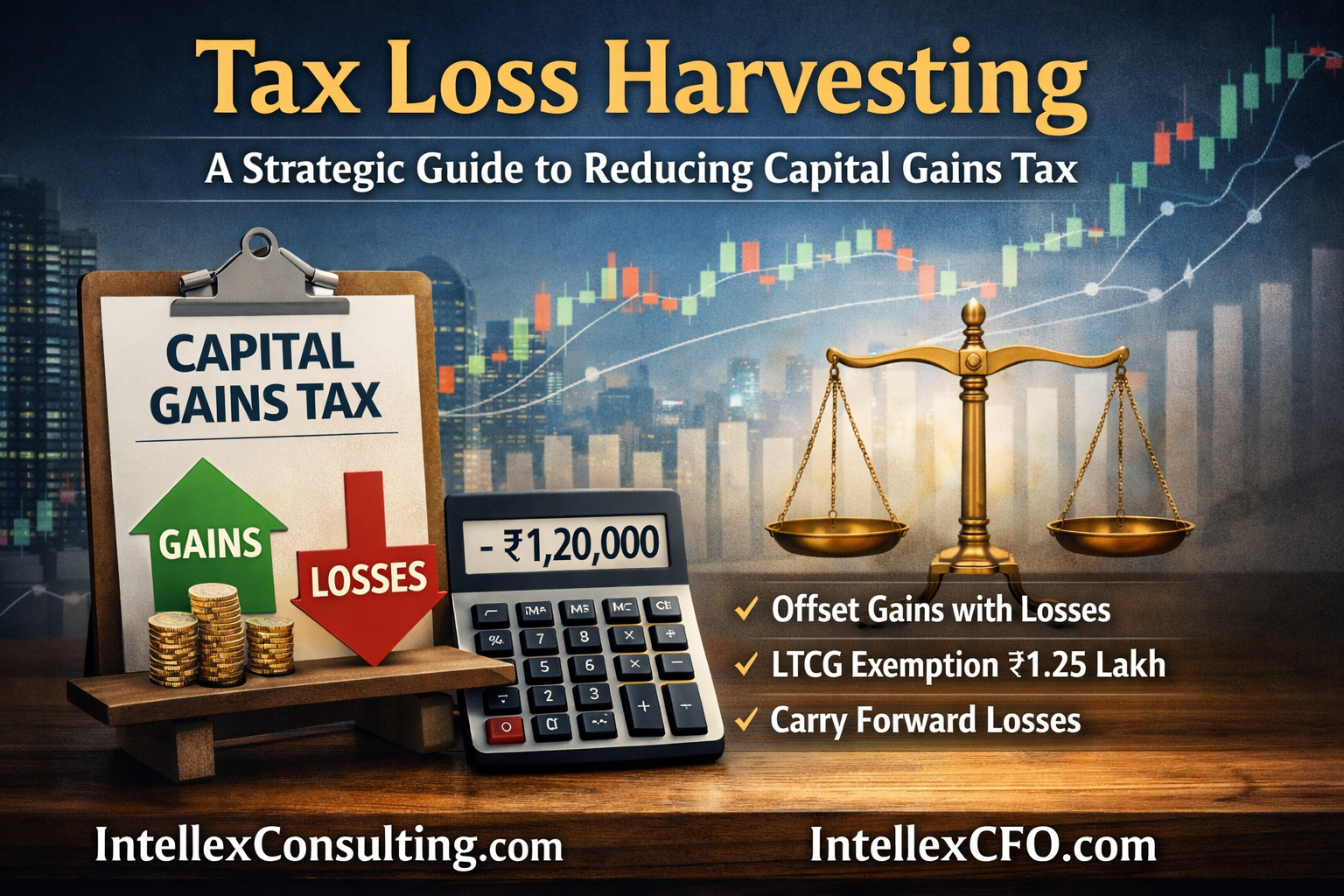
Strategic Tax Planning: Optimizing Portfolios via Tax Loss Harvesting
Learn how to optimize your investment portfolio using tax loss harvesting. Understand set-off rules, carry-forward benefits, and legal strategies to minimize capital gains tax in India.
Tax Loss Harvesting: A Strategic Guide to Reducing Capital Gains Tax
Tax Loss Harvesting is a sophisticated, legally compliant strategy designed to minimize capital gains tax liabilities. By strategically realizing losses, investors can offset taxable gains, thereby enhancing their net post-tax returns.
1. Defining Tax Loss Harvesting
Tax loss harvesting involves selling underperforming assets at a loss to neutralize capital gains realized elsewhere in your portfolio. Rather than viewing a loss as a total sunk cost, this strategy converts it into a “tax asset” to reduce your overall liability.
2. Asset Applicability
This strategy is applicable across various capital assets, including:
- Listed Equity Shares
- Equity-Oriented and Debt Mutual Funds
- Bonds and Debentures
Note: Capital losses can only be adjusted against capital gains; they cannot be set off against other income heads like salary or business income.
3. Regulatory Set-Off Provisions
Understanding the hierarchy of tax offsets is critical for compliance:
- Short-Term Capital Loss (STCL): Versatile; can be adjusted against both Short-Term (STCG) and Long-Term Capital Gains (LTCG).
- Long-Term Capital Loss (LTCL): Restricted; can only be adjusted against Long-Term Capital Gains (LTCG).
4. Practical Illustration (Equity Portfolio)
Consider an investor with the following transactions within a financial year:
- Realized STCG: ₹2,00,000
- Realized STCL: ₹1,20,000
- Net Taxable STCG: ₹80,000
By harvesting the ₹1,20,000 loss, the investor significantly reduces their taxable base, ensuring substantial tax savings.
5. Maximizing the LTCG Exemption
Under current regulations, Equity LTCG is exempt up to ₹1.25 lakh per financial year. “Tax Gain Harvesting”—the practice of selling and immediately repurchasing stocks to realize gains up to this limit allows investors to reset their cost of acquisition and reduce future tax exposure.
6. Provisions for Carrying Forward Losses
If total capital losses exceed gains in a given year, the unadjusted loss can be carried forward for up to 8 assessment years.
- Requirement: It is mandatory to file your Income Tax Return (ITR) before the original due date to preserve the right to carry forward these losses.
Also Read: Startup India Registration: Unlocking Tax Benefits and Growth
7. The “Wash Sale” Context in India
Unlike the US, Indian tax laws do not have an explicit “Wash Sale” rule. However, transactions must have commercial substance. Frequent, circular trading solely for tax evasion may be scrutinized under General Anti-Avoidance Rules (GAAR). Ensure transactions are documented and align with your broader investment objectives.
8. Optimal Implementation Window
While portfolio monitoring should be ongoing, the February–March period is the ideal window for execution. This allows for an accurate assessment of realized gains for the fiscal year and facilitates disciplined year-end rebalancing.
9. Common Pitfalls to Avoid
- Neglecting to harvest losses in stagnant or declining assets.
- Inaccurate categorization of STCL versus LTCL.
- Forfeiting carry-forward benefits due to late ITR filing.
Conclusion
Tax Loss Harvesting is a powerful lever for wealth preservation. When executed with precision, it transforms market volatility into a tax-saving opportunity, ensuring you retain a larger portion of your investment growth.
Team: IntellexCFO.com
More Featured Articles:
Funding & Investment Options to Grow India’s Real Estate & Allied Businesses
Loans Takeover proposals with enhancement of Banking limits for MSME Sector Companies
SME IPO in India 2025: Complete Guide for Investors & Growing Businesses
Loans Takeover proposals with enhancement of Banking limits for MSME Sector Companies
Why MSMEs Trust Us With Their Most Critical Financial Decisions
How Ex-Bankers Can Build a High-Income Second Career Through a Corporate DSA Partner Program
Our client looking for investment / acquisition in Logistic Sector :


2 thoughts on “Tax Loss Harvesting: A Strategic Guide to Reducing Capital Gains Tax.”