ITR Filing AY 2026-27: 5 Powerful Benefits of Filing Income Tax Returns and How to Choose the Right ITR Form.
Discover the top benefits of filing Income Tax Returns (ITR) for AY 2026-27 and learn how choosing the wrong ITR form can invalidate your return. Understand ITR-1, ITR-2, ITR-3, and ITR-4 eligibility, common mistakes, penalties, refunds, loan approvals, and compliance requirements.
ITR Filing AY 2026-27: More Than Tax Compliance – Why Filing Correctly Matters
For many taxpayers, filing an Income Tax Return (ITR) is viewed as an annual compliance requirement meant only to avoid penalties and notices from the Income Tax Department. However, this perception overlooks the substantial financial and legal benefits associated with timely and accurate tax filing.
An Income Tax Return is not merely a declaration of income. It serves as one of the most important financial documents that can influence your ability to obtain loans, claim refunds, secure visas, establish income credibility, and preserve valuable tax benefits.
At the same time, filing an ITR using the wrong return form can lead to serious consequences, including defective return notices, loss of refunds, denial of loss carry-forward benefits, and even treatment of the return as if it was never filed.
As the filing season for Assessment Year (AY) 2026-27 progresses, taxpayers must understand both the benefits of filing and the importance of selecting the correct ITR form.
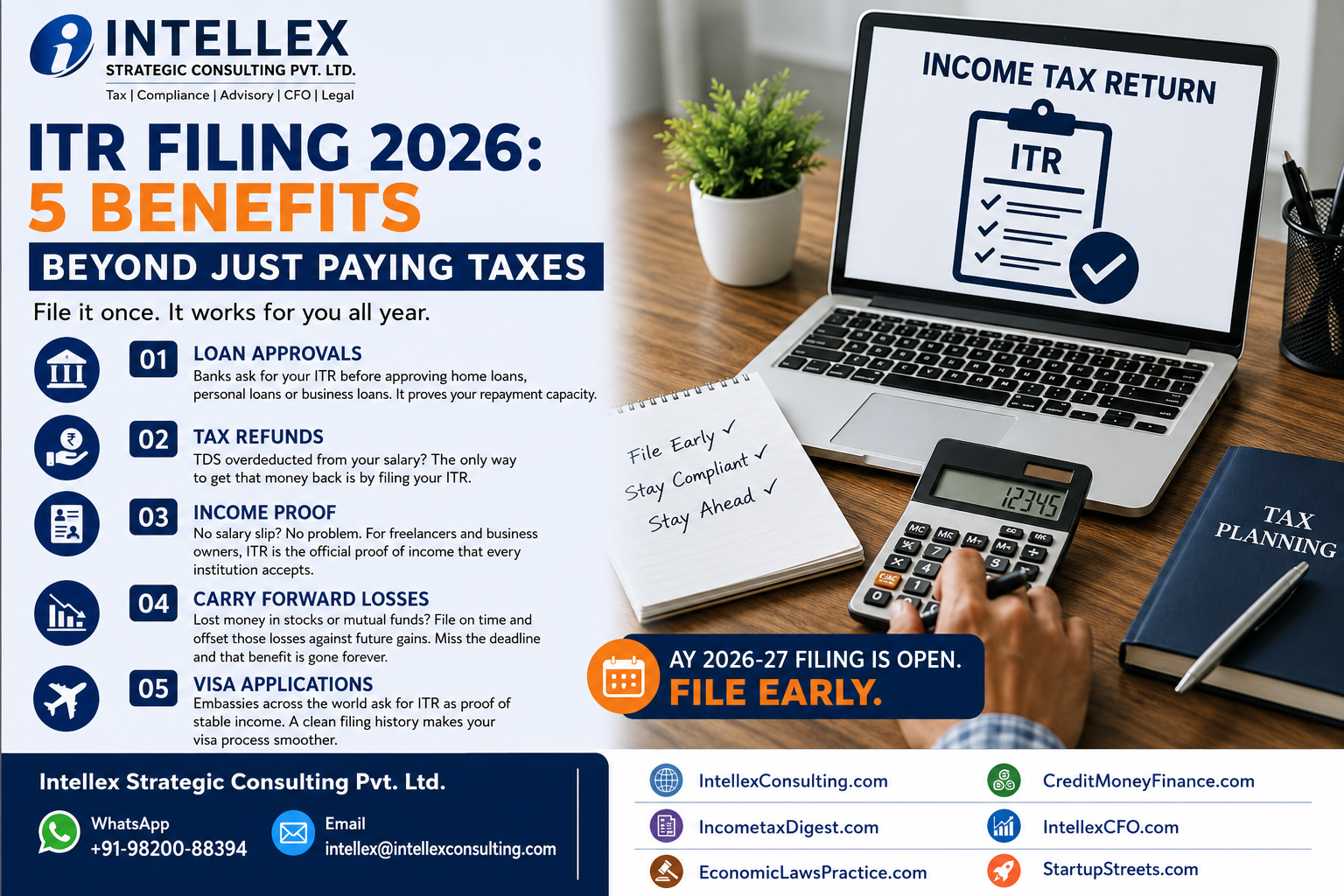
5 Major Benefits of Filing Your Income Tax Return
1. Improves Loan Eligibility and Creditworthiness
One of the most significant benefits of filing ITR is its role in securing loans from banks and financial institutions.
Whether you are applying for:
- Home loans
- Personal loans
- Business loans
- Vehicle loans
- Credit facilities
Banks generally require the last two to three years’ ITRs to assess your repayment capacity and financial stability.
For self-employed individuals, freelancers, consultants, and business owners, ITRs often serve as the primary evidence of income.
Why It Matters
A consistently filed ITR demonstrates:
- Financial discipline
- Stable income generation
- Transparent financial reporting
- Better loan eligibility
Without ITR records, obtaining higher-value loans can become difficult.
2. Enables Tax Refund Claims
Many salaried employees and professionals have excess tax deducted through:
- TDS on salary
- TDS on bank interest
- TDS on professional receipts
- Advance tax payments
The only legal method to claim such excess taxes back is by filing an Income Tax Return.
Common Situations
- Incorrect TDS deductions by employers
- Excess tax deduction by banks
- Tax-saving investments not considered during payroll processing
Failure to file the return means the refund remains unclaimed.
3. Acts as Official Proof of Income
For professionals and entrepreneurs who do not receive regular salary slips, the ITR becomes the most widely accepted proof of income.
It is frequently required for:
- Bank account openings
- Loan applications
- Credit card approvals
- Property purchases
- Government tenders
- Financial due diligence
Accepted Across Institutions
Unlike informal declarations, an ITR is:
- Government-recognized
- Legally valid
- Universally accepted
This makes it one of the strongest financial documents available to taxpayers.
4. Preserves Carry Forward of Capital and Business Losses
Many taxpayers invest in:
- Shares
- Mutual funds
- Real estate
- Business ventures
Losses arising from these investments can often be adjusted against future profits.
However, there is one critical condition:
The Return Must Be Filed Within the Due Date
Timely filing allows taxpayers to:
- Carry forward capital losses
- Carry forward business losses
- Reduce future tax liabilities
Missing the filing deadline can result in permanent loss of these tax-saving opportunities.
5. Facilitates Visa Processing and International Travel
Many foreign embassies and immigration authorities seek evidence of financial stability from visa applicants.
ITRs are often requested for:
- Tourist visas
- Business visas
- Student visas
- Long-term residency applications
Benefits During Visa Applications
A clean and consistent filing history demonstrates:
- Stable income
- Tax compliance
- Financial credibility
This can strengthen visa applications and improve approval prospects.
Choosing the Wrong ITR Form Can Invalidate Your Return
While filing an ITR is important, filing it incorrectly can create significant compliance risks.
Many taxpayers assume that if the Income Tax Portal accepts a return, the filing is valid.
This assumption is dangerous.
The Income Tax Department may subsequently issue a defect notice if the wrong form has been used.
In severe cases, the return may be treated as invalid and considered never filed.
Understanding the Correct ITR Forms for AY 2026-27
ITR-1 (SAHAJ)
Suitable For
Resident individuals with:
- Total income up to ₹50 lakh
- Salary income
- Pension income
- Interest income
- Income from up to two house properties
- Long-term capital gains under Section 112A up to ₹1.25 lakh (subject to prescribed conditions)
Not Suitable For
- Non-residents (NRIs)
- Company directors
- Holders of unlisted equity shares
- Taxpayers with foreign assets
- Taxpayers with complex capital gains
ITR-2
Suitable For
Individuals and HUFs having:
- Capital gains from shares
- Mutual fund transactions
- Property sales
- More than two house properties
- Foreign assets
- Foreign income
- Total income exceeding ₹50 lakh
- Directorship in companies
- Unlisted equity shareholdings
Example
A salaried employee who earned capital gains through stock market investments generally requires ITR-2.
ITR-4 (SUGAM)
Suitable For Presumptive Taxation
Taxpayers opting under:
Section 44AD
Businesses with turnover up to ₹3 crore (subject to prescribed digital receipt conditions).
Section 44ADA
Specified professionals with gross receipts up to ₹75 lakh.
Section 44AE
Eligible transport operators.
Additional Condition
Total income should generally not exceed ₹50 lakh.
Not Applicable To
- LLPs
- Taxpayers with complex capital gains situations
ITR-3
Suitable For
Individuals and HUFs carrying on:
- Business activities
- Professional practice
- Regular books of accounts
- Complex income structures
- Business income combined with capital gains
ITR-3 is often required where presumptive taxation provisions are not applicable.
Three Common Mistakes Taxpayers Make Every Year
Mistake 1
A salaried employee with mutual fund or stock market gains files ITR-1 instead of ITR-2.
Result
Incorrect reporting of capital gains.
Mistake 2
A freelancer using presumptive taxation earns capital gains but files ITR-4 instead of ITR-3.
Result
Incomplete disclosure of income.
Mistake 3
A director in a private company files ITR-1.
Result
Non-compliance with eligibility conditions.
Consequences of Filing the Wrong ITR Form
The impact can be substantial.
Defective Return Notice Under Section 139(9)
The department may classify the return as defective.
Taxpayers typically receive limited time to rectify defects.
Return Treated as Never Filed
Failure to correct defects may result in invalidation of the return.
This effectively places the taxpayer in a non-filer category.
Loss of Carry Forward Benefits
Capital losses and business losses may not be eligible for carry forward.
Refund Delays
Tax refunds can become significantly delayed while the return is under scrutiny.
Late Filing Fees
Additional fees under applicable provisions may become payable.
Exposure to Penalties
In cases involving under-reporting or incorrect reporting of income, penalties may apply under the Income-tax Act.
Quick Guide to Selecting the Correct ITR Form
| Income Profile | Appropriate Form |
|---|---|
| Salary, pension, interest, up to two house properties, income up to ₹50 lakh | ITR-1 |
| Capital gains, foreign assets, foreign income, income above ₹50 lakh, director | ITR-2 |
| Presumptive business/profession under Sections 44AD, 44ADA, 44AE | ITR-4 |
| Regular business income, books of accounts, complex income structure | ITR-3 |
Why Professional Review Is Recommended
Modern tax returns involve numerous reporting requirements, including:
- AIS reconciliation
- TIS verification
- Capital gains reporting
- Foreign asset disclosures
- Business income disclosures
- Tax credit matching
- Loss carry-forward claims
A professional review can help ensure:
- Correct ITR selection
- Accurate disclosures
- Faster refunds
- Reduced litigation risk
- Maximum tax efficiency
Conclusion
Income Tax Return filing is far more than an annual compliance exercise. A properly filed ITR can improve your financial credibility, facilitate loans, secure tax refunds, support visa applications, and preserve valuable tax benefits.
However, these advantages can be lost if taxpayers choose the wrong return form. Filing an incorrect ITR can trigger defect notices, delay refunds, deny loss carry-forward benefits, and even result in the return being treated as invalid.
As AY 2026-27 filing progresses, taxpayers should carefully evaluate their income profile and ensure that the correct ITR form is selected before submission. When in doubt, professional guidance can prevent costly mistakes and ensure complete compliance with tax laws.
Professional Assistance for ITR Filing and Tax Compliance
Intellex Strategic Consulting Pvt. Ltd.
For expert assistance in:
- ITR Filing for AY 2026-27
- Tax Planning
- Capital Gains Reporting
- Business Taxation
- Freelancer & Professional Tax Compliance
- Presumptive Taxation
- Income Tax Notices & Assessments
- Refund Processing
- NRI Taxation
- Corporate Tax Advisory
WhatsApp: +91 98200 88394
Email: intellex@intellexconsulting.com
Websites:
- IntellexConsulting.com
- CreditMoneyFinance.com
- IncometaxDigest.com
- IntellexCFO.com
- EconomicLawsPractice.com
- StartupStreets.com
Intellex Strategic Consulting Pvt. Ltd. provides comprehensive taxation, compliance, advisory, CFO, and regulatory support services for individuals, startups, professionals, SMEs, and corporates across India.
More Featured Articles:
How Businesses in the UAE Can Stay Ahead of Compliance Demands in 2026.
Startup India Registration: Unlocking Tax Benefits and Growth
SME IPO in India: A Comprehensive Guide for Growing Businesses Looking to Go Public
Funding & Investment Options to Grow India’s Real Estate & Allied Businesses


One thought on “ITR Filing AY 2026-27: 5 Powerful Benefits of Filing Income Tax Returns and How to Choose the Right ITR Form.”