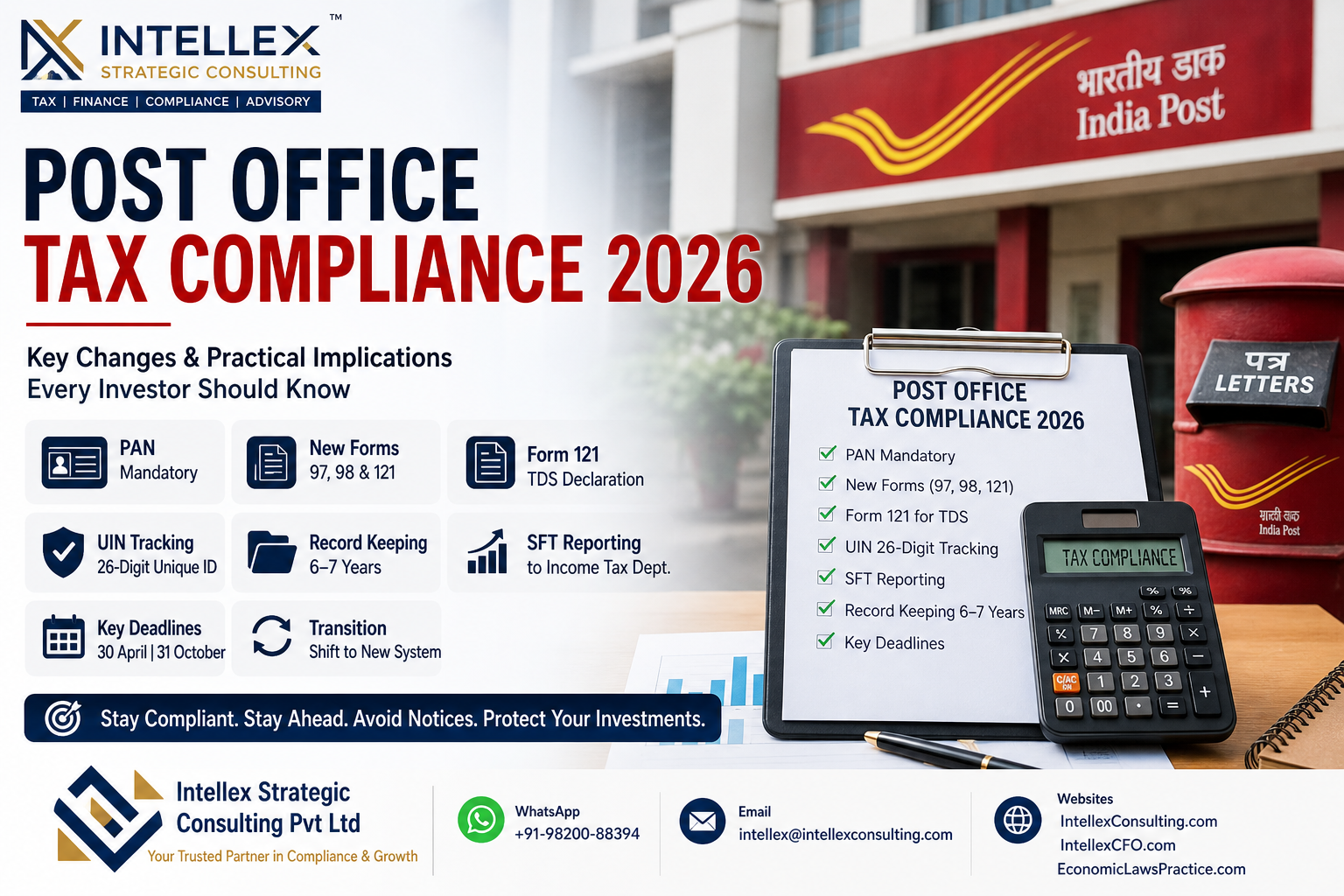
Post Office Tax Compliance 2026: Key Changes, SFT Reporting & Practical Impact on Investors.
Comprehensive guide to Post Office Tax Compliance 2026 in India—covering PAN rules, Form 121, UIN tracking, SFT reporting, deadlines, and practical implications. Stay compliant and avoid tax notices.
📌 Introduction: A New Era of Financial Transparency
India’s financial ecosystem is undergoing a structural transformation driven by digitisation, transparency, and data integration. The 2026 compliance reforms for Post Office savings schemes—administered by India Post—represent a significant step toward aligning small savings instruments with the broader tax compliance framework under the Income Tax Department.
These changes are not merely procedural—they fundamentally alter how transactions are tracked, reported, and scrutinised. For investors, depositors, and financial advisors, understanding these changes is critical to avoid penalties, notices, and compliance risks.
🔍 Why Post Office Compliance Is Tightening
Historically, Post Office schemes such as PPF, NSC, MIS, and RD were perceived as low-risk and loosely monitored from a tax reporting perspective. However, with the rise of data analytics and systems like AIS (Annual Information Statement), the government is moving toward:
- PAN-based financial tracking
- Centralised reporting via SFT
- Elimination of anonymous or unlinked transactions
- Increased scrutiny of high-value investments
The 2026 reforms bring Post Office transactions firmly into this ecosystem.
🔹 1. PAN Mandatory for Financial Transactions
The most significant change is the mandatory requirement of a Permanent Account Number (PAN) for:
- Deposits
- Withdrawals
- New investments
- Account openings
📌 Practical Implications
- Transactions without PAN may be restricted or declined
- Higher scrutiny for non-compliant accounts
- Automatic linkage with income tax records
This effectively eliminates the possibility of conducting substantial financial activities anonymously.
🔹 2. No PAN? Alternative Compliance via Form 97
Recognising that some individuals may not yet possess a PAN, the government has introduced Form 97 as a temporary compliance mechanism.
📌 Requirements
- Valid identity proof
- Declaration of financial details
- Interim compliance undertaking
📌 Practical Insight
While Form 97 provides temporary relief, it is not a long-term substitute. Obtaining a PAN is strongly recommended to avoid operational and compliance hurdles.
🔹 3. Introduction of New Compliance Forms (97, 98, 121)
The 2026 framework introduces standardised forms to replace fragmented declarations:
- Form 97 – PAN absence declaration
- Form 98 – Transaction-specific compliance
- Form 121 – TDS-related declarations
📌 Practical Implications
- Use of outdated forms may lead to rejection
- Increased standardisation improves processing efficiency
- Reduces ambiguity but requires awareness and accuracy
🔹 4. Major Shift: Form 121 Replaces Form 15G / 15H
A crucial reform is the introduction of Form 121, which replaces Form 15G/15H for certain Post Office schemes.
📌 What Changes?
- Consolidated declaration system
- Unified format for TDS exemption claims
📌 Practical Impact
- Reduces duplication across multiple accounts
- Requires careful and accurate filing
- Errors may result in unintended TDS deductions
🔹 5. UIN (Unique Identification Number) Tracking System
Every account and transaction is now linked to a 26-digit Unique Identification Number (UIN).
📌 Purpose
- End-to-end traceability
- Elimination of duplicate or hidden accounts
- Integration with tax databases
📌 Practical Insight
This system ensures that every financial footprint is digitally traceable, significantly increasing compliance accountability.
🔹 6. Mandatory Record Keeping (6–7 Years)
Taxpayers are now required to maintain detailed records for an extended duration:
📌 Documents to Retain
- Deposit receipts
- Withdrawal slips
- Form submissions (97/98/121)
- Account statements
📌 Why It Matters
- Required during scrutiny or reassessment
- Critical for resolving disputes or mismatches
Poor documentation can weaken your position in case of tax notices.
🔹 7. SFT Reporting: Automatic Disclosure to Tax Authorities
All high-value Post Office transactions will now be reported under the Statement of Financial Transactions (SFT) framework.
📌 What Is SFT?
A reporting mechanism where financial institutions share transaction data with the Income Tax Department.
📌 Impact on Taxpayers
- Transactions reflected in AIS/TIS
- Mismatches may trigger notices
- Increased risk of scrutiny for unexplained investments
📌 Practical Example
If your declared income does not justify your Post Office investments, it may lead to compliance inquiries.
🔹 8. Key Compliance Deadlines
Timely compliance is crucial to avoid penalties:
- 📅 30 April – Specific reporting and declaration deadlines
- 📅 31 October – Alignment with tax return and reporting timelines
📌 Practical Insight
Missing deadlines may result in:
- Penalties
- Invalid declarations
- Compliance flags in tax systems
🔹 9. Transition Provisions: Limited Flexibility
The government has allowed temporary acceptance of older forms and processes.
📌 However
- Gradual migration to new systems is mandatory
- Delayed transition increases compliance risk
📌 Recommendation
Adopt the new framework as early as possible to avoid last-minute disruptions.
📊 Broader Impact on Investors & Taxpayers
These reforms signal a clear shift toward:
✅ Data-Driven Compliance
Every transaction contributes to your financial profile.
✅ PAN-Based Ecosystem
Financial identity is now centralised and trackable.
✅ Increased Transparency
Reduced scope for unreported or misreported investments.
⚠️ Increased Scrutiny
Higher chances of notices for inconsistencies.
📌 Common Risks & How to Avoid Them
🚫 Risks
- AIS/TIS mismatches
- Incorrect or outdated forms
- Missing PAN linkage
- Poor documentation
✅ Mitigation
- Ensure PAN is linked to all accounts
- Use updated forms (97, 98, 121)
- Maintain records for at least 7 years
- Reconcile AIS with actual transactions
💼 How Professional Advisors Can Help
Given the complexity and increased reporting requirements, professional guidance is no longer optional for high-value or multiple Post Office investments.
📢 About Our Advisory Services
Intellex Strategic Consulting Pvt Ltd offers specialised support in tax compliance, SFT reporting, and financial structuring.
💼 Our Services Include:
- PAN linkage and compliance advisory
- SFT and AIS/TIS reconciliation
- Documentation and audit support
- Strategic tax planning for investors
- Handling income tax notices and scrutiny
📞 Contact Us:
- WhatsApp: +91-98200-88394
- Email: intellex@intellexconsulting.com
- Websites:
- IntellexConsulting.com
- IntellexCFO.com
- EconomicLawsPractice.com
📌 Final Takeaway
The Post Office Tax Compliance 2026 reforms are not just regulatory updates—they are part of India’s broader move toward a fully integrated financial intelligence system.
✔️ What You Should Do Now:
- Link your PAN immediately
- Transition to new forms
- Maintain proper documentation
- Monitor AIS/TIS regularly
- Seek professional advice when needed
Early compliance is not just safer—it is strategically smarter.
Intellex Strategic Consulting Pvt Ltd
More Featured Articles:
Income Tax Form 104: A Complete Guide to the New NPO Registration Process in India (2026).
8 Types of Tax-Free Income in India You Must Know (2026 Guide for Smart Tax Planning)
Ultimate Guide to Singapore Company Registration 2026: Rules, Costs, and Compliance.
The Ultimate Guide to Company Registration in Dubai 2026: Benefits, Compliance, and Costs.
Transfer Pricing Overhaul in India: A Complete Guide to New Form 48 (Effective FY 2026-27)


3 thoughts on “Post Office Tax Compliance 2026: Key Changes, SFT Reporting & Practical Impact on Investors.”