New Income-tax Act 2025: Key Features, Major Changes & What It Means for Taxpayers in India.
Explore the key features of the New Income-tax Act 2025 in India, including tax year concept, simplified structure, reduced sections, and major benefits for taxpayers and businesses.
Introduction
India’s tax framework is undergoing a significant transformation with the introduction of the New Income-tax Act, 2025. Designed to simplify compliance, improve transparency, and reduce litigation, this overhaul replaces decades of complex provisions with a streamlined and user-friendly structure.
This article highlights the key features, structural changes, and benefits of the new law for individuals, businesses, and professionals.
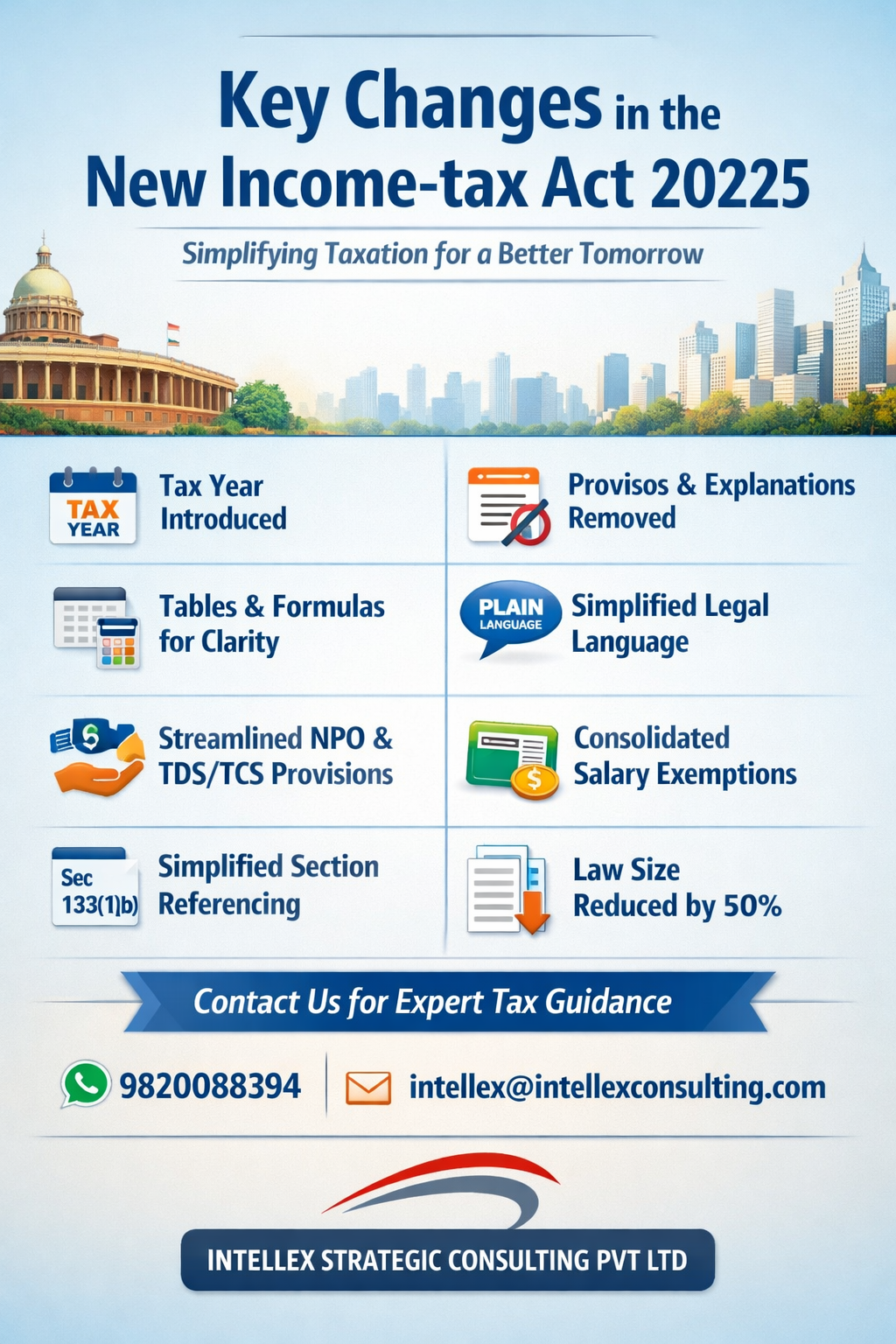
1. Introduction of “Tax Year”
One of the most notable reforms is the replacement of the dual concepts of:
Previous Year
Assessment Year
with a single unified term:
➡️ Tax Year
Why this matters:
Eliminates confusion for taxpayers and professionals
Aligns India’s tax system with global best practices
Simplifies return filing and tax planning
2. Removal of Provisos & Explanations
The new Act removes:
✅ 1200 Provisos
✅ 900 Explanations
These have been replaced with clear, standalone sub-sections.
Impact:
Reduces ambiguity and interpretation disputes
Makes provisions easier to understand
Enhances legal clarity for taxpayers and advisors
3. Use of Tables & Formulas
Tax-related information such as:
TDS (Tax Deducted at Source) rates
TCS (Tax Collected at Source) rates
Compliance timelines
are now presented using tables and structured formats.
Benefits:
Easier comprehension
Quick reference for professionals
Reduced chances of calculation errors
4. Simplified Legal Language
The Act replaces complex legal jargon with plain and simple language.
Example:
❌ “Notwithstanding”
✅ “Irrespective of”
Why it matters:
Makes the law accessible to non-experts
Reduces dependence on technical interpretation
Encourages voluntary compliance
5. Simplified Section Referencing
Old, lengthy references have been replaced with compact and logical numbering.
Example:
Old Format: Sub-clause (ii) of clause (b) of sub-section (1) of section 133
New Format: Section 133(1)(b)(ii)
Impact:
Faster navigation of provisions
Improved usability for professionals and businesses
6. Restructuring of Key Provisions
The Act introduces a more logical and structured framework:
✅ All Non-Profit Organisation (NPO) provisions consolidated into a single chapter
✅ Introduction of “Registered Non-Profit Organisation” as a unified term
✅ TDS/TCS provisions reduced from 65 sections to just 13 sections
✅ Exemptions reorganized into separate schedules
Outcome:
Better organization of tax laws
Easier compliance for NGOs and institutions
Reduced redundancy
7. Consolidation of Salary Provisions
All salary-related components are now grouped under one head:
Gratuity
Leave Encashment
Pension Commutation
VRS Compensation
Benefits:
Simplified tax planning for salaried individuals
Improved clarity in salary structuring
Easier filing and documentation
8. Major Reduction in Size of the Law
The new Act significantly reduces the volume of legislation:
| Particulars | Old Act | New Act (2025) |
|---|---|---|
| Chapters | 47 | 23 |
| Sections | 819 | 536 |
| Word Count | 5.12 Lakhs | 2.6 Lakhs |
| Provisos | 1200 | 0 |
| Explanations | 900 | 0 |
Key Takeaway:
➡️ A leaner, clearer, and more efficient tax law framework
Conclusion: A Landmark Reform in India’s Tax System
The New Income-tax Act, 2025 represents a major step toward:
Simplification of tax laws
Improved ease of doing business
Greater transparency and compliance
Reduced litigation
This reform is expected to benefit individual taxpayers, corporates, startups, and non-profit organisations alike, making India’s tax ecosystem more modern and globally aligned.
Need Expert Guidance?
Understanding and adapting to the new tax regime requires expert insight and strategic planning.
👉 For professional guidance, compliance support, and strategic tax advisory, you may approach:
Intellex Strategic Consulting Pvt Ltd
Services Offered:
Tax Advisory & Compliance
Corporate Structuring
Business Consulting
Regulatory & Legal Support
Contact Details:
📞 Phone: +91-98200-88394
📧 Email: intellex@intellexconsulting.com
🌐 Website: www.intellexconsulting.com
Partner with experts to navigate the New Income-tax Act, 2025 with confidence and clarity.
Team- Intellex Strategic Consulting Pvt Ltd
More Featured Articles:
SME IPO in India 2025: Complete Guide for Investors & Growing Businesses
Funding & Investment Options to Grow India’s Real Estate & Allied Businesses
Startup India Registration: Unlocking Tax Benefits and Growth
Understanding Tax Exemption and TDS Issues on Land Acquisition Compensation
Buying Land? Here’s Why You Might Get a Tax Notice!
Secured and Un-Secured Financial Products from Bajaj Finance Ltd
Why MSMEs Trust Us With Their Most Critical Financial Decisions



3 thoughts on “New Income-tax Act 2025: Key Features, Major Changes & What It Means for Taxpayers in India.”