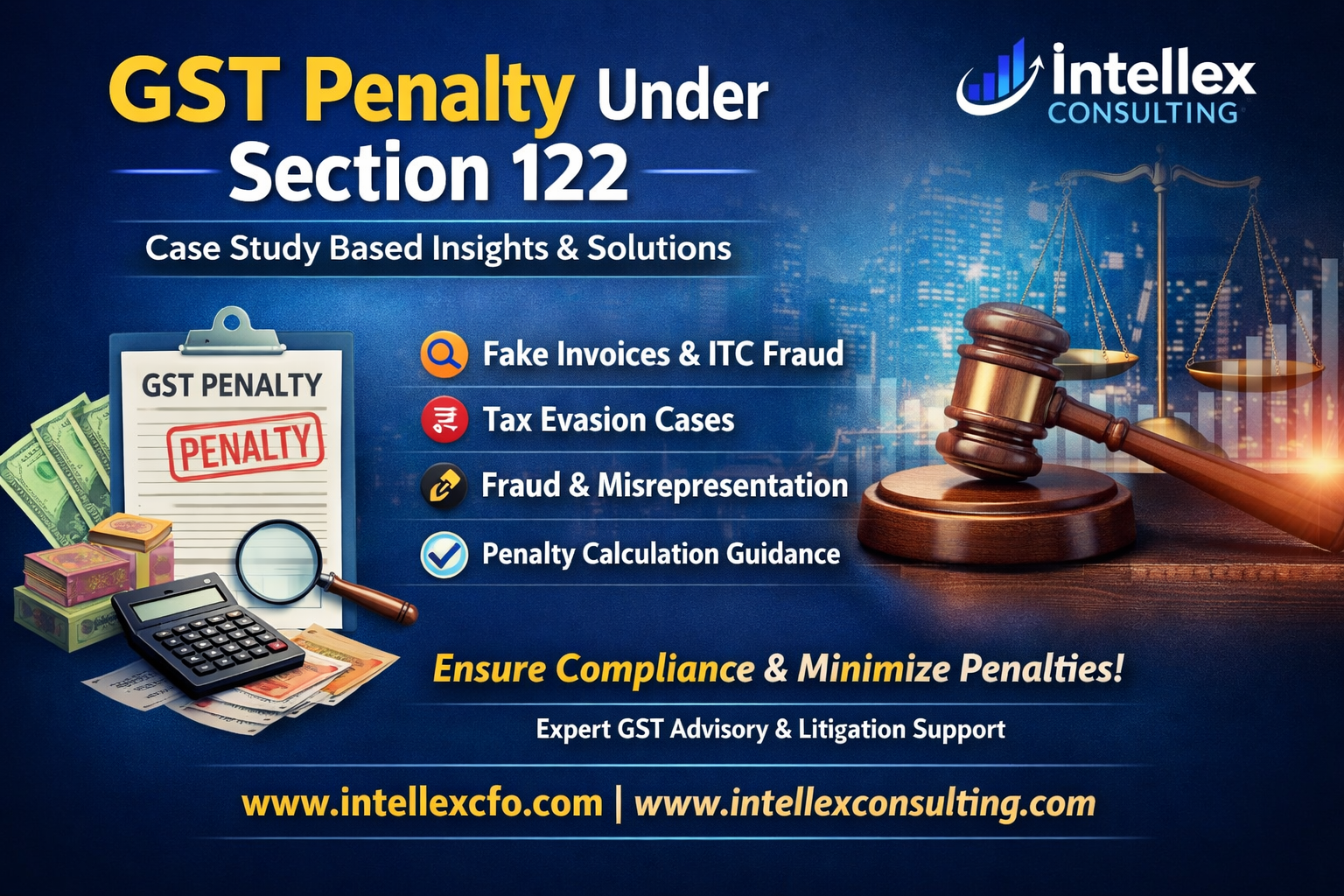
GST Penalty under Section 122 – A Practical Case Study Based Guide for Businesses & Professionals.
Comprehensive guide on GST penalty under Section 122 with practical case studies, penalty calculations, fraud implications, ITC risks, and compliance strategies for businesses in India.
Introduction: Why Section 122 Matters in GST Compliance
The introduction of Goods and Services Tax Act, 2017 brought a structured indirect tax regime in India. However, with simplification came strict enforcement. One of the most critical provisions for enforcement is Section 122, which governs penalties for various GST-related offences.
For businesses, CFOs, tax professionals, and consultants, understanding Section 122 is not just about compliance—it is about risk management, litigation avoidance, and financial discipline.
Understanding Section 122 – The Core Framework
Section 122 prescribes penalties for a wide range of defaults under GST. The law categorizes offences and imposes penalties based on intent, nature of violation, and financial impact.
Broadly, penalties fall into the following categories:
- Defaults by taxable persons
- Beneficiaries of fraudulent transactions
- E-commerce operator liabilities
- Short payment / wrongful ITC claims
- Aiding or abetting offences
Penalty for Taxable Persons – The Fundamental Rule
For most violations committed by a registered taxpayer:
👉 Penalty = Higher of ₹10,000 or tax amount involved
Practical Case Study
A company wrongfully claims Input Tax Credit (ITC) of ₹5 lakh.
- Tax involved: ₹5,00,000
- Minimum penalty: ₹10,000
✅ Applicable penalty: ₹5,00,000 (higher amount)
This highlights how penalty mirrors the tax exposure, making compliance critical.
Fake Invoicing & Bogus ITC – The Most Sensitive Area
Fake invoicing is one of the most aggressively prosecuted offences under GST.
Common Violations
- Issuing invoices without actual supply
- Passing fake ITC through circular trading
- Inflated or incorrect invoice details
Case Example
A business raises an invoice of ₹10 lakh without supply to pass ITC.
👉 Consequences:
- ITC reversal
- Penalty equal to tax involved
- Possible prosecution under Central Goods and Services Tax Act, 2017
📌 Key Insight: Authorities now use data analytics and GSTN matching to detect such frauds.
Tax Evasion & Non-Payment – Direct Financial Exposure
Penalty applies when:
- GST is not paid
- GST is short paid
- Tax collected but not deposited
Example
A trader collects ₹2 lakh GST but fails to deposit it.
👉 Penalty:
- ₹2 lakh (tax involved)
- Interest liability
- Possible additional proceedings
Fraud, Misrepresentation & Suppression of Facts
This includes deliberate actions such as:
- Suppressing turnover
- Misclassifying goods/services
- Using another entity’s GSTIN
Case Study
A company classifies taxable goods as exempt to reduce tax.
👉 Impact:
- Tax demand
- Penalty up to 100% of tax (fraud cases)
- Litigation exposure
Compliance Failures – Often Ignored but Costly
Even procedural lapses can attract penalties:
- Failure to obtain GST registration
- Non-maintenance of books
- Non-cooperation during audit
- Movement of goods without e-way bill
Example
Transporting goods without an e-way bill:
👉 Penalty may include:
- Detention of goods
- Monetary penalty
- Operational disruption
Section 122(1A) – Penalty on Beneficiaries of Fraud
A major addition and litigation hotspot.
What It Covers
If a person:
- Knowingly benefits from fake ITC
- Retains proceeds from fraudulent transactions
👉 Penalty = Amount of benefit derived
Practical Scenario
A company knowingly uses fake ITC of ₹8 lakh.
👉 Penalty:
- ₹8 lakh under Section 122(1A)
📌 Important Note: Courts are closely examining whether intent and knowledge are properly established.
Special Penalty Provisions Under Section 122
1. E-Commerce Operators
- Penalty: ₹10,000 or tax involved (whichever is higher)
2. Short Payment Cases
- Non-fraud: 10% of tax (minimum ₹10,000)
- Fraud cases: 100% of tax
3. Aiding or Abetting
- Penalty up to ₹25,000
Judicial Perspective – Key Interpretations
Indian courts have played a crucial role in shaping Section 122:
Important Observations
- Penalty can be independent of tax demand proceedings
- Relief granted in genuine or clerical error cases
- Employees or intermediaries may get protection if no direct involvement
- Retrospective application of Section 122(1A) is under scrutiny
📌 This makes documentation and intent extremely important in defending cases.
Defensive Strategy – How Businesses Can Stay Protected
To mitigate risks under Section 122:
1. Strengthen Documentation
- Maintain invoice trail
- Reconcile ITC regularly
- Vendor verification (GSTIN authenticity)
2. Conduct Internal GST Audits
- Identify mismatches early
- Correct errors before notices
3. Ensure Vendor Compliance
- Avoid dealing with suspicious vendors
- Monitor ITC eligibility
4. Respond Promptly to Notices
- Timely replies reduce penalties
- Legal representation improves outcomes
Conclusion: Compliance is the Best Defence
Section 122 of GST is designed to ensure discipline, transparency, and accountability. While penalties are stringent, the law also recognizes genuine taxpayers acting in good faith.
👉 Businesses that maintain:
- Proper records
- Transparent transactions
- Strong compliance systems
can effectively avoid penalties and defend themselves even in complex cases.
Team – Intellex Strategic Consulting Pvt Ltd
More Featured Posts:
GSTN Advisory: Key Enhancements in GSTR-3B Reporting (Effective January 2026).
Judicial Summary: Interest and Late Fees under GST.
Urgent GSTN Alert: GST Number Suspension Looms if Bank Details Not Submitted
CBIC Clarifies GST Registration Requirements for Warehouses Across States
GST Services by IntellexCFO.com to indian business community.
Secured and Un-Secured Financial Products from Bajaj Finance Ltd
Understanding Section 194T: New TDS Obligations for Partnership Firms and LLPs.
Our client looking for investment / acquisition in Logistic Sector :