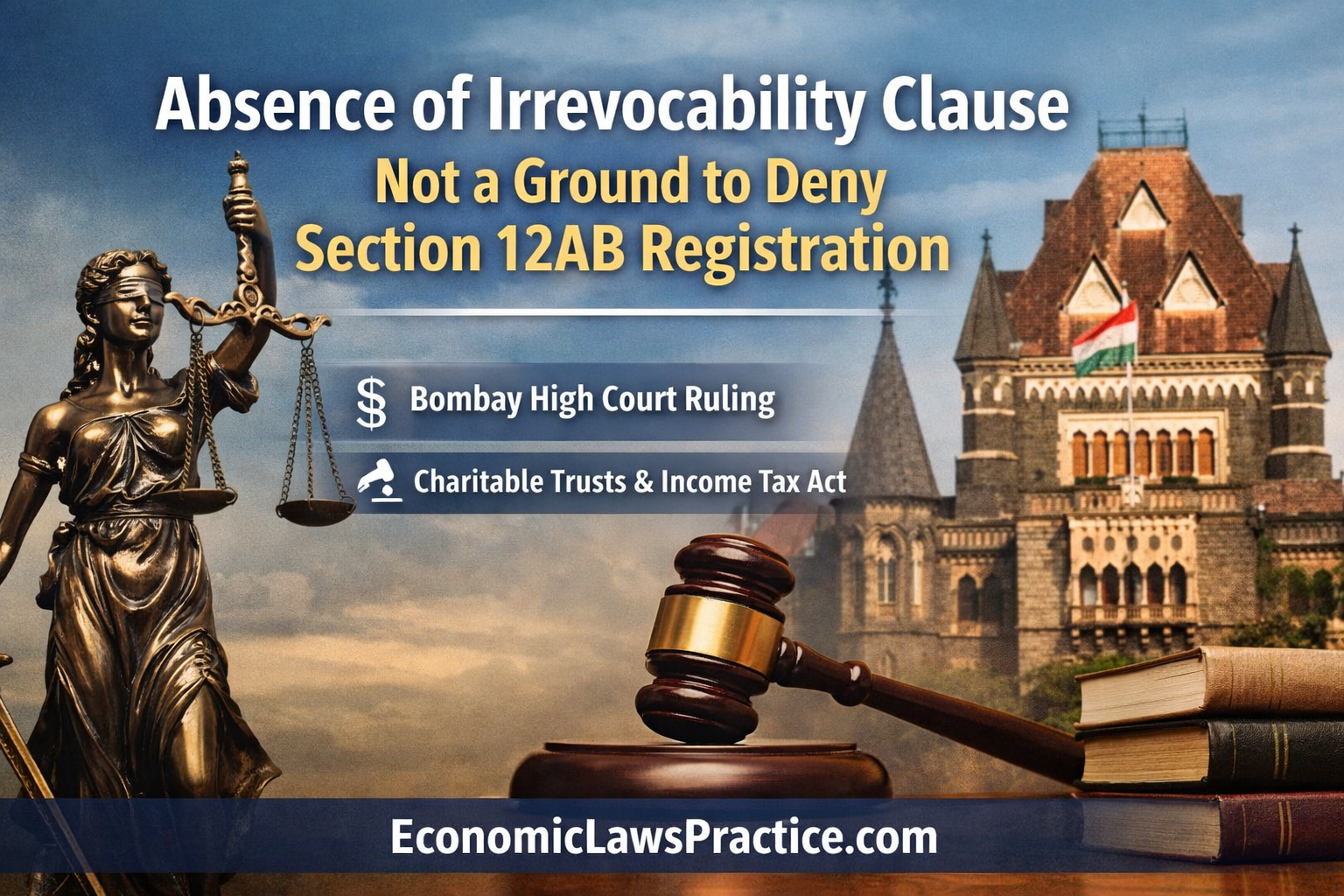
Bombay High Court Clarifies: Absence of Irrevocability Clause Cannot Deny Section 12AB Registration.
Bombay High Court rules that absence of an irrevocability clause in trust deeds is not a valid ground for denial of Section 12AB registration under the Income-tax Act, 1961.
Introduction
In a significant and taxpayer-friendly ruling, the Bombay High Court in Chamber of Tax Consultants & Others (W.P. (L) No. 7587 of 2026) has settled a long-standing controversy surrounding charitable trust registrations. The Court has categorically held that the absence of an explicit irrevocability clause in a trust deed cannot be a valid ground for denial or cancellation of registration under Section 12AB of the Income-tax Act, 1961.
This judgment provides much-needed clarity and relief to numerous charitable trusts that had faced rejection solely on technical grounds, despite otherwise complying with statutory requirements.
Background of the Issue
Over the past few years, several applications for registration or renewal under Section 12AB were rejected by the Commissioner (Exemptions) on the premise that the trust deed lacked an express clause declaring the trust as “irrevocable.”
This practice effectively introduced an additional condition not expressly mandated under the law, leading to widespread litigation and uncertainty in the non-profit sector.
Key Findings of the Bombay High Court
1. No Statutory Requirement for Irrevocability Clause
The Court firmly held that Section 12AB does not prescribe the existence of an irrevocability clause as a prerequisite for registration.
The statutory evaluation is limited to:
- The objects of the trust
- The genuineness of its activities
- Compliance with other applicable laws
The Court emphasized that tax authorities cannot import extraneous conditions that are not contemplated by the statute.
2. Absence of Clause Does Not Imply Revocability
Referring to Sections 60 to 63 of the Income-tax Act, 1961, the Court clarified that a transfer can only be treated as “revocable” if:
- There is an express provision for re-transfer of assets, or
- The transferor retains the power to reassume control
Mere silence in the trust deed does not imply that the trust is revocable. This interpretation reinforces a substance-over-form approach.
3. Legal Position under the Maharashtra Public Trusts Act
For trusts governed by the Maharashtra Public Trusts Act, 1950, the Court highlighted an important legal safeguard.
Once property is dedicated to a charitable trust:
- It cannot revert to the settlor
- Upon dissolution or revocation, assets are either:
- Taken over by statutory authorities, or
- Applied to similar charitable purposes
Thus, such trusts are inherently irrevocable in law, regardless of whether the trust deed expressly states so.
4. Rejection Based on Form 10AB Held Arbitrary
The Court also addressed a systemic flaw in the online filing process.
Applicants were compelled by the system to select “Yes” regarding irrevocability in Form 10AB. However, this declaration was later used against them in scrutiny proceedings.
The Court held this approach to be arbitrary and unsustainable, observing that taxpayers cannot be penalized for deficiencies in the Department’s own digital infrastructure.
5. Consistency with Earlier Registration Regime
The Court reaffirmed that the conditions governing registration under Sections 12A/12AA and Section 12AB are substantially similar.
Where a trust had previously been granted registration based on the same trust deed, authorities cannot introduce new conditions at the renewal stage without legislative backing.
Practical Implications for Charitable Trusts
This judgment has far-reaching implications:
- Relief from Technical Rejections: Trusts can no longer be denied registration merely due to absence of an irrevocability clause
- Reduced Litigation: The ruling is expected to curb unnecessary disputes and appeals
- Clarity in Law: Reinforces that statutory conditions must be strictly adhered to, without administrative overreach
- Support for Genuine Charities: Ensures that bona fide organizations are not penalized for drafting nuances
Conclusion
The ruling of the Bombay High Court marks a decisive step towards ensuring fairness and legal certainty in the registration process of charitable trusts. It reiterates a fundamental principle of tax jurisprudence: conditions for exemption or registration must be grounded in law, not administrative interpretation.
By holding that the absence of an irrevocability clause is not a valid ground for denial under Section 12AB, the Court has aligned the law with practical realities and protected the interests of genuine charitable institutions.
Team: EconomicLawsPractice.com
More Featured Articles:
New Income-tax Act 2025: Key Features, Major Changes & What It Means for Taxpayers in India.
How Ex-Bankers Can Build a High-Income Second Career Through a Corporate DSA Partner Program
New Section 285BAA on Crypto transactions under IncomeTax
GST Services by IntellexCFO.com to indian business community.