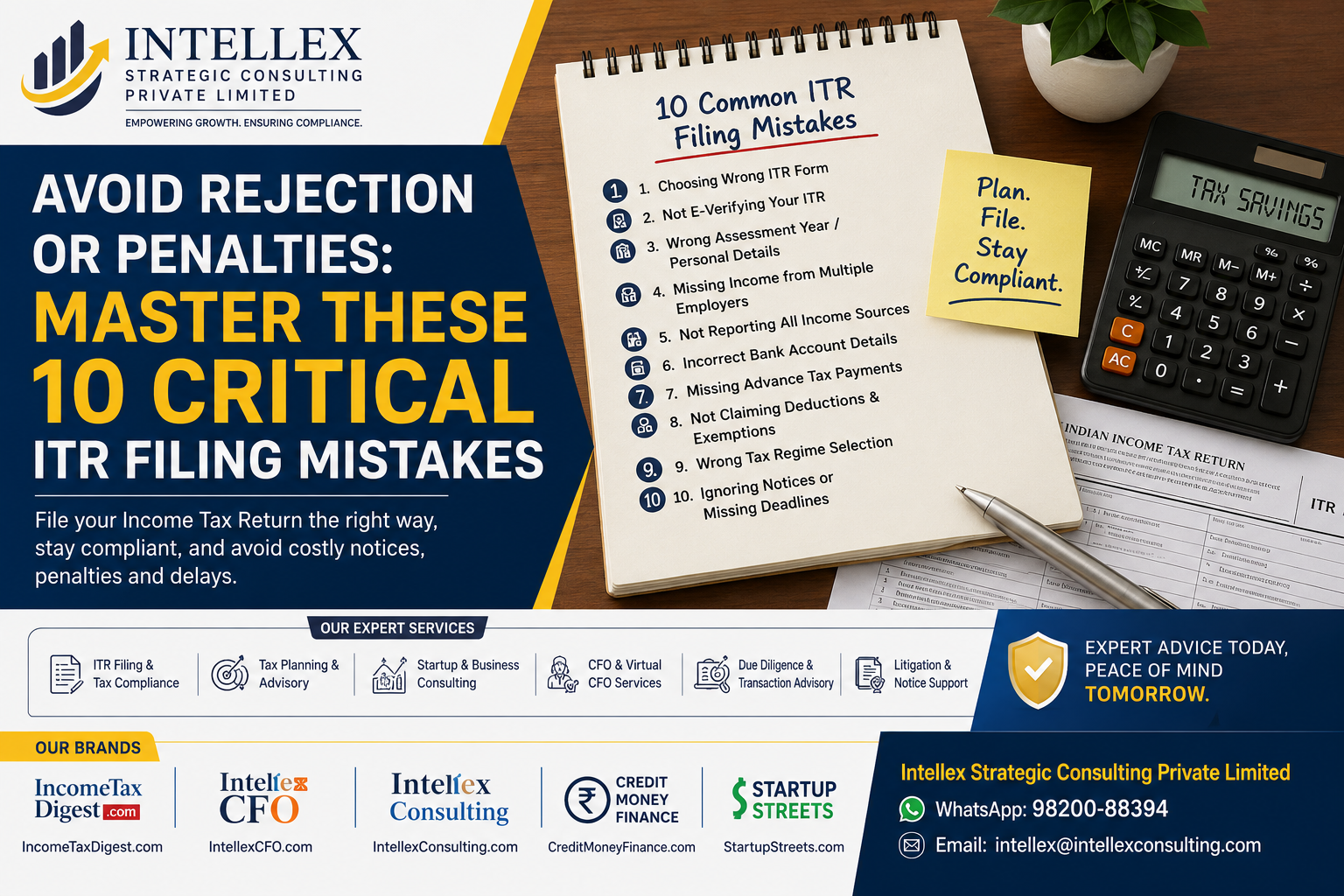
Avoid Rejection or Penalties: Master These 10 Critical ITR Filing Mistakes for FY 2025-26.
Avoid costly Income Tax Return filing mistakes in FY 2025-26. Learn the top 10 ITR filing errors, penalties, compliance risks, and expert tax advisory solutions from Intellex Strategic Consulting Private Limited.
Avoid Rejection or Penalties: Master These 10 Critical ITR Filing Mistakes
Income Tax Return (ITR) filing is no longer just a yearly compliance requirement — it has become a crucial financial responsibility that directly impacts taxpayers, businesses, startups, professionals, investors, and salaried individuals alike. With increased digital scrutiny, Artificial Intelligence-based tax analytics, AIS/TIS integration, and tighter compliance monitoring by the Income Tax Department, even minor mistakes in ITR filing can trigger notices, delays, penalties, scrutiny assessments, or refund rejections.
For Assessment Year 2026-27, taxpayers must be especially cautious while filing returns. Whether you are a salaried employee, entrepreneur, freelancer, investor, HNI, startup founder, NRI, or business owner, understanding the most common ITR filing mistakes can help you avoid unnecessary financial and legal complications.
At Intellex Strategic Consulting Private Limited, we assist individuals, startups, SMEs, corporates, and investors with end-to-end taxation, compliance, CFO advisory, transaction structuring, due diligence, tax planning, and financial consulting solutions across India.
1. Choosing the Wrong ITR Form
One of the most common and serious mistakes taxpayers make is selecting the incorrect ITR form.
Different categories of taxpayers are required to file different forms depending on:
- Nature of income
- Residential status
- Capital gains
- Business income
- Foreign assets
- Directorship
- Cryptocurrency transactions
For example:
- ITR-1 is suitable only for resident individuals earning salary/pension income up to ₹50 lakh with limited income sources.
- Taxpayers having capital gains, crypto income, foreign assets, or multiple house properties may need ITR-2 or ITR-3.
- Businesses and professionals with presumptive taxation may require ITR-4.
Filing the wrong form can lead to:
- Defective return notices
- Delayed refunds
- Return invalidation
- Additional compliance burden
Professional evaluation before filing helps ensure the correct form selection and proper disclosure.
2. Not E-Verifying the ITR
Many taxpayers believe that once the return is uploaded, the process is complete. However, an ITR is treated as invalid unless it is verified.
Taxpayers must complete e-verification within the prescribed timeline using:
- Aadhaar OTP
- Net banking
- Electronic Verification Code (EVC)
- Demat account verification
- Bank account validation
Failure to verify the return within 30 days can render the filing invalid, meaning the ITR is considered not filed at all.
This may result in:
- Late filing penalties
- Loss of carry-forward losses
- Delayed refunds
- Interest liability
3. Wrong Assessment Year or Incorrect Personal Information
Selecting the incorrect Assessment Year (AY) remains a surprisingly common error.
For income earned during FY 2025-26, the correct Assessment Year is:
AY 2026-27
Errors in the following details can also create processing complications:
- PAN number
- Aadhaar details
- Date of birth
- Email address
- Mobile number
- Residential status
- Bank account details
Incorrect information often leads to:
- Refund failures
- Verification mismatch
- Compliance notices
- Delayed processing
Taxpayers should cross-check all personal and banking details carefully before submission.
4. Ignoring Income from Multiple Employers
Employees who changed jobs during the financial year often forget to consolidate salary income from all employers.
Using only the latest Form 16 can lead to:
- Under-reporting of salary income
- Incorrect TDS claims
- Tax shortfall
- Interest liability
- Tax notices
Taxpayers must:
- Collect Form 16 from all employers
- Recalculate total taxable salary
- Reconcile TDS with Form 26AS and AIS
Proper salary consolidation is essential to avoid mismatch notices.
5. Not Reporting All Sources of Income
The Income Tax Department now receives extensive financial data through AIS (Annual Information Statement), TIS, banks, registrars, stock exchanges, mutual funds, and crypto exchanges.
Taxpayers must disclose all income sources including:
- Savings bank interest
- Fixed deposit interest
- Dividend income
- Rental income
- Capital gains
- Freelance income
- Foreign income
- Cryptocurrency/VDA transactions
- Bond interest
- Business income
Even exempt income must often be reported appropriately.
Failure to disclose income may trigger:
- Scrutiny notices
- Penalties
- Interest under various sections
- Prosecution in severe cases
6. Incorrect Bank Account Details
Refund delays are frequently caused by incorrect bank account information.
Common mistakes include:
- Wrong account number
- Incorrect IFSC code
- Non-prevalidated account
- Closed bank account
Refunds are credited directly through electronic transfer systems. Therefore, taxpayers should:
- Validate bank accounts on the portal
- Ensure account ownership matches PAN
- Double-check IFSC and account details
7. Missing Advance Tax Deadlines
Taxpayers having significant non-salary income are often liable to pay advance tax.
Advance tax installments are generally due on:
- 15 June
- 15 September
- 15 December
- 15 March
Delay or non-payment may attract interest under Sections 234B and 234C.
The interest implication is generally:
Interest=1% per month on unpaid advance tax Interest = 1% per month on unpaid advance tax}
Professionals, consultants, traders, investors, freelancers, landlords, and startup founders must carefully estimate tax liabilities throughout the year.
8. Not Claiming Eligible Deductions and Exemptions
Many taxpayers unknowingly pay excess taxes because they fail to claim available deductions and exemptions.
Important deductions include:
- Section 80C investments
- Section 80D medical insurance
- Section 80E education loan interest
- NPS deductions
- HRA exemptions
- Home loan interest
- Donations under 80G
Capital gains exemptions under:
- Section 54
- Section 54EC
- Section 54F
can also significantly reduce tax liabilities if structured correctly.
Professional tax planning can legally optimize tax outflows while maintaining full compliance.
9. Wrong Selection Between Old and New Tax Regime
Choosing the wrong tax regime can substantially increase tax liability.
Taxpayers must compare:
- Tax slab rates
- Available deductions
- Investment structures
- HRA benefits
- Business implications
- Long-term financial planning
The new regime may appear simpler, but the old regime may still offer significant savings depending on the taxpayer’s profile.
An expert comparative analysis can help determine the most tax-efficient structure.
10. Ignoring Income Tax Notices or Filing Deadlines
Ignoring notices from the Income Tax Department can escalate minor issues into major legal and financial problems.
Common notices may relate to:
- AIS mismatches
- TDS differences
- High-value transactions
- Capital gains mismatch
- Crypto disclosures
- Foreign asset reporting
Failure to respond can lead to:
- Penalties
- Best judgment assessments
- Refund withholding
- Litigation
- Prosecution in serious cases
Similarly, late filing may result in:
- Penalty under Section 234F
- Interest liability
- Loss of carry-forward losses
Timely filing and professional response management are critical.
Additional Critical Mistakes Taxpayers Must Avoid
Failure to Reconcile AIS, TIS, and Form 26AS
The Income Tax Department extensively compares ITR disclosures with:
- AIS
- TIS
- Form 26AS
- Bank data
- Securities transactions
- GST data
- Foreign remittances
Mismatch detection has become highly automated. Reconciliation before filing is now essential.
Non-Disclosure of Foreign Assets and Foreign Income
Resident and Ordinarily Resident (ROR) taxpayers must disclose:
- Foreign bank accounts
- Foreign shares
- ESOPs
- Overseas investments
- Foreign income
- Crypto holdings abroad
Failure to disclose under Schedule FA may attract severe penalties under the Black Money Act.
Non-Reporting of Mutual Fund Switches and Capital Gains
Many investors incorrectly assume that switching mutual fund schemes is tax-neutral.
However:
- Switching funds
- Redeeming SIP units
- Selling equity/debt funds
- ESOP liquidation
- Share sales
may trigger taxable capital gains.
Proper capital gains computation is essential.
Crypto and Virtual Digital Asset (VDA) Reporting Errors
Crypto taxation continues to be a major scrutiny area.
Income from:
- Bitcoin
- Ethereum
- NFTs
- Crypto trading
- Staking
- Token transfers
must be disclosed under Schedule VDA.
Current tax provisions generally include:
Tax on VDA Income=30%+applicable surcharge+cess
Loss set-off restrictions and TDS provisions also apply.
Why Professional Tax Advisory Matters More Than Ever
Modern tax compliance is no longer limited to simple return filing. Today’s taxpayers require:
- Strategic tax planning
- Compliance management
- Regulatory interpretation
- AIS reconciliation
- Capital gains advisory
- Startup structuring
- CFO advisory
- International taxation support
- Transaction documentation
- Litigation support
Professional guidance helps reduce:
- Compliance risk
- Tax leakages
- Penalties
- Scrutiny exposure
- Litigation risk
while improving long-term financial efficiency.
How Intellex Strategic Consulting Private Limited Can Help
Intellex Strategic Consulting Private Limited is a multidisciplinary professional services firm offering specialized solutions in:
- Income Tax Advisory
- ITR Filing Support
- Tax Planning
- Startup Advisory
- CFO Services
- Due Diligence
- Virtual CFO Services
- FEMA & Regulatory Advisory
- Company Compliance
- Financial Structuring
- Transaction Advisory
- Capital Raising Support
- Business Consulting
- Mergers & Acquisitions
- Litigation Coordination
Our associated platforms:
Contact Us
Intellex Strategic Consulting Private Limited
📞 WhatsApp: 98200-88394
📧 Email: intellex@intellexconsulting.com
For expert support in tax compliance, ITR filing, startup advisory, CFO services, financial structuring, and regulatory consulting, connect with our professional advisory team today.
Final Thoughts
As tax regulations become increasingly technology-driven and data-centric, taxpayers must move beyond basic filing practices and adopt a more strategic approach toward compliance.
Avoiding common ITR mistakes is not merely about preventing notices — it is about protecting your financial credibility, ensuring smooth refund processing, minimizing litigation risks, and building long-term financial discipline.
With proper planning, accurate disclosures, timely compliance, and expert professional guidance, taxpayers can confidently navigate the evolving Indian tax ecosystem while optimizing their financial outcomes.
Intellex Strategic Consulting Private Limited
More Featured Posts:
PAN Rules 2026: Major Changes in Quoting, Reporting & Compliance Every Taxpayer Must Know.
Ultimate Guide to Singapore Company Registration 2026: Rules, Costs, and Compliance.
The Ultimate Guide to Company Registration in Dubai 2026: Benefits, Compliance, and Costs.
Startup India Registration: Unlocking Tax Benefits and Growth
Finance Bill 2026 to Revolutionize GST with Faster Registration and 90% Automatic Refunds
How Businesses in the UAE Can Stay Ahead of Compliance Demands in 2026.