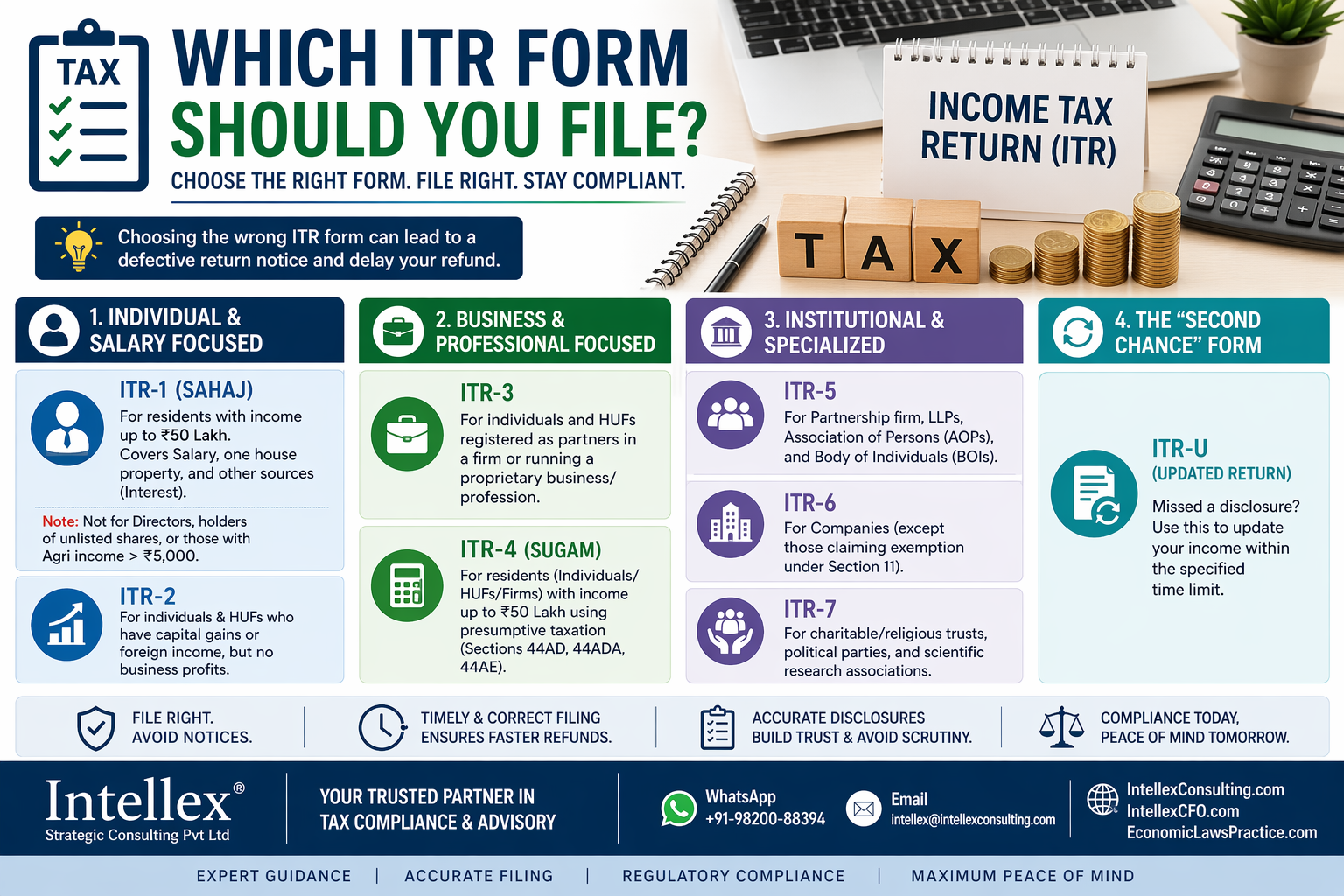
Which ITR Form Should You File? A Complete Taxpayer’s Guide to Avoid Costly Filing Errors (FY 2025–26 / AY 2026–27).
Filing your Income Tax Return (ITR) correctly is not just a compliance requirement—it is a financial responsibility that directly impacts your credibility, refunds, and future tax scrutiny. One of the most common and avoidable mistakes taxpayers make is selecting the wrong ITR form. This seemingly small error can trigger a defective return notice under Section 139(9), delay refunds, or even attract penalties.
This comprehensive guide simplifies the selection of ITR forms for individuals, businesses, and institutions, helping you file accurately and confidently.
Understanding the Importance of Choosing the Right ITR Form
Each ITR form is designed for a specific category of taxpayer and type of income. The Income Tax Department uses these classifications to ensure accurate reporting and efficient processing.
Filing the wrong form can result in:
- Rejection or defect notices
- Delayed tax refunds
- Increased scrutiny from tax authorities
- Additional compliance burden
Selecting the correct form ensures smoother processing and legal compliance.
1. Individual & Salary-Focused Taxpayers
ITR-1 (Sahaj): Simplified Filing for Salaried Individuals
ITR-1 is the most commonly used form, designed for resident individuals with straightforward income sources.
Eligibility:
- Total income up to ₹50 lakh
- Income from:
- Salary or pension
- One house property
- Other sources (interest income)
Not Applicable If:
- You are a company director
- You hold unlisted equity shares
- Agricultural income exceeds ₹5,000
- You have foreign assets or foreign income
This form is ideal for salaried individuals with uncomplicated financial profiles.
ITR-2: For Capital Gains & Foreign Income
ITR-2 is suitable for individuals and Hindu Undivided Families (HUFs) who do not have business income but have more complex financial structures.
Best suited for:
- Individuals earning capital gains (stocks, mutual funds, property)
- Those with foreign income or foreign assets
- Multiple house properties
This form is more detailed and requires careful reporting of investments and global income.
2. Business & Professional Taxpayers
ITR-3: For Entrepreneurs & Professionals
ITR-3 is designed for individuals and HUFs engaged in business or professional activities.
Applicable for:
- Proprietors running businesses
- Freelancers and professionals (doctors, lawyers, consultants)
- Partners in partnership firms
This form involves comprehensive financial disclosures including balance sheets and profit & loss statements.
ITR-4 (Sugam): Presumptive Taxation Scheme Users
ITR-4 simplifies tax filing for small taxpayers opting for presumptive taxation under Sections 44AD, 44ADA, and 44AE.
Eligibility:
- Resident Individuals, HUFs, and Firms (excluding LLPs)
- Income up to ₹50 lakh
- Opting for presumptive taxation
Advantages:
- Reduced compliance burden
- No need to maintain detailed books of accounts
This is a practical choice for small businesses and professionals seeking simplified compliance.
3. Institutional & Specialized Taxpayers
ITR-5: For Firms and Associations
Applicable to:
- Partnership firms
- Limited Liability Partnerships (LLPs)
- Association of Persons (AOPs)
- Body of Individuals (BOIs)
This form captures financial and operational details of non-corporate entities.
ITR-6: For Companies
Used by companies that do not claim exemption under Section 11 (income from property held for charitable purposes).
Mandatory for:
- Private limited companies
- Public limited companies
Filing is done electronically with digital signature.
ITR-7: For Charitable & Religious Entities
Applicable to entities claiming exemptions under sections like:
- Section 11 (charitable trusts)
- Section 12 (religious trusts)
Also used by:
- Political parties
- Scientific research institutions
This form ensures transparency in tax-exempt activities.
4. The “Second Chance” Form
ITR-U (Updated Return): Correct Past Mistakes
ITR-U allows taxpayers to update previously filed returns or file missed returns within a specified time window.
Use it when:
- You forgot to report income
- You need to correct errors
- You missed the original filing deadline
Important Note:
Additional tax liability applies, making timely and accurate filing the better option.
Common Mistakes to Avoid While Filing ITR
- Selecting incorrect ITR form
- Not reporting all income sources
- Ignoring AIS (Annual Information Statement) mismatches
- Incorrect bank details delaying refunds
- Missing deadlines
Attention to detail can prevent unnecessary notices and complications.
Why Professional Guidance Matters
Tax laws evolve frequently, and individual financial situations are becoming more complex with global income, digital assets, and diversified investments. Engaging experienced professionals ensures:
- Correct ITR form selection
- Accurate income reporting
- Tax optimization within legal framework
- Compliance with latest regulations
About Our Services
Intellex Strategic Consulting Pvt Ltd offers expert tax advisory and compliance services tailored to individuals, businesses, and institutions across India.
Our Services Include:
- ITR filing for all categories
- Tax planning and advisory
- Business and professional compliance
- Handling notices and assessments
Contact Us:
- 📱 WhatsApp: +91-98200-88394
- 📧 Email: intellex@intellexconsulting.com
- 🌐 Websites:
- IntellexConsulting.com
- IntellexCFO.com
- EconomicLawsPractice.com
Conclusion
Choosing the correct ITR form is the foundation of accurate tax compliance. Whether you are a salaried individual, a business owner, or a trustee of a charitable institution, understanding the nuances of each form can save you from costly errors and regulatory hassles.
A careful, informed approach or the guidance of a trusted advisor ensures that your tax filing is not just compliant, but also efficient and stress-free.
Intellex Strategic Consulting Pvt Ltd
More Featured Articles:
Taxable Event Under GST: Understanding “Supply” – The Heart of GST Law in India.
Post Office Tax Compliance 2026: Key Changes, SFT Reporting & Practical Impact on Investors.
Income Tax Form 104: A Complete Guide to the New NPO Registration Process in India (2026).
SME IPO in India: A Comprehensive Guide for Growing Businesses Looking to Go Public
Funding & Investment Options to Grow India’s Real Estate & Allied Businesses


One thought on “Which ITR Form Should You File? A Complete Taxpayer’s Guide to Avoid Costly Filing Errors (FY 2025–26 / AY 2026–27).”