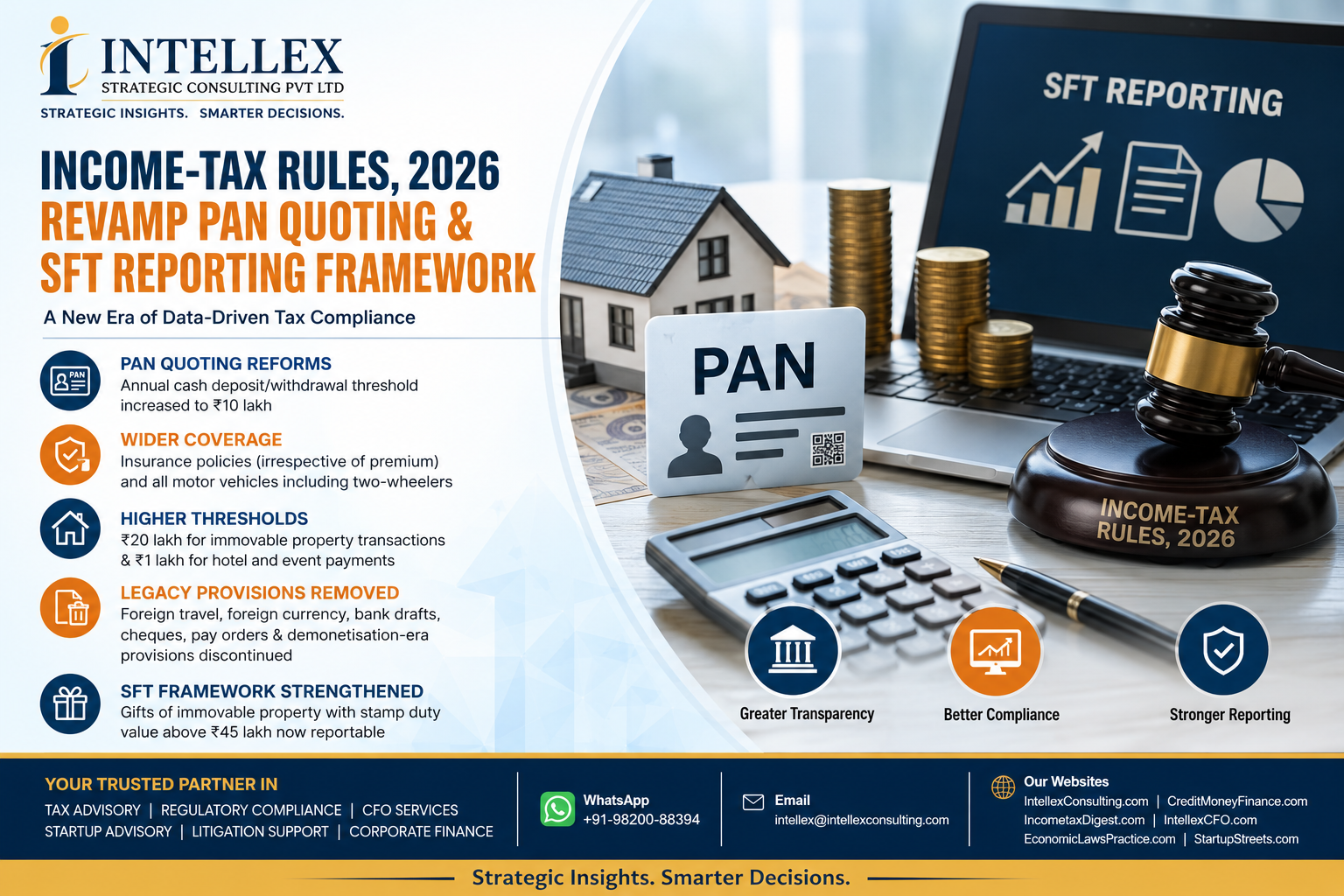
Income-tax Rules, 2026 Revamp PAN Quoting and SFT Reporting Framework: A New Era of Data-Driven Tax Compliance in India
The Income-tax Rules, 2026 introduce major changes to PAN quoting requirements and Specified Financial Transaction (SFT) reporting. Learn how the new regulations impact taxpayers, property transactions, financial institutions, businesses, and compliance professionals.
India’s tax administration is undergoing a significant transformation with the introduction of the Income-tax Rules, 2026. The new framework substantially modernizes the rules governing Permanent Account Number (PAN) quoting requirements and reporting of Specified Financial Transactions (SFT).
These reforms are aligned with the Government’s broader objective of building a technology-driven, transparent, and data-centric tax ecosystem. By leveraging financial data analytics and expanding reporting obligations, the Income Tax Department aims to improve tax compliance, reduce tax evasion, and enhance the accuracy of taxpayer profiling.
The changes impact individuals, businesses, financial institutions, insurers, property registrars, reporting entities, and compliance professionals across India.
Why the PAN and SFT Framework Has Been Revamped
Over the past decade, tax authorities have increasingly relied on data intelligence rather than traditional assessment methods.
The Income-tax Rules, 2026 seek to:
- Expand financial transparency.
- Capture high-value transactions more effectively.
- Reduce fragmentation in reporting requirements.
- Improve taxpayer risk assessment.
- Strengthen information gathering through digital reporting systems.
- Eliminate obsolete and redundant reporting provisions.
- Enhance integration between financial institutions and tax authorities.
The revised framework reflects the Government’s move toward continuous monitoring of financial activity through structured reporting mechanisms.
Major Changes in PAN Quoting Requirements Under Rule 159
One of the most significant reforms under the new Rules is the restructuring of PAN quoting obligations.
Instead of focusing on individual transactions, the new framework emphasizes aggregate annual financial activity.
1. Cash Deposits and Withdrawals Above ₹10 Lakh
Earlier, PAN quoting requirements were often linked to transaction-specific thresholds, including cash transactions exceeding ₹50,000 per day in certain circumstances.
Under the revised Rule 159:
- PAN becomes mandatory where aggregate cash deposits exceed ₹10 lakh during a financial year.
- PAN is also mandatory where aggregate cash withdrawals exceed ₹10 lakh during a financial year.
- The focus shifts from individual transactions to annual financial behaviour.
Impact
This change allows tax authorities to monitor cumulative cash-intensive activities and identify patterns that may indicate tax risks.
2. Insurance Policy Transactions
The earlier framework linked PAN requirements to premium thresholds.
Under the new rules:
- PAN quoting requirements apply to insurance policy transactions irrespective of premium amount.
- The compliance burden shifts toward universal identification rather than threshold-based monitoring.
Impact
The Income Tax Department gains broader visibility into insurance investments and policy ownership structures.
3. Expansion of Motor Vehicle Coverage
The previous provisions largely focused on motor vehicles excluding certain categories.
The revised rules now expand coverage to include:
- Two-wheelers
- Motorcycles
- Other eligible vehicle categories
Impact
Vehicle purchases now form a wider part of the tax reporting ecosystem, helping authorities track significant consumption and asset acquisition patterns.
4. Increased Threshold for Immovable Property Transactions
A major relief measure has been introduced for property transactions.
Earlier Threshold
₹10 lakh
New Threshold
₹20 lakh
PAN quoting becomes mandatory when the value of an immovable property transaction exceeds ₹20 lakh.
Impact
- Reduces compliance burden on smaller transactions.
- Focuses departmental attention on higher-value real estate dealings.
- Aligns reporting obligations with current property market valuations.
5. Increased Threshold for Hotel and Event Payments
The revised rules also rationalize hospitality and event-related reporting requirements.
Earlier Threshold
₹50,000
New Threshold
₹1 lakh
This includes payments made towards:
- Hotels
- Banquet halls
- Event venues
- Similar hospitality arrangements
Impact
The increase reflects inflation and changing market realities while reducing unnecessary compliance for routine transactions.
PAN Quoting Requirements Removed Under Income-tax Rules, 2026
The Government has simultaneously eliminated several outdated provisions.
The following reporting requirements have been discontinued:
Foreign Travel Expenditure
PAN quoting linked to foreign travel expenses has been removed.
Foreign Currency Purchases
Reporting obligations relating to foreign currency purchases have been discontinued.
Bank Drafts and Pay Orders
Requirements connected with:
- Bank drafts
- Banker’s cheques
- Pay orders
have been removed from the PAN reporting framework.
Demonetisation-Era Reporting Provisions
Several provisions introduced during the demonetisation period have now become obsolete and have been formally eliminated.
Impact
The removal of redundant provisions simplifies compliance and reduces reporting duplication.
Strengthening the SFT Framework Under Rule 237
Alongside PAN reforms, the Government has significantly expanded the Statement of Financial Transactions (SFT) reporting regime.
The revised Rule 237 broadens the scope of reportable transactions and enhances institutional accountability.
What is an SFT?
A Statement of Financial Transactions (SFT) is a reporting mechanism through which specified entities furnish information regarding high-value financial transactions to the Income Tax Department.
Reporting entities may include:
- Banks
- Financial institutions
- Registrars
- Property registration authorities
- Mutual fund houses
- Insurance companies
- Other prescribed institutions
The information collected is used for:
- Risk assessment
- Data analytics
- Tax compliance verification
- Detection of undisclosed income and assets
Landmark Change: Reporting of Gifts of Immovable Property
One of the most noteworthy changes under Rule 237 is the inclusion of certain non-monetary property transfers.
New Reporting Requirement
Gifts of immovable property must now be reported where:
- Stamp duty value exceeds ₹45 lakh.
- Transfer occurs without consideration or for inadequate consideration.
Earlier Position
Only conventional sale transactions generally attracted reporting obligations.
New Position
Even gift transactions involving high-value real estate will now come within the SFT reporting net.
Why This Change Matters
The inclusion of gifted immovable properties significantly increases the Department’s visibility over wealth transfers.
The authorities can now better monitor:
- Family settlements.
- Inter-generational wealth transfers.
- Gift deeds.
- Transfers among relatives.
- High-value property movements with little or no consideration.
This closes an important information gap that previously existed within the reporting ecosystem.
Implications for Taxpayers
The revised framework has several implications:
Greater Transparency
High-value transactions will become increasingly visible to tax authorities.
Improved Data Matching
The Department can cross-reference:
- PAN data
- Property records
- Banking transactions
- Insurance information
- Other financial disclosures
Enhanced Compliance Requirements
Taxpayers must ensure:
- PAN details are correctly reported.
- Property transactions are accurately documented.
- Financial records remain consistent across various reporting platforms.
Increased Scrutiny of Asset Transfers
Gift transactions involving high-value properties may attract greater attention during assessments and verification proceedings.
Implications for Businesses and Financial Institutions
Organizations acting as reporting entities must strengthen their compliance systems.
Key areas requiring attention include:
- Customer identification procedures.
- PAN collection and verification.
- Transaction monitoring mechanisms.
- SFT reporting infrastructure.
- Internal compliance controls.
- Data quality management systems.
Financial institutions will need enhanced technology solutions to capture aggregate annual transaction thresholds and ensure timely reporting.
The Bigger Picture: India’s Move Towards Data-Centric Tax Administration
The Income-tax Rules, 2026 demonstrate a clear shift away from transaction-based monitoring toward integrated financial intelligence.
The Government’s strategy increasingly relies on:
- Artificial intelligence-driven analytics.
- Data integration across departments.
- Real-time information sharing.
- Automated compliance verification.
- Risk-based assessments.
As India’s digital economy expands, tax administration is expected to become increasingly predictive, data-driven, and technology-enabled.
Conclusion
The Income-tax Rules, 2026 mark a significant milestone in India’s tax compliance landscape. By restructuring PAN quoting requirements and expanding the SFT reporting framework, the Government has strengthened its ability to monitor high-value financial activities while simultaneously removing several outdated reporting provisions.
The introduction of annual aggregate thresholds, broader insurance reporting, expanded vehicle coverage, revised property transaction limits, and the inclusion of gifted immovable properties under SFT reporting collectively signal a new era of financial transparency.
Taxpayers, businesses, financial institutions, and compliance professionals must proactively review their processes and reporting systems to align with the new regulatory framework and avoid potential compliance risks.
Professional Advisory & Compliance Support
Businesses, financial institutions, property owners, startups, and high-net-worth individuals seeking assistance with Income-tax Rules, 2026 compliance, PAN reporting obligations, SFT reporting requirements, tax litigation, regulatory advisory, and transaction structuring may contact:
Intellex Strategic Consulting Pvt Ltd
WhatsApp: +91-98200-88394
Email: intellex@intellexconsulting.com
Websites:
- IntellexConsulting.com
- CreditMoneyFinance.com
- IncometaxDigest.com
- IntellexCFO.com
- EconomicLawsPractice.com
- StartupStreets.com
Intellex Strategic Consulting Pvt Ltd provides specialized advisory services in taxation, regulatory compliance, corporate finance, transaction structuring, startup advisory, CFO services, and strategic business consulting across India.
Intellex Strategic Consulting Pvt Ltd
More Featured Articles:
SME IPO in India: A Comprehensive Guide for Growing Businesses Looking to Go Public
Funding & Investment Options to Grow India’s Real Estate & Allied Businesses
How Businesses in the UAE Can Stay Ahead of Compliance Demands in 2026.
How Ex-Bankers Can Build a High-Income Second Career Through a Corporate DSA Partner Program
Loans Takeover proposals with enhancement of Banking limits for MSME Sector Companies


One thought on “Income-tax Rules, 2026 Revamp PAN Quoting and SFT Reporting Framework: A New Era of Data-Driven Tax Compliance in India.”