GST Show Cause Notice (SCN): Complete Guide to Issuance, Validity, Legal Requirements, Taxpayer Rights, and Defence Strategies under GST.
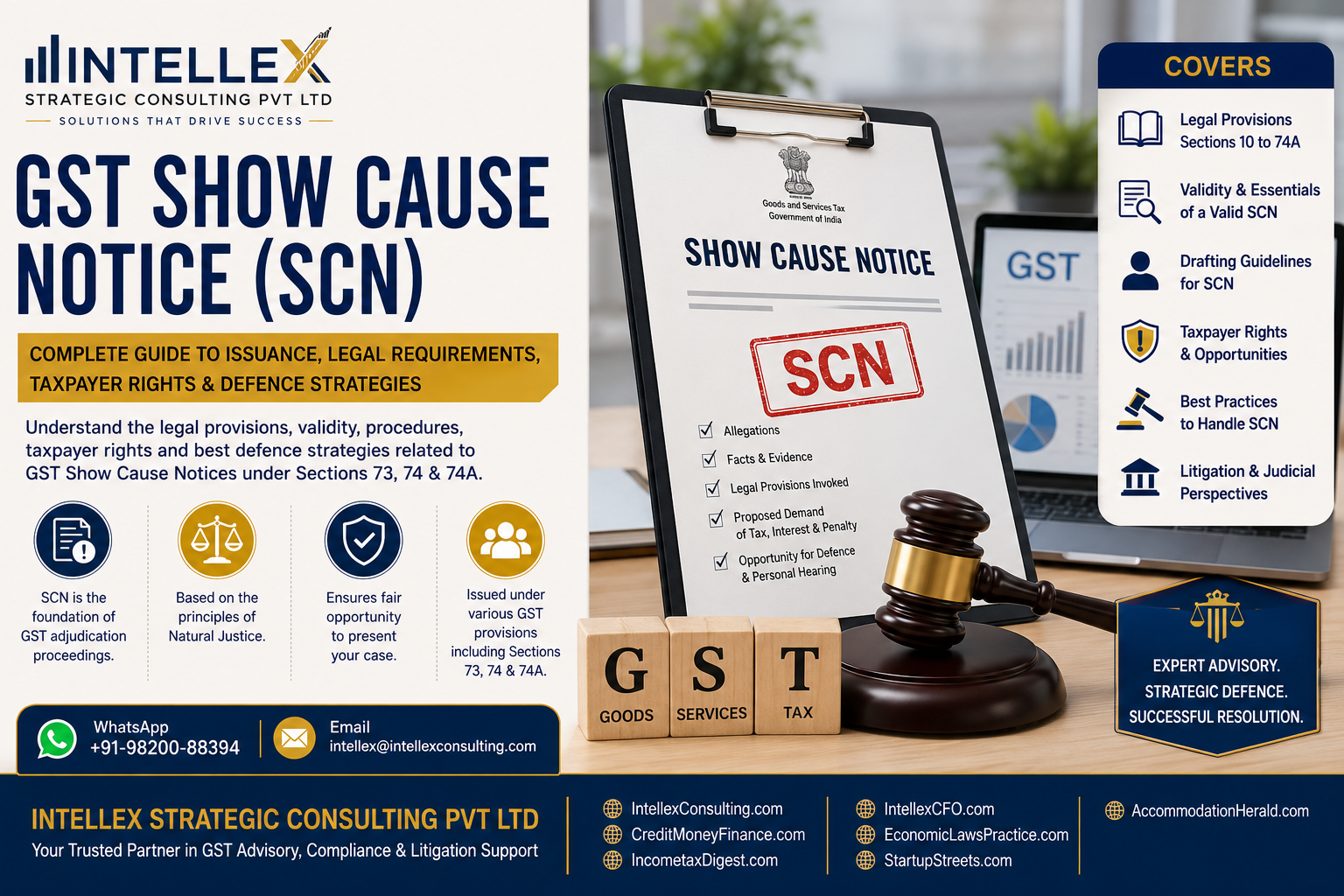
Understand everything about GST Show Cause Notices (SCNs), including legal provisions, validity requirements, taxpayer rights, adjudication procedures, Sections 73, 74, 74A, penalties, and defence strategies. A comprehensive guide for businesses, taxpayers, professionals, and GST consultants.
The Goods and Services Tax (GST) framework in India places significant emphasis on compliance, transparency, and procedural fairness. One of the most critical components of GST enforcement and adjudication is the issuance of a Show Cause Notice (SCN).
A Show Cause Notice serves as the foundation of GST adjudication proceedings and is often the first formal communication from the tax authorities when they believe there has been a violation of GST provisions, short payment of tax, wrongful availment of Input Tax Credit (ITC), excess refunds, or other compliance failures.
Understanding the legal significance, procedural requirements, and taxpayer rights relating to an SCN is essential for every business, GST practitioner, CFO, tax consultant, and entrepreneur.
What is a Show Cause Notice (SCN) under GST?
A Show Cause Notice (SCN) is an official notice issued by the GST authorities requiring a taxpayer to explain why a proposed tax demand, penalty, recovery action, cancellation, or other adverse action should not be taken against them.
The concept is rooted in the Principles of Natural Justice, which mandate that no person should be condemned without being heard.
Before any adverse order is passed against a taxpayer, GST authorities are generally required to:
- Inform the taxpayer of the allegations.
- Provide supporting evidence.
- Allow sufficient opportunity for response.
- Grant personal hearing where required.
- Consider taxpayer submissions before passing an order.
Thus, an SCN acts as the starting point of quasi-judicial proceedings under GST.
Why is a Show Cause Notice Issued?
The primary objectives of issuing an SCN are:
1. Compliance with Legal Requirements
GST law generally requires authorities to issue a notice before raising tax demands or imposing penalties.
2. Initiation of Adjudication Proceedings
An SCN formally commences adjudication and assessment proceedings.
3. Communication of Allegations
The taxpayer is informed about the specific violations alleged by the department.
4. Opportunity of Defence
The taxpayer is provided a fair opportunity to explain, clarify, and submit evidence.
5. Adherence to Natural Justice
The SCN mechanism ensures fairness and transparency in tax administration.
Major GST Provisions Under Which SCNs May Be Issued
Several provisions under the GST law empower authorities to issue Show Cause Notices.
| GST Section | Purpose |
|---|---|
| Section 10 | Wrongful availment of Composition Scheme |
| Section 21 | Excess Input Tax Credit distributed by ISD |
| Section 35 | Failure to properly account for supplies |
| Section 50 | Interest on delayed payment of tax |
| Section 51 | TDS defaults |
| Section 52 | TCS defaults |
| Section 63 | Discrepancies found during return scrutiny |
| Section 65 | Audit findings |
| Section 66 | Findings from Special Audit |
| Section 73 | Non-fraud cases involving tax short payment, non-payment, erroneous refund, or wrong ITC |
| Section 74 | Fraud, suppression, or wilful misstatement cases |
| Section 74A | Tax demand provisions applicable from FY 2024-25 onwards |
Section 73: SCN in Non-Fraud Cases
Section 73 applies where tax has:
- Not been paid
- Short paid
- Erroneously refunded
- Input Tax Credit wrongly availed or utilized
without involving fraud, wilful misstatement, or suppression of facts.
Examples include:
- Classification errors
- Genuine interpretation disputes
- Calculation mistakes
- Clerical errors
- Inadvertent compliance failures
Penalties under Section 73 are generally less severe compared to fraud cases.
Section 74: SCN in Fraud and Suppression Cases
Section 74 applies where authorities allege:
- Fraud
- Wilful misstatement
- Suppression of facts
- Intentional tax evasion
Examples may include:
- Fake invoices
- Bogus ITC claims
- Concealment of turnover
- Fictitious transactions
- Deliberate tax evasion schemes
These cases attract significantly higher penalties and stricter scrutiny.
Section 74A: New Unified Demand Mechanism
The Finance Act introduced Section 74A for tax periods from FY 2024-25 onwards.
The objective is to simplify demand and recovery provisions by creating a more streamlined framework for adjudication and recovery proceedings.
Businesses should closely monitor future notifications and procedural guidelines issued under this provision.
Essentials of a Valid GST Show Cause Notice
Not every notice issued by the department qualifies as a legally valid SCN.
For a Show Cause Notice to withstand judicial scrutiny, it should satisfy certain essential requirements.
1. Proper Inquiry or Investigation
Authorities should conduct adequate verification, scrutiny, audit, investigation, or intelligence gathering before issuing an SCN.
Notices issued without sufficient factual basis may be challenged.
2. Written and Clear Communication
The notice must be in writing and clearly drafted.
Vague allegations are generally unsustainable.
3. Specific Allegations
The taxpayer must clearly understand:
- What violation is alleged
- Which provisions are invoked
- How the demand has been computed
4. Statement of Facts
The SCN should contain:
- Relevant facts
- Transaction details
- Findings of investigation
- Basis of allegations
5. Relied Upon Documents (RUDs)
The department must disclose documents and evidence relied upon for making allegations.
These may include:
- Audit reports
- Statements
- Invoices
- E-way bills
- Financial records
- Investigation reports
Failure to provide relied-upon documents may weaken the department’s case.
6. Competent Authority
The notice must be issued by an officer having proper jurisdiction and authority under GST law.
7. Proper Service
The notice must be served through legally recognized modes prescribed under GST law.
Improper service may invalidate proceedings.
8. Limitation Period
The SCN must be issued within the statutory time limits prescribed under GST law.
Time-barred notices can be challenged.
Key Guidelines for Drafting a GST Show Cause Notice
A well-drafted SCN should contain the following:
Clear Statement of Violations
The alleged contraventions must be specifically identified.
Legal Provisions Invoked
Relevant sections, rules, notifications, and circulars should be cited.
Supporting Facts and Evidence
The department should provide the factual basis supporting its allegations.
Demand Computation
The SCN should clearly quantify:
- Tax liability
- Interest liability
- Proposed penalties
Relied Upon Documents
Copies of relevant evidence should be attached or made available.
Authority Details
The notice should mention:
- Name of officer
- Designation
- Jurisdiction
- Contact details
Reply Procedure
The notice should specify:
- Due date for response
- Portal requirements
- Submission process
Personal Hearing
An opportunity for personal hearing should be provided wherever required.
Compliance with Prescribed Forms
The notice should follow prescribed GST formats and procedures.
Common Defects Found in GST SCNs
Taxpayers often encounter notices containing procedural or legal deficiencies.
Some common defects include:
- Vague allegations
- Mechanical issuance of notices
- Lack of evidence
- Non-supply of relied-upon documents
- Incorrect calculations
- Lack of jurisdiction
- Violation of limitation provisions
- Non-grant of hearing
- Failure to explain basis of demand
- Contradictory findings
Such defects may form strong grounds for legal challenge.
Rights of Taxpayers Upon Receiving an SCN
Every taxpayer has certain legal rights during GST proceedings.
These include:
Right to Receive Complete Notice
The taxpayer is entitled to know the allegations in detail.
Right to Access Evidence
All relied-upon documents should be made available.
Right to File Written Reply
A comprehensive reply can be submitted with supporting documents.
Right to Personal Hearing
Taxpayers may seek an opportunity to explain their case orally.
Right to Representation
Authorized representatives, GST practitioners, advocates, chartered accountants, or consultants may appear on behalf of the taxpayer.
Right to Fair Adjudication
Authorities must consider all submissions before passing an order.
Best Practices for Businesses Responding to GST SCNs
Upon receiving an SCN, businesses should:
Act Promptly
Avoid delaying responses.
Conduct Internal Review
Review:
- GST returns
- Invoices
- Books of accounts
- E-way bills
- Reconciliations
Gather Supporting Evidence
Prepare documentation supporting the business position.
Seek Professional Advice
Complex notices should be reviewed by GST experts.
File Comprehensive Reply
Address every allegation with legal and factual support.
Attend Personal Hearing
Use the hearing effectively to clarify disputed issues.
Consequences of Ignoring an SCN
Failure to respond can result in:
- Ex parte orders
- Tax demands
- Interest liability
- Penalties
- Recovery proceedings
- Bank account attachment
- Litigation costs
Ignoring an SCN is rarely advisable.
Judicial Importance of a Proper SCN
Indian courts and tribunals have repeatedly emphasized that:
- Natural justice must be followed.
- Notices should not be vague.
- Taxpayers must receive adequate opportunity.
- Adjudication should be fair and reasoned.
An invalid or defective SCN can often lead to the quashing of subsequent orders.
Key Takeaway
A Show Cause Notice (SCN) is the cornerstone of GST adjudication and enforcement proceedings. Whether issued under Sections 73, 74, 74A, audit provisions, return scrutiny provisions, or other GST sections, an SCN must be legally valid, factually supported, properly drafted, and properly served.
Businesses should never treat a GST Show Cause Notice as a routine communication. A timely, professional, and legally robust response can significantly reduce tax exposure, avoid penalties, and protect business interests.
Understanding your rights, maintaining proper documentation, and obtaining expert guidance can make a substantial difference in successfully handling GST litigation and compliance proceedings.
Professional GST Advisory & Litigation Support
Intellex Strategic Consulting Pvt Ltd provides comprehensive GST advisory, compliance, litigation support, GST audits, GST health checks, tax assessments, departmental representations, Show Cause Notice responses, appeals, and indirect tax consulting services across India.
Contact Details
Intellex Strategic Consulting Pvt Ltd
📱 WhatsApp: +91-98200-88394
📧 Email: intellex@intellexconsulting.com
🌐 Websites:
- IntellexConsulting.com
- CreditMoneyFinance.com
- IncometaxDigest.com
- IntellexCFO.com
- EconomicLawsPractice.com
- StartupStreets.com
- AccommodationHerald.com
For professional assistance in responding to GST Show Cause Notices, handling departmental investigations, managing GST disputes, and ensuring GST compliance, businesses can connect with Intellex Strategic Consulting Pvt Ltd for expert guidance and representation.
Intellex Strategic Consulting Pvt Ltd
More Featured Articles:
Ultimate Guide to Singapore Company Registration 2026: Rules, Costs, and Compliance.
The Ultimate Guide to Company Registration in Dubai 2026: Benefits, Compliance, and Costs.
How Businesses in the UAE Can Stay Ahead of Compliance Demands in 2026.