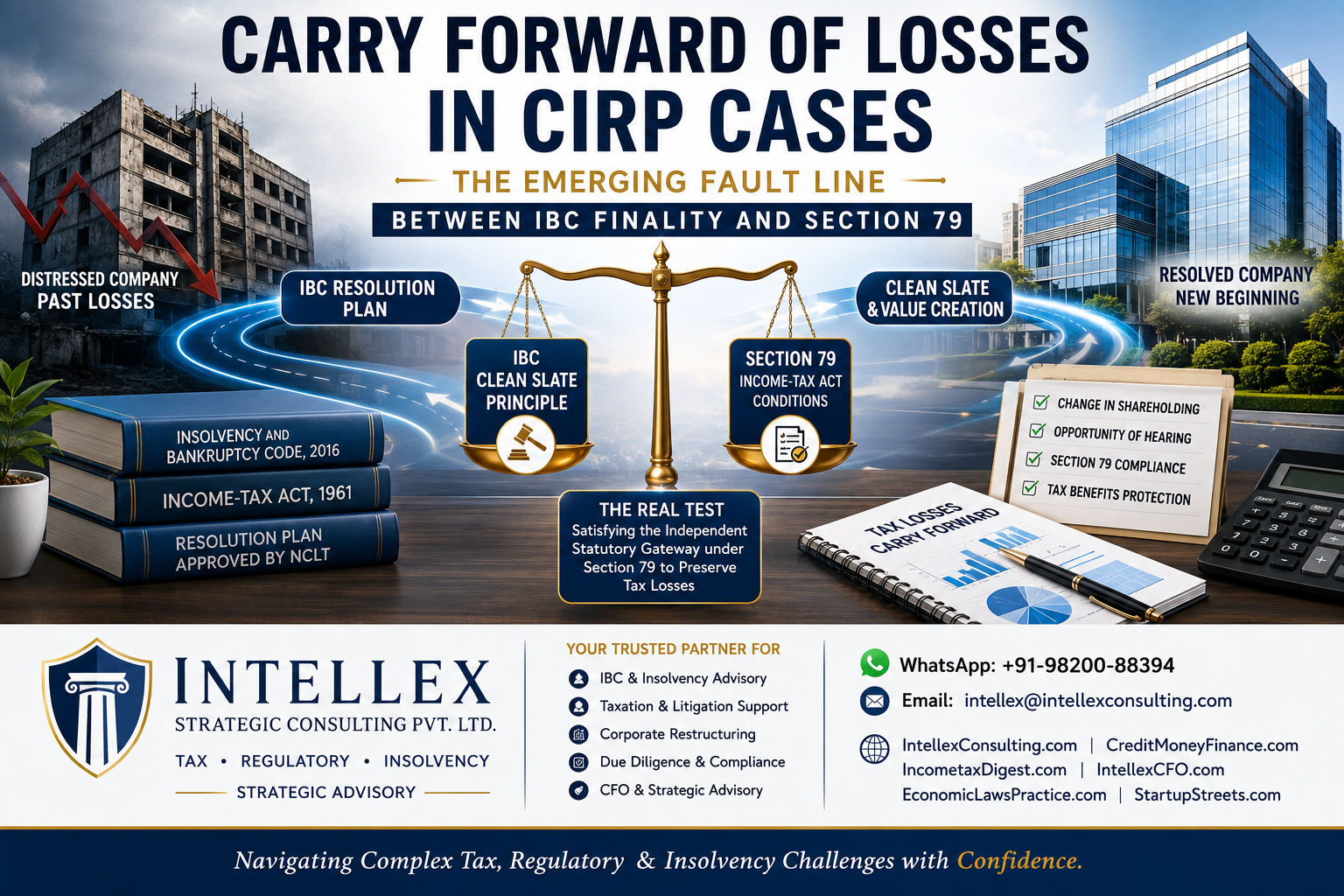
Carry Forward of Losses in CIRP Cases: The Emerging Fault Line Between IBC Finality and Section 79 of the Income-tax Act.
Carry forward of tax losses in CIRP cases is emerging as a major dispute between resolution applicants and the Income-tax Department. Learn how Section 79 of the Income-tax Act interacts with IBC resolutions, the impact of the JSW Steel ruling, and key compliance strategies for preserving tax losses.
As insolvency resolutions under the Insolvency and Bankruptcy Code, 2016 (IBC) continue to increase, a significant tax controversy has begun to emerge. Resolution applicants acquiring distressed companies through the Corporate Insolvency Resolution Process (CIRP) often factor accumulated tax losses into their valuation and acquisition strategy.
However, the Income-tax Department has increasingly started issuing notices challenging the carry forward and set-off of such losses after completion of CIRP. This development has created uncertainty for investors, resolution applicants, insolvency professionals, and lenders.
At the heart of the controversy lies a fundamental question:
Does the “clean slate” principle under the IBC automatically preserve tax losses, or must the assessee independently satisfy the conditions prescribed under Section 79 of the Income-tax Act, 1961?
This issue is rapidly becoming one of the most important fault lines between insolvency law and tax law.
Understanding the IBC Framework
The “Clean Slate” Principle
The Insolvency and Bankruptcy Code was enacted to facilitate revival of financially distressed businesses and maximize value for stakeholders.
A key feature of the framework is the finality accorded to an approved resolution plan.
Under Section 31 of the IBC:
- An approved resolution plan becomes binding on all stakeholders.
- Government authorities, including tax authorities, are bound by the approved plan.
- Claims not included in the approved resolution plan stand extinguished.
- Resolution applicants acquire the corporate debtor on a fresh footing.
The objective is clear: a successful resolution applicant should not be burdened with unknown historical liabilities after investing in the revival of the business.
Supreme Court Recognition of the Clean Slate Doctrine
The landmark judgment of the Hon’ble Supreme Court in:
Ghanashyam Mishra & Sons Pvt. Ltd. v. Edelweiss Asset Reconstruction Company Ltd.
firmly established that:
- Once a resolution plan is approved, all claims not forming part of the plan stand extinguished.
- Government authorities cannot subsequently raise or enforce historical claims.
- Resolution applicants are entitled to certainty and finality.
The Supreme Court emphasized that successful resolution applicants cannot be exposed to endless litigation and undisclosed liabilities after implementation of a resolution plan.
This judgment significantly strengthened confidence in the insolvency resolution framework.
Section 79 of the Income-tax Act – The Governing Tax Provision
While the IBC grants commercial finality, tax benefits are governed by the Income-tax Act.
The controversy primarily revolves around Section 79.
General Rule under Section 79
Section 79 seeks to prevent trafficking in tax losses.
The provision generally states that:
- A company cannot carry forward and set off accumulated business losses if there is a substantial change in shareholding.
- At least 51% of voting power should continue to be held by the same shareholders.
The legislative intent is to prevent acquisition of shell companies merely for utilizing accumulated tax losses.
Special Relaxation for IBC Cases
Recognizing that insolvency resolutions necessarily involve change in ownership, Parliament introduced a specific relaxation under Section 79.
The exemption allows carry forward of losses where:
- The change in shareholding occurs pursuant to an approved resolution plan under the IBC.
- Certain prescribed conditions are satisfied.
A critical requirement incorporated into the provision is that the resolution plan should be approved after affording a reasonable opportunity of being heard to the jurisdictional Principal Commissioner of Income Tax (PCIT) or Commissioner of Income Tax (CIT).
This condition has now become the focal point of litigation.
Why Is the Income-tax Department Issuing Notices?
In recent years, the Department has increasingly scrutinized cases involving substantial tax losses preserved after CIRP.
The Department’s position is generally based on the following arguments:
1. Section 79 Is an Independent Statutory Provision
According to the Department, while the IBC may extinguish past tax liabilities, preservation of tax losses is a separate statutory benefit.
Therefore, the assessee must independently satisfy Section 79 conditions.
2. Opportunity of Hearing Requirement
The Department frequently argues that:
- The jurisdictional PCIT/CIT was not effectively heard.
- No meaningful opportunity was provided before approval of the resolution plan.
- Mere circulation of documents may not satisfy statutory requirements.
3. Tax Benefits Are Not Automatic
The Department contends that:
- IBC approval does not automatically grant tax benefits.
- Conditions expressly prescribed in the Income-tax Act must still be fulfilled.
As a result, notices are being issued seeking to deny carry forward and set-off of accumulated losses.
The Emerging Judicial Trend
The JSW Steel Line of Cases
One of the most discussed developments has been the approach adopted in cases involving:
JSW Steel Limited
The Income Tax Appellate Tribunal (ITAT) examined whether the statutory conditions under Section 79 had been satisfied.
The broader reasoning reflected in such decisions suggests:
- Tax concessions cannot automatically arise merely because a resolution plan has been approved.
- Compliance with the specific requirements of Section 79 remains necessary.
- The burden may lie upon the assessee to demonstrate fulfillment of the statutory conditions.
The rulings have emboldened tax authorities to revisit large tax loss claims arising from CIRP resolutions.
The Core Legal Conflict
The controversy effectively involves two competing legal principles.
View 1: IBC Finality Must Prevail
Supporters of this approach argue:
- The objective of IBC is revival of distressed businesses.
- Resolution applicants evaluate transactions based on available tax attributes.
- Subsequent denial of losses undermines commercial certainty.
- The clean slate principle would be diluted if tax benefits can be challenged after plan approval.
Under this view, substantial deference should be given to approved resolution plans.
View 2: Tax Statutes Must Be Independently Complied With
The Revenue’s perspective is that:
- Tax benefits are creatures of statute.
- Every exemption, deduction, or concession must satisfy statutory conditions.
- IBC cannot override explicit conditions contained in Section 79.
- Preservation of losses requires affirmative compliance with the Income-tax Act.
Under this interpretation, tax authorities retain the right to verify compliance with Section 79 even after CIRP completion.
Practical Implications for Resolution Applicants
The issue has significant commercial implications.
Valuation Risks
Accumulated tax losses often represent substantial value.
If such losses are ultimately denied:
- Enterprise valuations may be impacted.
- Financial projections may require revision.
- Expected tax shields may disappear.
Increased Litigation
Tax disputes relating to Section 79 are likely to increase.
Potential forums include:
- Assessing Officers
- Commissioner (Appeals)
- Income Tax Appellate Tribunal
- High Courts
- Supreme Court
Due Diligence Requirements
Future resolution applicants should carefully examine:
- Whether notice was served on tax authorities.
- Whether meaningful participation was allowed.
- Records evidencing opportunity of hearing.
- Compliance documentation maintained during CIRP.
Drafting of Resolution Plans
Resolution professionals and legal advisors may increasingly seek:
- Explicit references to Section 79 compliance.
- Documentary evidence of tax authority participation.
- Detailed records of notices and communications.
Such safeguards may become critical in defending future tax assessments.
Strategic Considerations Going Forward
Given the evolving litigation landscape, stakeholders should consider:
For Resolution Applicants
- Conduct detailed tax due diligence.
- Quantify exposure if losses are denied.
- Maintain evidence of statutory compliance.
- Seek expert tax opinions during acquisition planning.
For Insolvency Professionals
- Ensure robust communication with tax authorities.
- Maintain documentary evidence of notices issued.
- Preserve records demonstrating opportunity of hearing.
For Lenders and Investors
- Reassess valuation assumptions involving carried-forward losses.
- Evaluate potential tax litigation risks.
- Factor uncertainty into transaction structuring.
Conclusion
The controversy surrounding carry forward of losses in CIRP cases represents one of the most significant emerging intersections between insolvency law and tax law.
The issue is no longer whether the IBC binds the Income-tax Department. The law on that aspect has been substantially settled through the clean slate doctrine and judicial precedents.
The real dispute lies elsewhere.
The central question is whether an assessee has successfully crossed the independent statutory gateway contained in Section 79 of the Income-tax Act for preserving accumulated losses after a change in ownership under an approved resolution plan.
As tax authorities intensify scrutiny and judicial precedents continue to evolve, resolution applicants must move beyond assumptions and focus on demonstrable compliance. The future of tax loss preservation in CIRP cases may ultimately depend not merely on the existence of an approved resolution plan, but on the ability to prove satisfaction of the specific statutory conditions embedded within the Income-tax Act.
Professional Assistance
Intellex Strategic Consulting Pvt. Ltd. provides specialized advisory services in:
- IBC and Insolvency Taxation
- Corporate Restructuring & Resolution Planning
- Section 79 Compliance Reviews
- Tax Due Diligence for Resolution Applicants
- Income-tax Litigation & Representation
- NCLT and CIRP Advisory
- CFO and Strategic Tax Advisory Services
- Corporate Law and Regulatory Compliance
WhatsApp: +91-98200-88394
Email: intellex@intellexconsulting.com
Websites:
- IntellexConsulting.com
- CreditMoneyFinance.com
- IncometaxDigest.com
- IntellexCFO.com
- EconomicLawsPractice.com
- StartupStreets.com
For professional guidance on CIRP tax implications, Section 79 compliance, tax litigation strategy, and insolvency-related structuring, businesses and resolution applicants may seek expert assistance from Intellex Strategic Consulting Pvt. Ltd.
Economic LawsPractice.com
More Featured Articles:
Ultimate Guide to Singapore Company Registration 2026: Rules, Costs, and Compliance.
The Ultimate Guide to Company Registration in Dubai 2026: Benefits, Compliance, and Costs.
GST Advisory Services by IntellexCFO.com to indian business community.
Funding & Investment Options to Grow India’s Real Estate & Allied Businesses



One thought on “Carry Forward of Losses in CIRP Cases: The Emerging Fault Line Between IBC Finality and Section 79 of the Income-tax Act.”