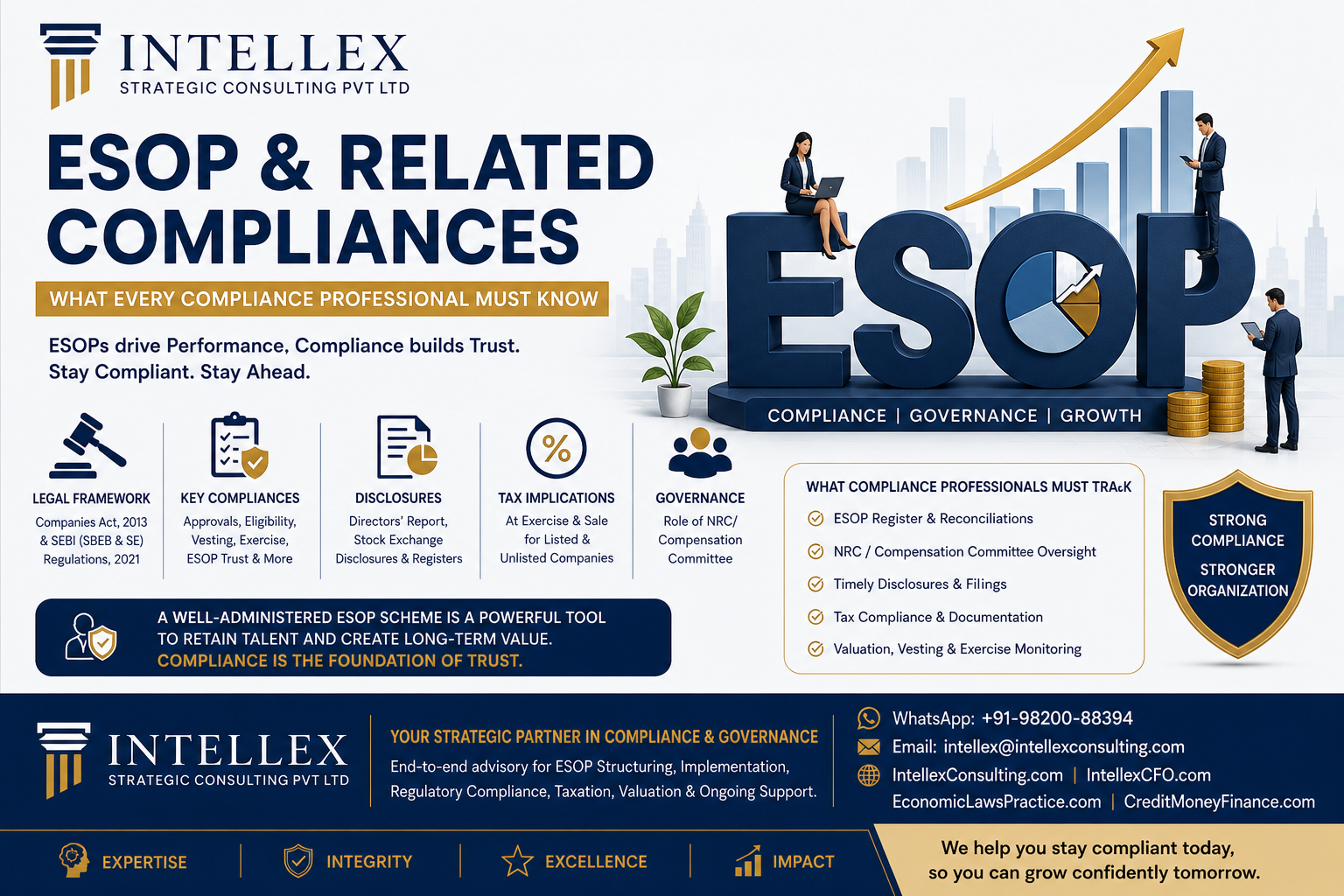
ESOP Compliance in India: A Complete Guide for Compliance Professionals (2026 Edition).
Comprehensive guide on ESOP compliance in India covering SEBI regulations, Companies Act provisions, taxation, disclosures, and best practices for compliance professionals.
ESOP and Related Compliances – What Every Compliance Professional Must Know
Employee Stock Option Plans (ESOPs) have evolved into one of the most strategic instruments for companies to align employee interests with long-term business growth. While they are widely appreciated for talent retention and wealth creation, ESOPs come with a dense regulatory and compliance framework that requires precision and continuous monitoring.
For compliance professionals, ESOPs are not just HR tools—they are governance mechanisms with legal, financial, and tax implications.
1. Understanding ESOPs: The Strategic Context
An ESOP grants employees the right (but not obligation) to purchase shares of the company at a predetermined price after a specified vesting period.
From a compliance standpoint, ESOPs involve:
- Capital restructuring
- Shareholder rights
- Regulatory disclosures
- Taxation implications
A poorly administered ESOP can lead to regulatory penalties, reputational risk, and employee disputes.
2. The Legal Framework Governing ESOPs in India
a. Companies Act, 2013
Section 62(1)(b) governs the issuance of shares to employees under ESOP schemes.
Key requirements:
- Mandatory shareholder approval via special resolution
- Detailed explanatory statement in the notice
- Compliance with Rule 12 of Companies (Share Capital and Debentures) Rules, 2014
b. SEBI (Share Based Employee Benefits and Sweat Equity) Regulations, 2021
Applicable to listed companies, these regulations provide a comprehensive framework for ESOP administration.
Core areas covered:
- Eligibility of employees
- Grant, vesting, and exercise conditions
- Pricing mechanisms
- Disclosure norms
- Role of the Nomination and Remuneration Committee (NRC)
These regulations consolidated earlier ESOP and sweat equity guidelines into a single unified framework.
3. Key Compliance Requirements
a. Shareholder Approval
- ESOP schemes must be approved before grant
- Any material modification requires fresh approval
b. Eligibility Restrictions
- Promoters and promoter group are not eligible
- Independent Directors are excluded under SEBI regulations
c. Vesting and Exercise Conditions
- Minimum 1-year vesting period
- Exercise period must be clearly defined in the scheme
- Conditions for early vesting (death, disability, etc.) must be specified
d. ESOP Trust Mechanism
Many companies use an ESOP Trust for:
- Secondary market acquisitions
- Efficient share distribution
Compliance considerations:
- Trust deed and governance structure
- Funding mechanism
- Accounting treatment
- SEBI restrictions on trust operations
4. Disclosure and Reporting Requirements
a. Directors’ Report Disclosures
Companies must disclose:
- Options granted, vested, exercised, lapsed
- Exercise price
- Employee-wise details (for senior management)
- Dilution impact
b. Stock Exchange Filings (for Listed Companies)
- Periodic disclosures of ESOP activity
- Compliance certificates
- Scheme-related updates
c. Maintenance of Registers
A robust ESOP Register should track:
- Grants
- Vesting schedules
- Exercises
- Lapses
This becomes critical during:
- Statutory audits
- SEBI inspections
- Due diligence
5. Tax Implications of ESOPs
ESOP taxation occurs at two stages:
a. At the Time of Exercise
- Difference between Fair Market Value (FMV) and exercise price
- Taxed as perquisite under salary income
b. At the Time of Sale
- Capital gains tax applies
- Holding period determines:
- Short-term capital gains (STCG)
- Long-term capital gains (LTCG)
c. Special Considerations for Unlisted Companies
- Valuation complexities
- Deferred taxation provisions for eligible startups
- Liquidity challenges for employees
6. Role of the Nomination & Remuneration Committee (NRC)
The NRC plays a central role in ESOP governance:
Responsibilities include:
- Approving grants
- Monitoring vesting
- Ensuring regulatory compliance
- Reviewing scheme performance
Regular meetings and proper documentation are essential for audit trails.
7. Practical Compliance Challenges
a. Data Reconciliation
Mismatch between HR and compliance records can lead to:
- Incorrect disclosures
- Audit qualifications
b. Valuation Issues
- Determining FMV for unlisted companies
- Consistency in valuation methodology
c. Regulatory Interpretation
- Ambiguities in eligibility and structuring
- Frequent updates in SEBI framework
d. Employee Communication
- Lack of clarity can lead to disputes
- ESOP documentation must be transparent and precise
8. Best Practices for Compliance Professionals
- Maintain a centralized ESOP management system
- Conduct quarterly reconciliations
- Ensure legal, HR, and finance alignment
- Keep detailed documentation and audit trails
- Periodically review the scheme against evolving regulations
9. Why ESOP Compliance Matters
A well-structured ESOP is not just a compensation tool—it is a governance framework that reflects the company’s commitment to transparency and long-term value creation.
Poor compliance, on the other hand, can result in:
- Regulatory penalties
- Shareholder disputes
- Employee dissatisfaction
Conclusion
ESOP compliance is a domain where precision is everything. From shareholder approvals to taxation and disclosures, each step demands meticulous attention.
For compliance professionals, mastering ESOP frameworks is no longer optional—it is a critical capability in modern corporate governance.
A well-administered ESOP scheme can transform employee engagement and create sustainable value, but only when backed by strong compliance discipline.
How We Can Help
Intellex Strategic Consulting Pvt Ltd provides end-to-end advisory and compliance support for ESOP structuring, implementation, and regulatory compliance.
📞 WhatsApp: +91-98200-88394
📧 Email: intellex@intellexconsulting.com
🌐 Websites:
- IntellexConsulting.com
- IntellexCFO.com
- EconomicLawsPractice.com
- CreditMoneyFinance.com
Our services include:
- ESOP scheme design and structuring
- Regulatory compliance and filings
- ESOP trust advisory
- Tax and valuation guidance
- Ongoing compliance management
Intellex Strategic Consulting Pvt Ltd
More Featured Posts:
Post Office Tax Compliance 2026: Key Changes, SFT Reporting & Practical Impact on Investors.
The Ultimate Guide to Company Registration in Dubai 2026: Benefits, Compliance, and Costs.
Ultimate Guide to Singapore Company Registration 2026: Rules, Costs, and Compliance.
ECB Rules Changed Big Time in 2026: What Indian Businesses Must Know to Unlock Global Funding.



2 thoughts on “ESOP Compliance in India: A Complete Guide for Compliance Professionals (2026 Edition).”