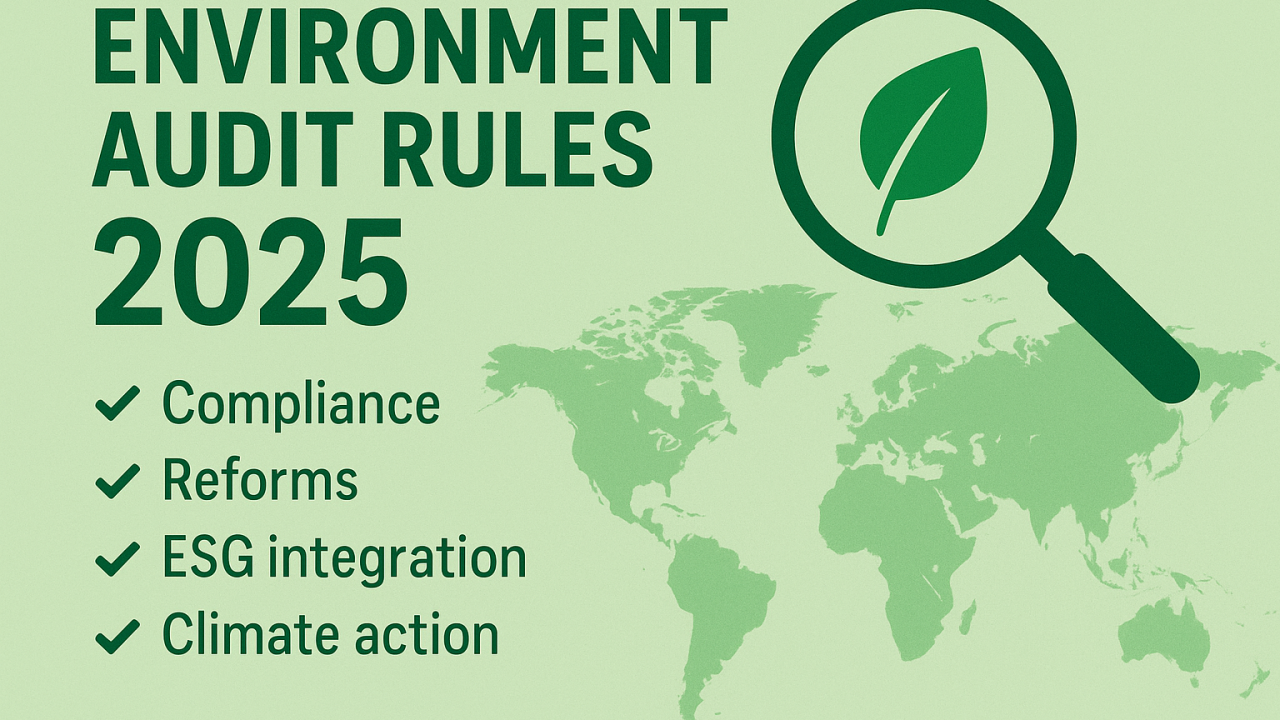
The Environment Audit Rules, 2025 – What Every Corporate Leader Needs to Know.
Stay compliant with India’s new Environment Audit Rules, 2025. Learn how mandatory third-party environmental audits, ESG accountability, audit readiness, and stricter compliance norms will impact corporate governance, legal risk, sustainability reporting, and business operations.
The Environment Audit Rules, 2025, notified by the Indian Ministry of Environment, Forest and Climate Change (MoEFCC) on August 29, 2025, introduce a mandatory, third-party audit system for specified projects and industries. Corporate leaders must understand these rules as they shift India’s environmental compliance from a reactive, regulator-led model to a proactive, independent, and transparent framework.
The Ministry of Environment, Forest and Climate Change (MoEFCC) has notified the Environment Audit Rules, 2025 on 29th August 2025 a major reform that’s set to redefine how Indian companies manage environmental compliance.
If you’re in Senior Management, Legal, Compliance or ESG, this one deserves your attention
What These Rules Mean:
These Rules aim to make environmental compliance audit-based and verifiable – moving from paper compliance to real, data-driven accountability.
✅ Independent Audits: Certified Environment Auditors (CEAs) & Registered Environment Auditors (REAs) will be empanelled and randomly assigned to companies.
✅ Reduced Conflicts of Interest: Auditors will be assigned through a central mechanism – no more “self-appointed” checks.
✅ Comprehensive Scope: Audits will cover projects, processes, and activities affecting the environment – including emissions, effluents, waste, and energy use.
✅ Accountability & Governance: A new Environment Audit Designated Agency (EADA) will certify and monitor auditors.
✅ Stronger Penalties: Misreporting or non-compliance may lead to environmental compensation, suspension, or prosecution.
Why It Matters to Legal & Senior Management Teams:
This is not “just another compliance rule.”
It’s a shift in corporate governance:
• Environmental audit outcomes can now directly affect ESG scores, investor trust, and financing.
• Random audits mean you must be ready all the time.
• Internal documentation, monitoring systems, and risk controls will now be under external scrutiny.
• Legal exposure will increase — especially if environmental compensation is computed through audit findings.
What Smart Companies Should Do
✅ Map all activities with potential environmental impact.
✅ Strengthen documentation & internal controls.
✅ Integrate environmental data with ESG reporting.
✅ Prepare for independent audit and third-party verification.
✅ Build audit-readiness as a Board-level priority.
How Intellex Strategic Consulting Pvt Ltd can Help
At Intellex, we go beyond compliance , we help you convert risk into resilience. Here’s how:
Gap Analysis: Assess your current compliance status under the new Rules.
Audit Readiness: Build documentation, reporting, and response frameworks.
Legal & Regulatory Advisory: Ensure your contracts, disclosures, and remediation measures are airtight.
ESG Integration: Align environmental audit results with sustainability goals and investor disclosures.
Training & Capacity Building: Empower your management & EHS teams to navigate the new regime confidently.
Environmental audits are not just a legal requirement anymore – they’re a strategic advantage for companies that are proactive.
Let’s make compliance your competitive edge.
Intellex Strategic Consulting Pvt Ltd
More Featured Articles:
Ultimate Guide to Singapore Company Registration 2026: Rules, Costs, and Compliance.
The Ultimate Guide to Company Registration in Dubai 2026: Benefits, Compliance, and Costs.