The NBFC 50-50 Test Explained: How to Determine Whether Your Company Qualifies as an NBFC Under RBI Regulations.
Understand the NBFC 50-50 test under RBI guidelines—learn how asset and income criteria determine NBFC classification, compliance requirements, and regulatory risks for companies in India.
The NBFC 50-50 Test – How Do You Determine If a Company is an NBFC?
One of the most frequently asked questions in corporate compliance and financial regulation is deceptively simple: When does a company become a Non-Banking Financial Company (NBFC)?
The answer lies in a critical regulatory benchmark prescribed by the Reserve Bank of India — commonly referred to as the 50-50 test.
This test serves as the foundation for determining whether a company falls within the regulatory ambit of an NBFC and consequently whether it must obtain registration and comply with RBI norms.
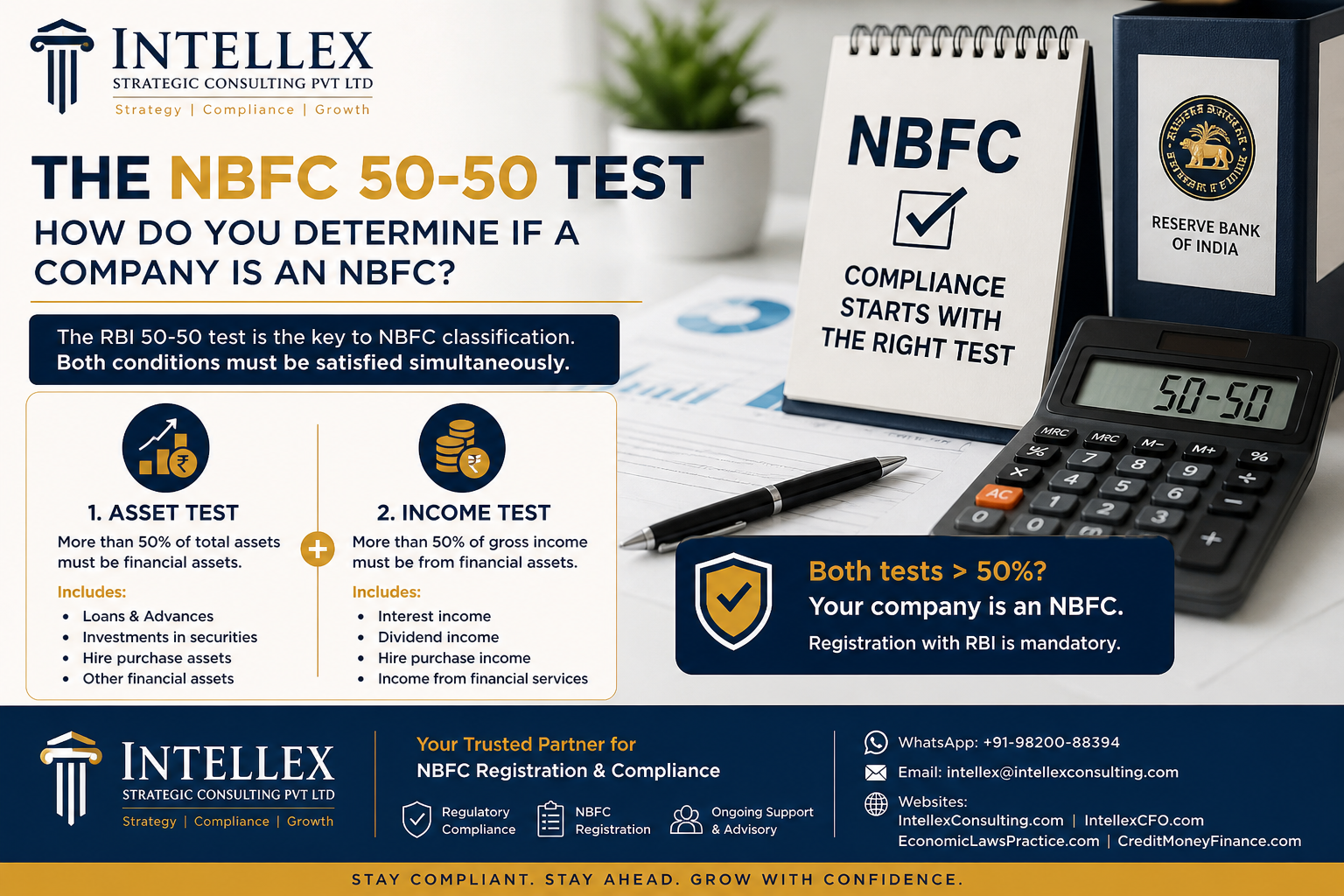
Understanding the 50-50 Test
The 50-50 test is a dual-condition framework, meaning both conditions must be satisfied simultaneously.
1. Asset-Based Criterion (Financial Assets Test)
A company must ensure that:
More than 50% of its total assets are financial assets
What qualifies as financial assets?
Financial assets typically include:
- Loans and advances
- Investments in shares, debentures, bonds, and securities
- Hire purchase and leasing assets
- Receivables arising from financial transactions
- Any other asset of a financial nature
What is excluded?
- Fixed assets (plant, machinery, buildings)
- Inventory and trade receivables (non-financial in nature)
- Intangible assets unrelated to financial activity
2. Income-Based Criterion (Financial Income Test)
The second limb requires:
More than 50% of the company’s gross income must come from financial assets
What constitutes financial income?
- Interest income
- Dividend income
- Income from investments
- Hire purchase income
- Leasing income
- Fees from financial services
The Golden Rule: Both Conditions Must Be Met
This is where many companies make mistakes.
✔ If both criteria exceed 50% → Company is an NBFC
✘ If only one criterion is met → NOT an NBFC
This dual requirement ensures that only companies predominantly engaged in financial activities are classified as NBFCs.
Legal Implication Under RBI Framework
Under the RBI Act:
No company can carry on the business of a non-banking financial institution without obtaining a Certificate of Registration (CoR) from the Reserve Bank of India.
Failure to comply can result in:
- Regulatory penalties
- Business restrictions
- Legal consequences
- Reputational damage
Why the 50-50 Test is Crucial for Compliance Professionals
The importance of this test extends far beyond initial classification.
1. It is a Continuous Test, Not a One-Time Exercise
Business models evolve. A company that was previously outside NBFC classification may:
- Increase lending activities
- Expand investment portfolios
- Generate higher financial income
This can push it beyond the 50-50 threshold over time.
2. Risk of Unintentional Non-Compliance
Companies often overlook:
- Group entities with mixed activities
- Investment-heavy subsidiaries
- Treasury-driven income growth
Crossing the threshold unknowingly means:
Operating as an NBFC without RBI registration — a direct violation
3. Group-Level Monitoring is Essential
Organizations should:
- Periodically review financial statements
- Track asset composition and income streams
- Monitor subsidiaries and SPVs
- Evaluate restructuring impact
Practical Example
Consider a company with:
- 55% of assets in loans and investments ✔
- Only 40% of income from financial sources ✘
➡ Result: Not an NBFC
Now consider:
- 60% financial assets ✔
- 65% financial income ✔
➡ Result: NBFC — Registration required
Best Practices for Businesses
To stay compliant, companies should:
1. Conduct Periodic 50-50 Assessments
Quarterly or annual reviews are advisable.
2. Align Business Strategy with Regulatory Position
Be clear whether you intend to:
- Remain a non-NBFC
- Transition into an NBFC
3. Maintain Documentation
Keep:
- Asset classification workings
- Income segmentation analysis
- Board-level notes on classification
4. Seek Expert Guidance
Regulatory interpretation can be nuanced—professional advice helps avoid costly mistakes.
Conclusion
The NBFC 50-50 test is not just a technical rule—it is a regulatory gateway that determines whether a company enters one of the most tightly supervised sectors in India.
Understanding and applying this test correctly is essential for:
- CFOs
- Compliance professionals
- Promoters and business owners
Ignoring it is not an option—because the cost of misclassification can be significant.
How Intellex Can Help
Intellex Strategic Consulting Pvt Ltd offers expert advisory and compliance support in NBFC classification, RBI registration, and ongoing regulatory compliance.
📱 WhatsApp: +91-98200-88394
📧 Email: intellex@intellexconsulting.com
🌐 Websites:
- IntellexConsulting.com
- IntellexCFO.com
- EconomicLawsPractice.com
- CreditMoneyFinance.com
Whether you are evaluating your NBFC status or planning registration, Intellex provides strategic, legal, and financial expertise under one roof.
Intellex Strategic Consulting Pvt Ltd
More Featured Articles:
RBI FLA Return 2026: Compliance Challenges for GIFT IFSC Entities Under FEMA Explained.
Transfer Pricing Overhaul in India: A Complete Guide to New Form 48 (Effective FY 2026-27)
8 Types of Tax-Free Income in India You Must Know (2026 Guide for Smart Tax Planning)
Funding & Investment Options to Grow India’s Real Estate & Allied Businesses

8 thoughts on “The NBFC 50-50 Test Explained: How to Determine Whether Your Company Qualifies as an NBFC Under RBI Regulations.”