Material Outsourcing in NBFCs: RBI Guidelines, Risks, and Compliance Framework Every NBFC Must Follow.
A comprehensive guide on material outsourcing in NBFCs, covering RBI regulations, compliance requirements, risk management, and best practices. Essential reading for compliance professionals.
Material Outsourcing in NBFCs: What It Means and What Compliance Professionals Must Ensure
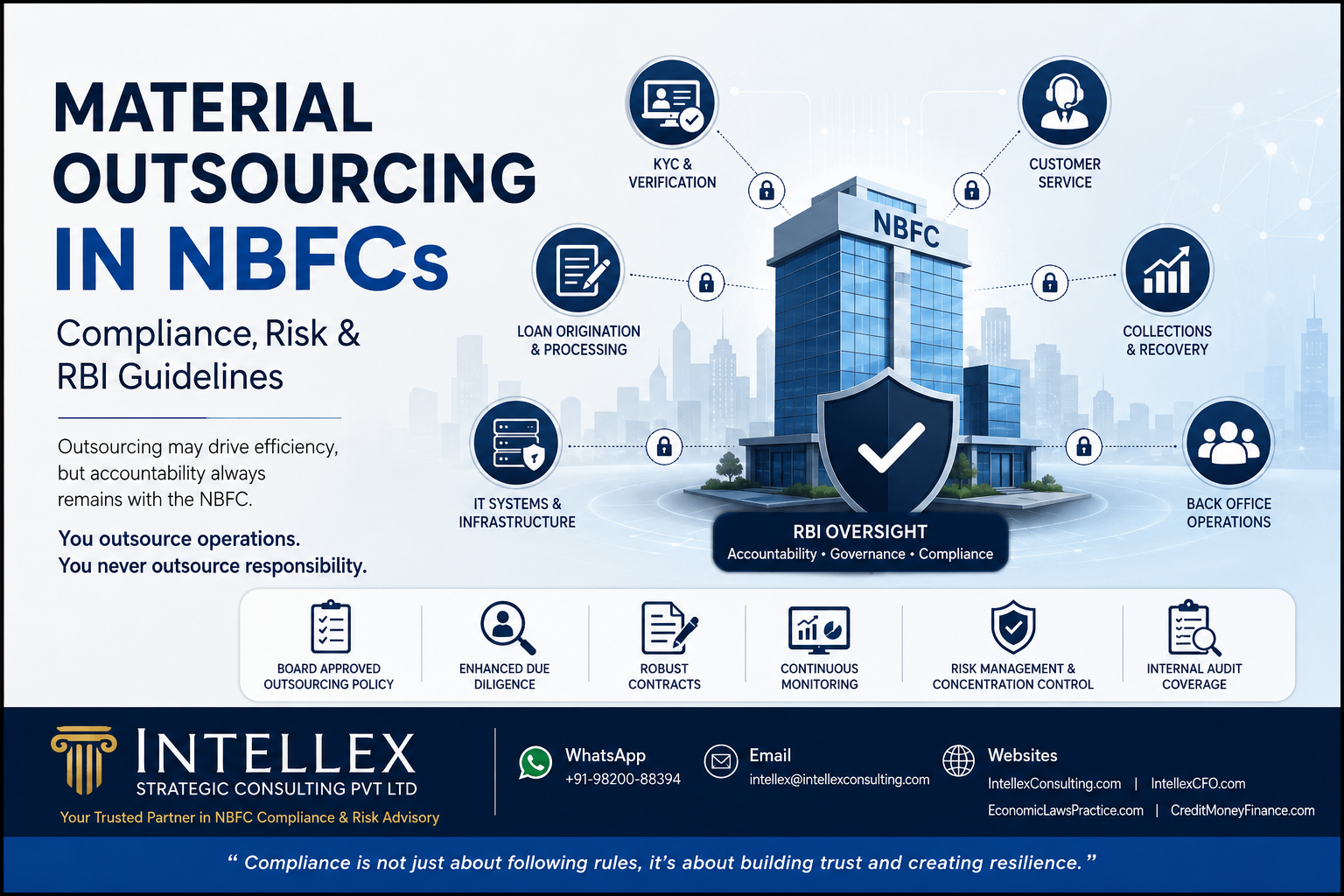
Outsourcing is no longer a support function—it is a core operational strategy for Non-Banking Financial Companies (NBFCs). From loan origination platforms and KYC verification to collections, customer service, and back-office operations, NBFCs today rely extensively on third-party service providers.
However, the regulatory stance of the Reserve Bank of India (RBI) is unequivocal:
Outsourcing does not dilute accountability.
Even when activities are outsourced, the NBFC retains full responsibility for regulatory compliance, customer protection, and operational integrity. This principle forms the backbone of RBI’s outsourcing framework.
Understanding Material Outsourcing
Not all outsourcing arrangements are treated equally. RBI introduces the concept of material outsourcing, which carries heightened regulatory scrutiny.
What qualifies as Material Outsourcing?
An outsourcing arrangement is considered material when:
- The activity is critical to business operations
- A disruption could impact financial stability
- There is potential for reputational damage
- The function involves customer data or sensitive information
- It affects regulatory compliance obligations
Examples of Material Outsourcing in NBFCs
- Loan origination and underwriting platforms
- Collections and recovery operations
- KYC and customer onboarding processes
- Core IT systems and cloud infrastructure
- Customer grievance handling
In essence, if the failure of a service provider can meaningfully disrupt the NBFC’s functioning or regulatory standing, the outsourcing is material.
RBI’s Expectations from NBFCs
1. Board-Approved Outsourcing Policy
Every NBFC must have a comprehensive outsourcing policy approved by its Board. This policy should clearly define:
- Criteria for identifying material outsourcing
- Vendor selection standards
- Due diligence procedures
- Contractual safeguards
- Monitoring and oversight mechanisms
This is not a “check-the-box” requirement—RBI expects the policy to be practically implementable and actively enforced.
2. Enhanced Due Diligence for Material Outsourcing
Before entering into a material outsourcing arrangement, NBFCs must conduct robust due diligence, covering:
- Financial strength of the service provider
- Operational capability and scalability
- Regulatory compliance history
- Data security and IT controls
- Business continuity and disaster recovery (BCP/DR)
A superficial assessment is a common compliance gap. RBI expects documented, evidence-backed evaluation.
3. Strong Contractual Framework
Contracts with service providers must be detailed and legally enforceable. Key clauses include:
- Right to audit by the NBFC and regulators
- Data confidentiality and protection obligations
- Business continuity requirements
- Restrictions on sub-contracting
- Clear termination rights
- Defined service level agreements (SLAs)
Contracts are not just legal documents—they are risk control instruments.
4. Continuous Monitoring and Oversight
Compliance does not end at onboarding.
NBFCs must ensure:
- Periodic performance reviews
- Compliance assessments
- Risk evaluations
- Audit coverage of outsourced functions
Monitoring must be continuous, structured, and documented.
5. Non-Outsourceable Functions
RBI explicitly prohibits outsourcing of certain critical functions:
- Internal audit
- Compliance function
- Core KYC responsibility (ultimate accountability remains with NBFC)
- Credit decision-making and sanctioning authority
- Regulatory reporting and interface with RBI
These functions are fundamental to governance and cannot be delegated.
6. Managing Concentration Risk
A frequently overlooked risk is vendor concentration.
NBFCs must assess:
- Dependence on a single service provider
- Exposure to group entities or related vendors
- Geographic and operational concentration risks
A disruption at one vendor should not paralyze the entire NBFC.
7. Integration with Internal Audit
All material outsourcing arrangements must fall within the internal audit scope.
Audit should evaluate:
- Vendor compliance with contractual obligations
- Effectiveness of oversight mechanisms
- Data security and operational controls
- Risk management practices
Key Risks in Material Outsourcing
Compliance professionals must actively manage the following risks:
1. Operational Risk
Failure of a service provider can disrupt critical processes.
2. Compliance Risk
Regulatory violations by vendors still impact the NBFC.
3. Data Security Risk
Outsourcing increases exposure to data breaches and cyber threats.
4. Reputational Risk
Customer dissatisfaction or misconduct by vendors damages brand trust.
5. Strategic Risk
Over-reliance on vendors may weaken internal capabilities.
Bridging the Gap: Policy vs Practice
One of the most common issues in NBFCs is the gap between documented policies and actual implementation.
Many organizations:
- Have outsourcing policies on paper
- Conduct initial due diligence
- But fail in ongoing monitoring and documentation
What Compliance Professionals Should Do
- Periodically review all outsourcing arrangements
- Identify material outsourcing contracts
- Strengthen oversight frameworks
- Ensure audit trails and documentation
- Test business continuity plans
- Evaluate vendor risk continuously
The goal is not compliance for the sake of compliance—but resilience, accountability, and regulatory confidence.
Practical Compliance Checklist
✔ Identify all outsourced activities
✔ Classify material vs non-material outsourcing
✔ Ensure Board-approved outsourcing policy
✔ Conduct enhanced due diligence
✔ Execute robust contracts
✔ Monitor vendors regularly
✔ Include outsourcing in internal audit
✔ Assess concentration risk
✔ Maintain detailed documentation
Conclusion
Material outsourcing is a powerful enabler for NBFC growth but it is equally a high-risk regulatory area.
The RBI’s message is clear:
You can outsource operations, but never accountability.
For compliance professionals, the focus must shift from policy creation to policy execution—ensuring that every material outsourcing arrangement is governed, monitored, and auditable.
About Us – Your Compliance Partner
Intellex Strategic Consulting Pvt Ltd specializes in regulatory compliance, risk advisory, and governance frameworks for NBFCs and financial institutions.
We assist in:
- Drafting and implementing outsourcing policies
- Vendor due diligence and risk assessment
- Compliance audits and gap analysis
- RBI regulatory advisory
- End-to-end NBFC compliance solutions
📞 WhatsApp: +91-98200-88394
📧 Email: intellex@intellexconsulting.com
🌐 Websites:
- IntellexConsulting.com
- IntellexCFO.com
- EconomicLawsPractice.com
- CreditMoneyFinance.com
Intellex Strategic Consulting Pvt Ltd
More Compliances Posts:
ESOP Compliance in India: A Complete Guide for Compliance Professionals (2026 Edition).
RBI FLA Return 2026: Compliance Challenges for GIFT IFSC Entities Under FEMA Explained.
3 thoughts on “Material Outsourcing in NBFCs: RBI Guidelines, Risks, and Compliance Framework Every NBFC Must Follow.”