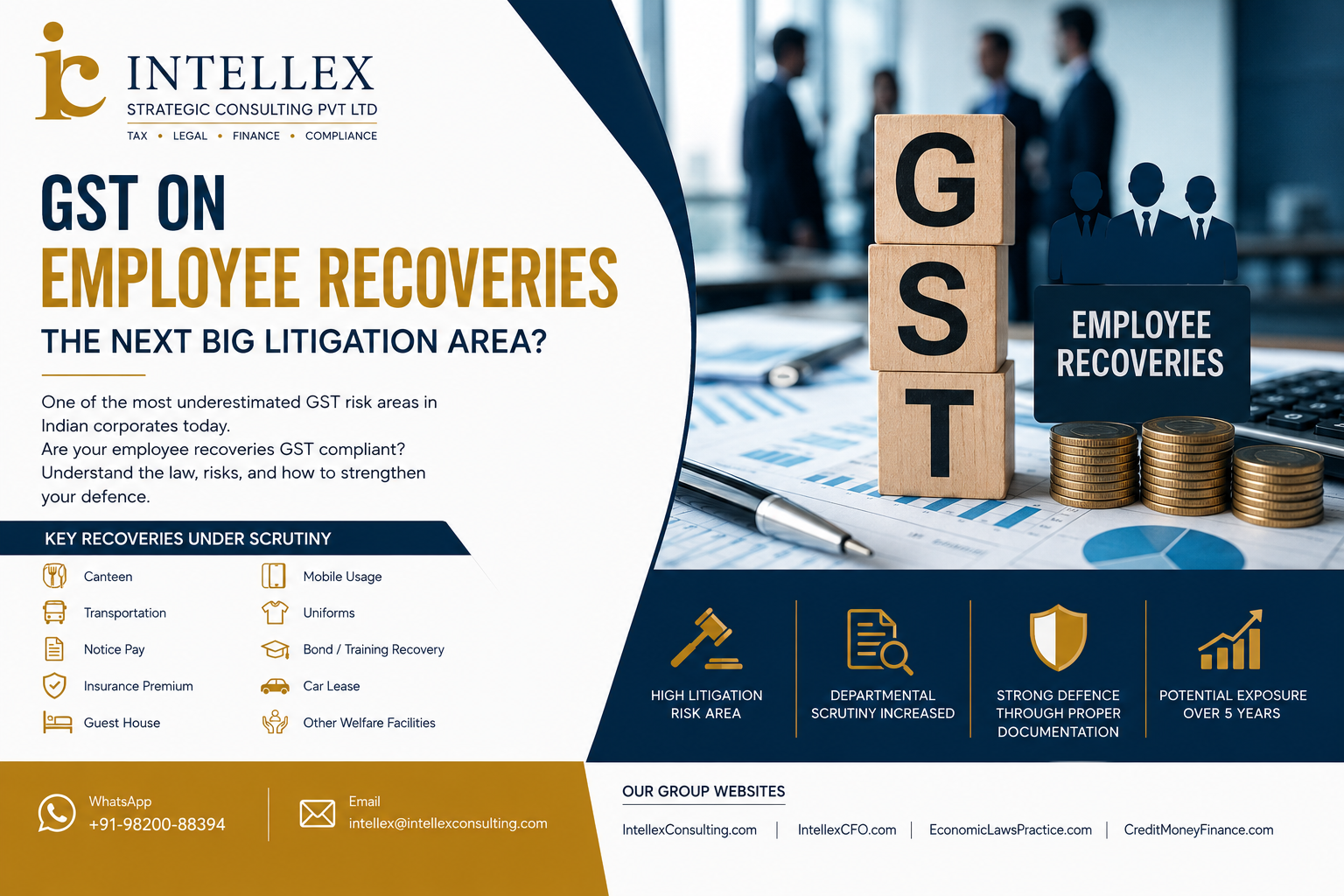
GST on Employee Recoveries Under GST in India: The Emerging Litigation Minefield for Corporates.
A detailed analysis of GST applicability on employee recoveries in India including canteen recoveries, transport facilities, insurance premiums, notice pay, guest house expenses, and employee welfare deductions. Understand CBIC circulars, legal positions, litigation risks, compliance strategies, and practical GST defence mechanisms for corporates.
GST on Employee Recoveries – The Next Major GST Litigation Battlefield in India
The Indian GST regime continues to evolve through litigation, departmental interpretations, advance rulings, and judicial pronouncements. While businesses have largely stabilized their positions on conventional GST matters, a relatively under-discussed yet rapidly emerging risk area is now attracting significant scrutiny from GST authorities across India:
“GST on Employee Recoveries”
Across industries, employers routinely recover certain amounts from employees towards welfare facilities, contractual obligations, and shared amenities. Historically, most corporates treated these recoveries as internal employment-related adjustments rather than taxable outward supplies.
However, GST authorities are increasingly questioning this treatment.
What appears to be a minor payroll deduction today could potentially result in substantial GST exposure involving:
- GST liability
- Interest
- Penalties
- Extended limitation disputes
- Litigation costs
- Audit observations
- DGGI investigations
For large organizations with thousands of employees, even nominal monthly recoveries can accumulate into multi-crore tax exposures over a five-year period.
This issue is now becoming one of the most important GST risk areas for Indian corporates.
Common Employee Recoveries Under Scrutiny
Organizations commonly recover amounts from employees towards:
- Canteen facilities
- Transportation and bus services
- Group medical insurance premiums
- Mobile and telephone usage
- Guest house accommodation
- Uniforms and safety equipment
- Bond recovery and training recovery
- Car lease facilities
- Club memberships
- Food coupons and meal cards
- Housing and accommodation facilities
- Internet reimbursements
- Notice pay recovery
- Staff welfare amenities
While many businesses consider these to be employment-related recoveries, tax authorities increasingly view them through the lens of “supply” under GST law.
Core Legal Question: Does Employee Recovery Amount to “Supply” Under GST?
The entire controversy revolves around the interpretation of Section 7 of the CGST Act, 2017.
Under GST law, tax is applicable only if there exists:
- A “supply”
- For “consideration”
- In the course or furtherance of business
The controversy arises because employee recoveries involve:
- A monetary recovery
- A facility or benefit
- A relationship between employer and employee
The tax department argues that once consideration is recovered, GST may become applicable.
However, industry contends that employer-employee transactions fundamentally differ from commercial transactions.
Employer-Employee Relationship Under GST
One of the strongest legal foundations available to taxpayers lies in Schedule III of the CGST Act.
Schedule III specifically states that:
Services by an employee to the employer in the course of employment are neither supply of goods nor supply of services.
The legislative intent clearly recognizes that employer-employee relationships are outside normal commercial taxation.
However, the dispute emerges when the transaction is reversed — namely:
When employer provides facilities to employees and recovers amounts.
The department’s position is that such recoveries may constitute outward supplies by the employer.
Industry disputes this interpretation strongly.
Department’s Stand on Employee Recoveries
GST authorities increasingly adopt the following arguments:
1. Recovery Equals Consideration
Where an employer recovers money from employees for facilities, the department alleges that:
- A service is being provided
- Consideration is being received
- Therefore GST becomes applicable
This interpretation heavily relies on the wide scope of “consideration” under GST.
2. Employer Providing Facilities Amounts to Business Activity
Authorities sometimes argue that organized provision of facilities such as:
- Transportation
- Canteen
- Accommodation
- Insurance
constitutes business-related supply activities.
3. Separate Recovery Indicates Commercial Intent
If organizations:
- Raise invoices
- Show recoveries separately
- Book income entries
- Recover amounts with markup
the department often treats such activities as taxable commercial supplies.
Industry’s Defence Against GST on Employee Recoveries
Most taxpayers strongly contest the above interpretation.
The industry position generally rests on the following principles:
1. Employer-Employee Relationship Is Not Commercial
Employee welfare arrangements arise from employment contracts and HR obligations — not from independent business transactions.
The relationship lacks commercial character.
2. Cost Sharing Is Not Supply
Many employers merely recover actual costs without profit motive.
Pure reimbursement or cost-sharing arrangements should not qualify as taxable supplies.
3. Welfare Facilities Are Integral to Employment
Several facilities are necessary for:
- Employee welfare
- Industrial compliance
- Operational efficiency
- Labour law obligations
Hence they should not be treated as independent taxable supplies.
4. No Intent to Conduct Business With Employees
Most organizations do not commercially operate canteens, transportation fleets, or welfare amenities for profit.
The facilities are incidental to employment.
Key Litigation Areas Under GST
1. GST on Canteen Recoveries
This is presently among the most litigated employee recovery issues.
Typical Scenario
The employer:
- Engages a canteen vendor
- Pays vendor charges
- Recovers part cost from employees
Department’s Argument
- Food service supplied to employees
- Recovery treated as consideration
- GST applicable
Taxpayer’s Defence
- Factory canteens may be mandatory under the Factories Act
- Employer merely facilitates statutory welfare
- No profit element exists
- Pure reimbursement arrangement
Important Risk Factors
High litigation risk exists where:
- Recovery exceeds actual cost
- Markup exists
- Employer earns margin
- Separate GST invoice issued
- Recoveries treated as revenue income
2. GST on Transportation Recoveries
Employers often provide:
- Employee buses
- Cab facilities
- Pick-up and drop arrangements
especially for:
- Factories
- IT companies
- BPOs
- Night shift operations
Department’s View
Recovery from employees indicates transportation service.
Defence Position
- Transportation is operational necessity
- Employee safety obligation
- No independent business activity
- Cost-sharing arrangement only
3. GST on Insurance Premium Recoveries
Organizations frequently provide:
- Group health insurance
- Mediclaim policies
- Parental coverage
- Top-up insurance
where part premium is recovered from employees.
Key Litigation Question
Whether employer merely facilitates insurance or actually supplies insurance service.
Defence Available
- Insurance provided through insurer
- Employer acts as facilitator
- No independent supply by employer
4. GST on Guest House Recoveries
Many corporates provide temporary accommodation facilities for:
- Relocating employees
- Travelling staff
- Senior management
- Factory personnel
Recoveries from employees sometimes trigger GST disputes.
Authorities may view such recoveries as taxable accommodation services.
5. GST on Bond Recovery and Training Recovery
Several companies recover amounts when employees:
- Leave before minimum service period
- Breach employment bond
- Exit after specialized training
The legal debate centers around whether such recovery represents:
- Compensation for breach
OR - Consideration for tolerating an act
This issue remains heavily litigated.
Notice Pay Recovery – Important Relief for Taxpayers
One of the most significant developments came through:
CBIC Circular No. 178/10/2022-GST
The circular clarified that:
Notice Pay Recovery generally should NOT attract GST.
The rationale:
- It represents compensation for breach of employment contract
- Not consideration for service
- Employer is not supplying any service
This clarification provided substantial relief to industry.
However, despite the circular, practical disputes still continue during audits and investigations.
Why Employee Recoveries Have Become a Major GST Audit Focus
GST authorities increasingly use:
- Payroll analytics
- Ledger scrutiny
- Expense verification
- ERP reviews
- HR reconciliation
- Vendor matching
- Employee deduction analysis
to identify potential tax leakages.
Authorities now routinely examine:
- Salary ledgers
- Employee deduction heads
- Welfare expense recoveries
- Payroll accounting entries
- Inter-department cost allocations
during GST audits and DGGI investigations.
Key Risk Indicators for GST Authorities
The following factors significantly increase litigation exposure:
❌ Recovery Above Actual Cost
Markup or surplus recovery creates strong departmental allegations of commercial supply.
❌ Separate Invoice to Employees
Issuing tax invoices strengthens the perception of taxable supply.
❌ Recoveries Booked as Revenue
Accounting treatment matters significantly.
If recoveries appear as operational income rather than expense offsets, litigation risk increases.
❌ Lack of HR Policy Documentation
Weak documentation undermines defence arguments.
❌ Outsourced Commercial Structures
Complex vendor arrangements may create additional GST interpretation issues.
Strong Defence Factors for Taxpayers
Corporates can significantly strengthen their position where:
✅ Recovery Is Purely Cost-to-Cost
No markup or commercial margin.
✅ Facility Is Employment Linked
Facility embedded in employment terms and welfare policy.
✅ Statutory Requirement Exists
Especially under:
- Factories Act
- Labour welfare laws
- Safety regulations
✅ No Profit Motive Exists
No commercial exploitation or independent business activity.
✅ Proper Documentation Maintained
Strong agreements, HR policies, accounting treatment, and internal approvals become critical.
Importance of Accounting Treatment
Accounting entries can heavily influence litigation outcomes.
Tax authorities frequently examine whether recoveries are shown as:
- Income
OR - Expense reimbursement adjustments
Improper accounting classification can weaken legal defence.
Advance Rulings – Mixed Landscape
Several Advance Rulings across states have created inconsistent positions on employee recoveries.
Some rulings favored taxpayers while others supported departmental interpretations.
This inconsistent jurisprudence has further increased uncertainty.
Since Advance Rulings are fact-specific and jurisdiction-specific, businesses should avoid blindly relying on isolated rulings without comprehensive legal analysis.
Financial Exposure Can Become Enormous
Many companies underestimate the cumulative impact of small deductions.
Consider:
- ₹300 monthly canteen recovery
- Across 5,000 employees
- Over 5 years
Potential exposure may include:
- GST demand
- Interest
- Penalty
- Extended period allegations
This can quickly escalate into multi-crore disputes.
Strategic Compliance Measures for Corporates
Organizations should proactively conduct:
GST Health Check of Employee Recoveries
A structured review should examine:
- Nature of recoveries
- Legal characterization
- HR policy wording
- Accounting treatment
- Vendor agreements
- Payroll treatment
- Employment contracts
- GST positions adopted
- Documentation adequacy
Practical Risk Mitigation Strategies
Businesses should consider:
✔️ Reviewing All Employee Deduction Heads
Map every employee recovery from payroll.
✔️ Eliminating Markup Structures
Avoid commercial appearance.
✔️ Strengthening HR Documentation
Clearly define facilities as welfare/employment arrangements.
✔️ Reviewing Accounting Entries
Avoid reflecting recoveries as revenue income wherever defensible.
✔️ Conducting Periodic GST Risk Reviews
Especially for large workforce organizations.
✔️ Obtaining Legal Opinions
For high-value or sensitive recovery structures.
Future of Litigation in This Area
This issue is expected to witness:
- Increased departmental notices
- DGGI investigations
- High Court litigation
- Conflicting judgments
- Possible future CBIC clarifications
Until stronger judicial clarity emerges, this area will remain highly litigation-prone.
Final Analysis – Should Employee Recoveries Really Be Taxable?
The larger policy debate remains unresolved.
From a strict technical perspective, the department relies upon the wide definition of “supply” and “consideration”.
However, from a practical and economic standpoint:
- Employer-employee relationships are not ordinary commercial relationships
- Welfare recoveries often lack profit motive
- Many facilities arise from statutory obligations
- Cost-sharing should arguably not amount to business supply
Treating every employee welfare recovery as taxable may create excessive compliance burdens and unintended litigation for businesses.
At the same time, aggressive recovery structures involving markup or commercial characteristics may legitimately attract GST scrutiny.
Ultimately, each case depends heavily on:
- Facts
- Documentation
- Accounting treatment
- Commercial substance
- Employment framework
- Recovery methodology
Therefore, organizations should avoid adopting overly simplistic positions and instead undertake detailed GST risk assessments.
How Intellex Strategic Consulting Pvt Ltd Can Help
Intellex Strategic Consulting Pvt Ltd provides specialized advisory and litigation support services relating to:
- GST on employee recoveries
- GST health checks
- GST litigation strategy
- DGGI investigation support
- GST audit preparedness
- HR policy review from GST perspective
- Employee welfare structuring
- Tax risk mitigation
- Corporate compliance reviews
- Advance ruling strategy
- GST documentation framework
Contact Details
- WhatsApp: +91-98200-88394
- Email: intellex@intellexconsulting.com
Group Websites
Intellex Strategic Consulting Pvt Ltd
More Featured Similar Posts:
Taxable Event Under GST: Understanding “Supply” – The Heart of GST Law in India.
GST Notice Threshold Proposal: A Game-Changer for Taxpayers and MSMEs in India.
Income Tax Form 104: A Complete Guide to the New NPO Registration Process in India (2026).
8 Types of Tax-Free Income in India You Must Know (2026 Guide for Smart Tax Planning)
Funding & Investment Options to Grow India’s Real Estate & Allied Businesses
One thought on “GST on Employee Recoveries Under GST in India: The Emerging Litigation Minefield for Corporates.”