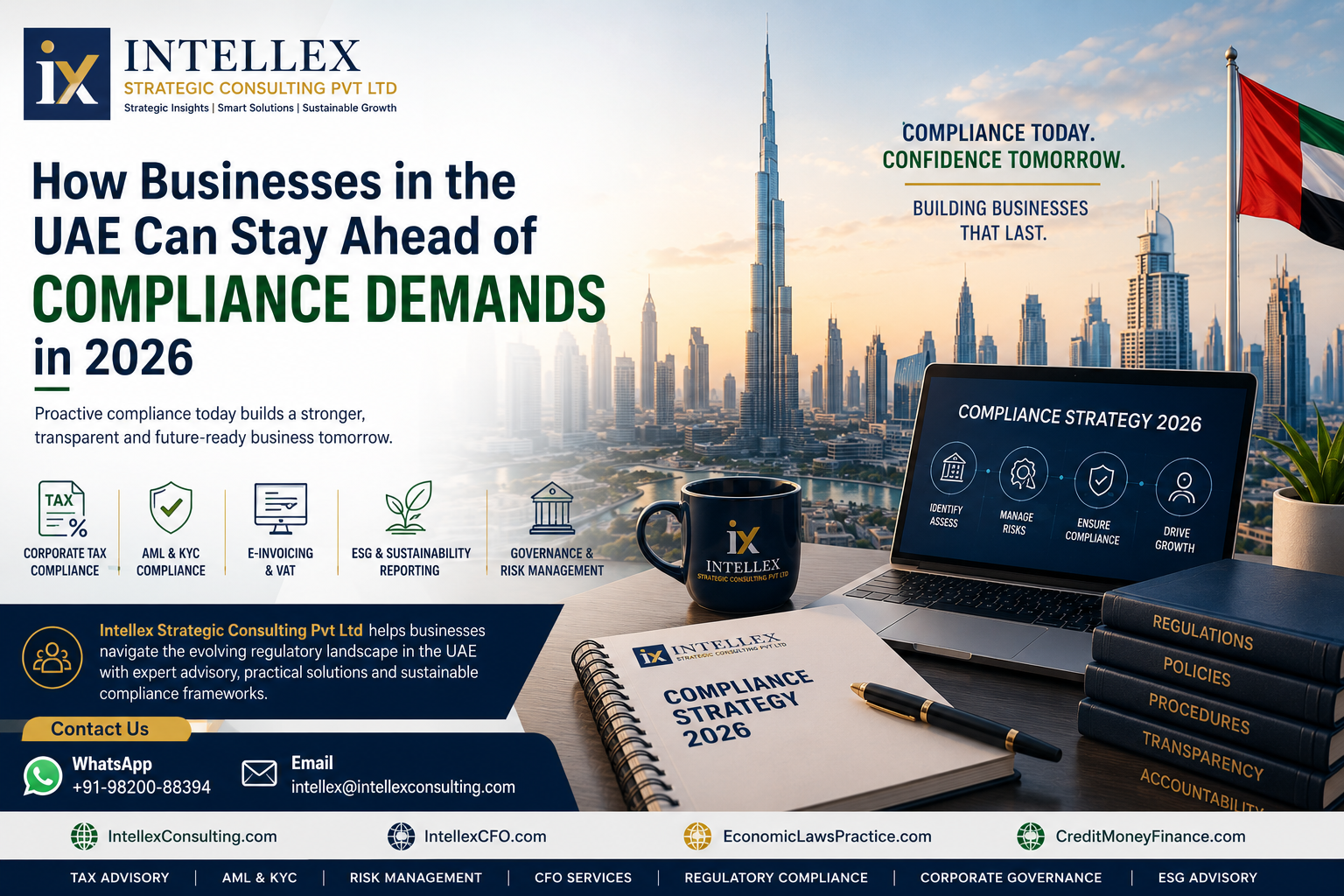
How Businesses in the UAE Can Stay Ahead of Compliance Demands in 2026.
Discover how UAE businesses can stay ahead of compliance demands in 2026 with proactive strategies covering Corporate Tax, AML, ESG, VAT, e-invoicing, data governance, and regulatory risk management. Learn how expert advisors like Intellex Strategic Consulting Pvt Ltd help businesses remain compliant and audit-ready across the UAE.
How Businesses in the UAE Can Stay Ahead of Compliance Demands in 2026
The United Arab Emirates has evolved into one of the world’s most dynamic and globally connected business destinations. However, alongside this growth has come a rapidly expanding regulatory ecosystem that now demands significantly higher levels of corporate governance, financial transparency, tax discipline, and operational accountability.
In 2026, compliance in the UAE is no longer limited to annual license renewals or basic bookkeeping. Businesses operating across Mainland UAE, Free Zones, DIFC, ADGM, and regulated sectors are now expected to maintain continuous compliance frameworks that integrate taxation, AML controls, ESG reporting, economic substance, digital invoicing, and data governance.
Companies that proactively adapt to these changes will gain operational resilience, investor confidence, smoother banking relationships, and reduced regulatory exposure. Businesses that ignore these developments may face penalties, reputational damage, banking restrictions, audit scrutiny, and operational disruptions.
Recent industry reports indicate that UAE businesses are experiencing increased compliance complexity due to tighter enforcement, corporate tax implementation, digitized tax systems, AML reforms, and ESG reporting expectations.
Why Compliance Has Become a Strategic Priority in the UAE
The UAE has transformed from a low-regulation commercial hub into a highly sophisticated international financial and business center aligned with global standards.
Several factors are driving this shift:
- Introduction and enforcement of UAE Corporate Tax
- Enhanced Anti-Money Laundering (AML) supervision
- FATF-related monitoring and global transparency obligations
- Greater scrutiny on Ultimate Beneficial Ownership (UBO)
- Expansion of ESG and sustainability reporting
- Digitization of tax administration and e-invoicing
- Cross-border tax transparency initiatives
- Stricter audit and governance expectations
- Increased enforcement by regulators and free zone authorities
Businesses are now expected to demonstrate:
- Substance over form
- Real operational presence
- Accurate financial reporting
- Transparent ownership structures
- Traceable transactions
- Proper governance systems
- Real-time compliance readiness
Experts note that 2026 represents a transition from “basic filing compliance” to “continuous compliance management.”
Key Compliance Areas UAE Businesses Must Focus on in 2026
1. UAE Corporate Tax Compliance
Corporate Tax remains the most significant compliance development affecting UAE businesses.
The UAE Corporate Tax regime is now moving into a mature enforcement phase where authorities are focusing heavily on:
- Documentation quality
- Audit defensibility
- Transfer pricing alignment
- Tax accounting reconciliation
- Substance validation
- Group structuring
- Free Zone qualification tests
Businesses can no longer rely on informal accounting systems or spreadsheet-based tax calculations.
Important Corporate Tax focus areas include:
- Accurate financial statements
- Transfer pricing documentation
- Related-party transaction reporting
- Small Business Relief eligibility
- Free Zone qualifying income assessment
- Tax grouping evaluations
- Deferred tax implications
- Cross-border structuring reviews
Regulators are increasingly emphasizing “substance over form” and consistency between VAT filings, accounting records, and tax returns.
2. Anti-Money Laundering (AML) and KYC Compliance
AML enforcement in the UAE is intensifying significantly.
The UAE’s AML framework has become one of the strictest in the region due to:
- FATF commitments
- Global banking expectations
- Enhanced enforcement powers
- Expanded reporting obligations
- Increased scrutiny of DNFBPs and financial entities
Industries under heightened AML focus include:
- Real estate
- Precious metals and jewelry
- Financial services
- Corporate service providers
- Crypto and virtual assets
- Insurance
- Accounting and audit firms
Businesses must now maintain:
- Risk-based AML frameworks
- Customer Due Diligence (CDD)
- Enhanced Due Diligence (EDD)
- Ongoing transaction monitoring
- STR reporting mechanisms
- AML training programs
- Independent AML audits
- UBO verification systems
Experts warn that documentation failures and weak internal controls are becoming major penalty triggers in 2026.
3. E-Invoicing and Digital Tax Transformation
The UAE is moving rapidly toward digitized taxation systems.
The phased rollout of e-invoicing and digital tax administration is expected to reshape how businesses manage:
- Billing systems
- ERP integrations
- Tax reconciliations
- Vendor management
- Audit trails
- VAT compliance
- Real-time reporting
Businesses that fail to modernize their accounting and ERP systems may struggle with:
- Regulatory integration
- Audit readiness
- VAT reconciliations
- Invoice traceability
- Tax authority inspections
Industry reports indicate that e-invoicing pilots are expected to expand significantly during 2026.
4. ESG and Sustainability Reporting
Environmental, Social, and Governance (ESG) compliance is becoming increasingly important in the UAE.
Large corporates, listed entities, financial institutions, and multinational groups are now under pressure to demonstrate:
- Sustainability metrics
- Carbon footprint tracking
- Governance transparency
- Ethical sourcing
- Climate disclosures
- Diversity reporting
- Responsible investing frameworks
ESG expectations are increasingly influencing:
- Investor decisions
- Banking relationships
- Procurement eligibility
- International partnerships
- Access to funding
Businesses that establish ESG frameworks early will likely gain a competitive advantage in the UAE market.
5. Economic Substance and Operational Authenticity
Authorities are focusing more aggressively on identifying businesses lacking genuine operational substance.
Companies are expected to demonstrate:
- Real commercial activity
- Genuine office presence
- Active management in the UAE
- Employee infrastructure
- Business purpose legitimacy
- Proper governance records
Free Zone businesses especially need to maintain clear evidence supporting:
- Qualifying income status
- Operational substance
- Decision-making processes
- Revenue classification
Industry commentary increasingly reflects that “paper companies” and artificial structures are becoming difficult to sustain in the UAE ecosystem.
6. Data Governance and AI Compliance
As businesses increasingly adopt AI-driven systems, regulators globally are paying closer attention to:
- Data privacy
- Algorithmic accountability
- Decision transparency
- Cybersecurity
- AI governance
- Record retention
Compliance teams now need stronger coordination with:
- IT departments
- Cybersecurity teams
- Legal advisors
- Data governance specialists
The future of compliance is becoming deeply technology-driven.
How Smart Businesses Are Staying Ahead
Building Compliance into Daily Operations
Leading companies are embedding compliance into:
- ERP systems
- HR workflows
- Procurement cycles
- Vendor onboarding
- Financial reporting
- Board governance
Compliance is becoming an operational discipline rather than an annual checklist.
Conducting Periodic Compliance Health Checks
Businesses are increasingly performing:
- Tax risk reviews
- AML gap assessments
- Internal audits
- UBO reviews
- Transfer pricing reviews
- VAT reconciliations
- Regulatory mapping exercises
Preventive compliance is proving far less expensive than regulatory remediation.
Strengthening Documentation Standards
Regulators increasingly demand evidence.
Businesses should maintain:
- Board resolutions
- Commercial agreements
- Tax documentation
- AML records
- Vendor due diligence
- Internal policy manuals
- Transaction support files
Weak documentation is now a major enforcement risk.
Investing in Compliance Technology
Modern compliance increasingly requires:
- Automated accounting systems
- Digital audit trails
- E-invoicing integration
- Compliance dashboards
- AML monitoring systems
- Workflow automation
- Regulatory reporting tools
Technology-driven compliance is becoming essential for scalability.
Creating Board-Level Compliance Oversight
In 2026, regulators increasingly expect compliance accountability at senior management and board levels.
Businesses should establish:
- Compliance committees
- Risk oversight structures
- Internal reporting systems
- Escalation protocols
- Governance documentation
Compliance can no longer remain isolated within finance departments alone.
Industries Facing Higher Compliance Pressure in 2026
Certain sectors are expected to experience particularly high regulatory scrutiny:
- Financial services
- FinTech
- Crypto and virtual assets
- Real estate
- Healthcare
- Insurance
- Cross-border trading
- Logistics
- Precious metals
- Professional services
- Free Zone holding structures
These sectors require enhanced governance, documentation, and audit readiness.
Common Compliance Mistakes UAE Businesses Must Avoid
Treating Compliance as a One-Time Exercise
Regulators expect ongoing monitoring and continuous compliance management.
Weak Recordkeeping
Incomplete documentation creates significant audit and enforcement exposure.
Poor Tax and Accounting Alignment
Mismatch between VAT filings, financial statements, and tax returns can trigger investigations.
Generic AML Policies
Template-based AML frameworks without operational implementation are increasingly ineffective.
Ignoring Regulatory Updates
The UAE regulatory landscape is evolving rapidly. Businesses must monitor changes continuously.
Delaying Technology Upgrades
Legacy accounting systems may not support future e-invoicing and digital reporting obligations.
The Future of Compliance in the UAE
The UAE is positioning itself as a highly transparent, globally integrated, technology-driven business jurisdiction.
The future compliance landscape will likely involve:
- Real-time tax monitoring
- AI-assisted regulatory supervision
- Fully digitized invoicing
- Automated reporting systems
- Stronger ESG obligations
- Enhanced beneficial ownership transparency
- More frequent regulatory inspections
- Cross-border data exchange frameworks
Businesses that embrace compliance as a strategic advantage rather than a burden will likely outperform competitors in the coming years.
How Intellex Strategic Consulting Pvt Ltd Can Help
Intellex Strategic Consulting Pvt Ltd provides specialized advisory and compliance support services for businesses operating in the UAE and across international markets.
Our services include:
- UAE Corporate Tax Advisory
- AML Compliance Frameworks
- Risk Management Consulting
- Regulatory Structuring
- Financial Compliance Reviews
- Corporate Governance Advisory
- Business Structuring Solutions
- Internal Audit Support
- ESG Advisory
- CFO and Virtual CFO Services
- Cross-Border Regulatory Consulting
- Compliance Documentation and SOP Development
Our associated platforms:
Contact Details
- WhatsApp: +91-98200-88394
- Email: intellex@intellexconsulting.com
Conclusion
Compliance in the UAE is entering a new era in 2026.
Businesses can no longer afford reactive or fragmented approaches to regulation. Corporate Tax, AML enforcement, ESG expectations, e-invoicing, and governance requirements are collectively reshaping how businesses operate across the UAE.
Organizations that invest early in compliance infrastructure, governance systems, documentation quality, and technology integration will not only reduce regulatory risk but also strengthen investor confidence, banking relationships, operational resilience, and long-term growth potential.
In the UAE’s rapidly evolving business environment, compliance is no longer merely a legal requirement — it has become a core strategic advantage.
Intellex Strategic Consulting Pvt Ltd
More Featured Posts:
Ultimate Guide to Singapore Company Registration 2026: Rules, Costs, and Compliance.
RBI FLA Return 2026: Compliance Challenges for GIFT IFSC Entities Under FEMA Explained.
The Ultimate Guide to Company Registration in Dubai 2026: Benefits, Compliance, and Costs.
Taxable Event Under GST: Understanding “Supply” – The Heart of GST Law in India.


5 thoughts on “How Businesses in the UAE Can Stay Ahead of Compliance Demands in 2026.”