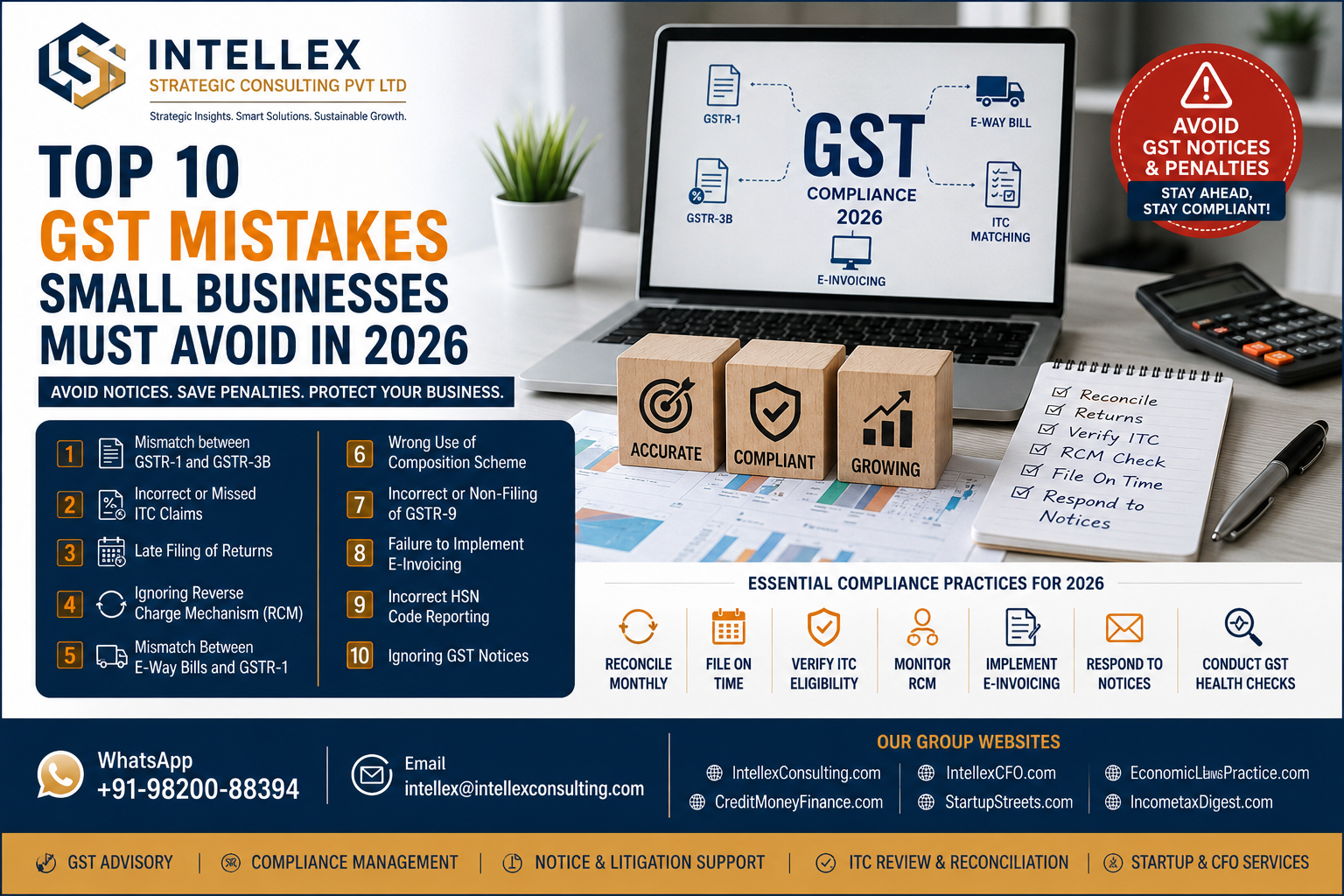
Top 10 GST Mistakes Small Businesses Must Avoid in 2026: Complete Compliance Guide to Prevent Notices, Penalties & ITC Loss.
Avoid costly GST mistakes in 2026. Learn the top 10 GST compliance errors small businesses make, including GSTR-1 vs GSTR-3B mismatch, ITC errors, e-invoicing failures, RCM issues, and GST notice handling. Expert GST advisory by Intellex Strategic Consulting Pvt Ltd.
Top 10 GST Mistakes Small Businesses Must Avoid in 2026
India’s Goods and Services Tax (GST) system in 2026 has evolved into a highly data-driven and automated compliance ecosystem. The GST Network (GSTN) now integrates real-time reconciliation between:
- GSTR-1
- GSTR-3B
- GSTR-2B
- E-Way Bills
- E-Invoices
- Annual Returns
- Vendor compliance records
As a result, even minor mismatches or procedural errors can trigger automated notices, input tax credit (ITC) denial, penalties, interest liabilities, or GST registration scrutiny.
For small businesses, startups, traders, manufacturers, exporters, service providers, and MSMEs, maintaining robust GST compliance procedures is no longer optional — it is a critical business necessity.
This article explains the top GST mistakes businesses commonly make in 2026 and how to avoid them effectively.
Why GST Compliance Has Become More Critical in 2026
The GST department now uses advanced analytics, AI-based reconciliation tools, and automated risk assessment systems to detect:
- Return mismatches
- Fake ITC claims
- E-way bill inconsistencies
- Non-reporting of invoices
- HSN/SAC code errors
- Vendor non-compliance
- Abnormal ITC utilisation patterns
Automated scrutiny under Rules such as Rule 88C, Rule 88D, and other GST compliance mechanisms has increased substantially.
Businesses that fail to maintain monthly reconciliations face higher risks of:
- GST notices
- ITC blockage
- Interest demands
- Penalties
- Recovery proceedings
- Suspension or cancellation of GST registration
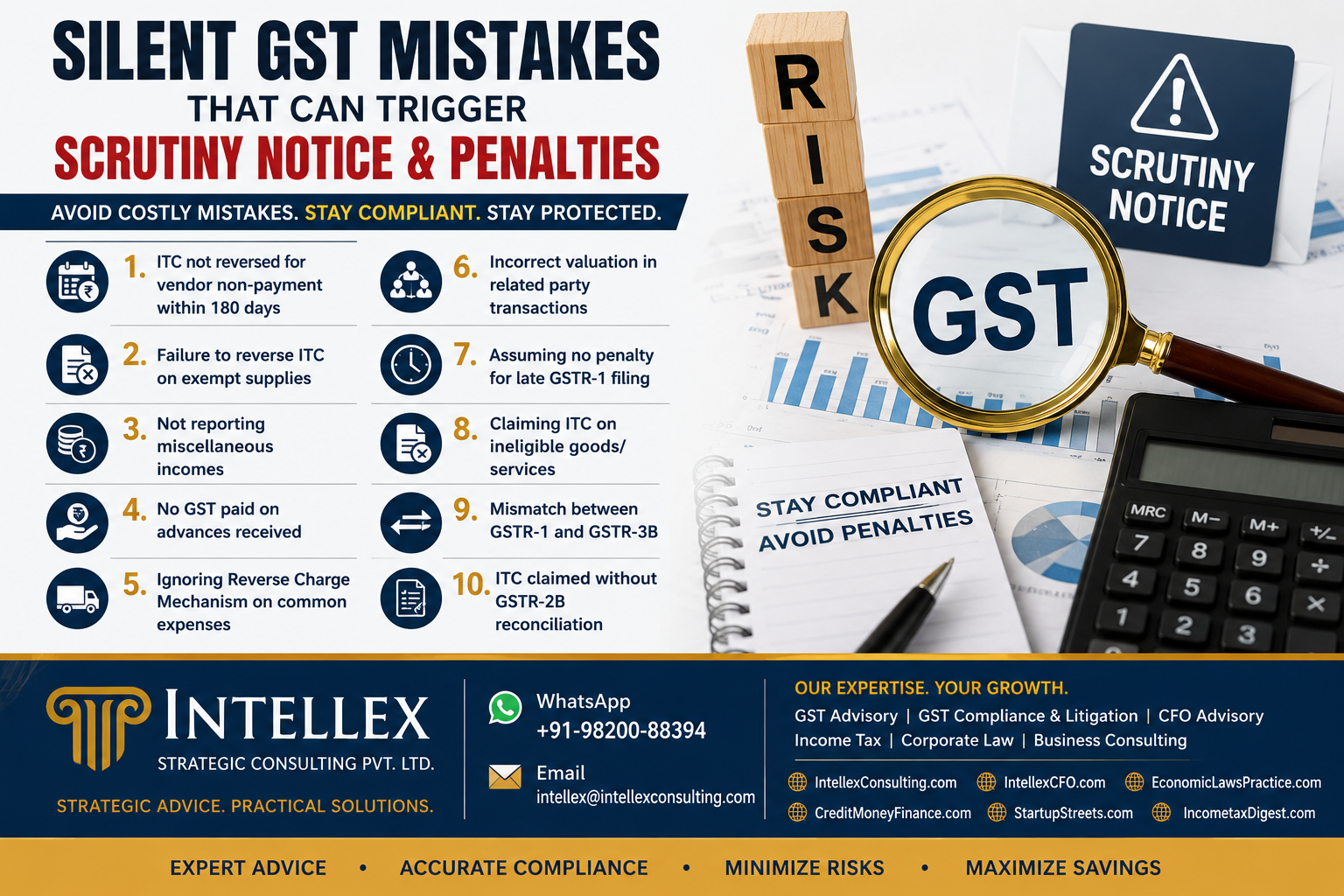
1. Mismatch Between GSTR-1 and GSTR-3B
One of the most common GST mistakes in 2026 is inconsistency between outward supplies reported in GSTR-1 and tax liability disclosed in GSTR-3B.
Why This Is Dangerous
The GST system now automatically compares:
- Sales invoices uploaded in GSTR-1
- Tax liability discharged in GSTR-3B
Any significant difference triggers automated notices under Rule 88C.
Common Reasons for Mismatch
- Incorrect invoice reporting
- Missing invoices
- Amendments not reflected properly
- Wrong tax rates
- Clerical data entry errors
- Timing differences
Consequences
- Automated GST notices
- Additional tax demand
- Interest liability
- Departmental scrutiny
Best Practice
Businesses should conduct monthly reconciliation before filing returns to ensure:
- Tax liability matches exactly
- Invoice values are consistent
- Amendments are properly reflected
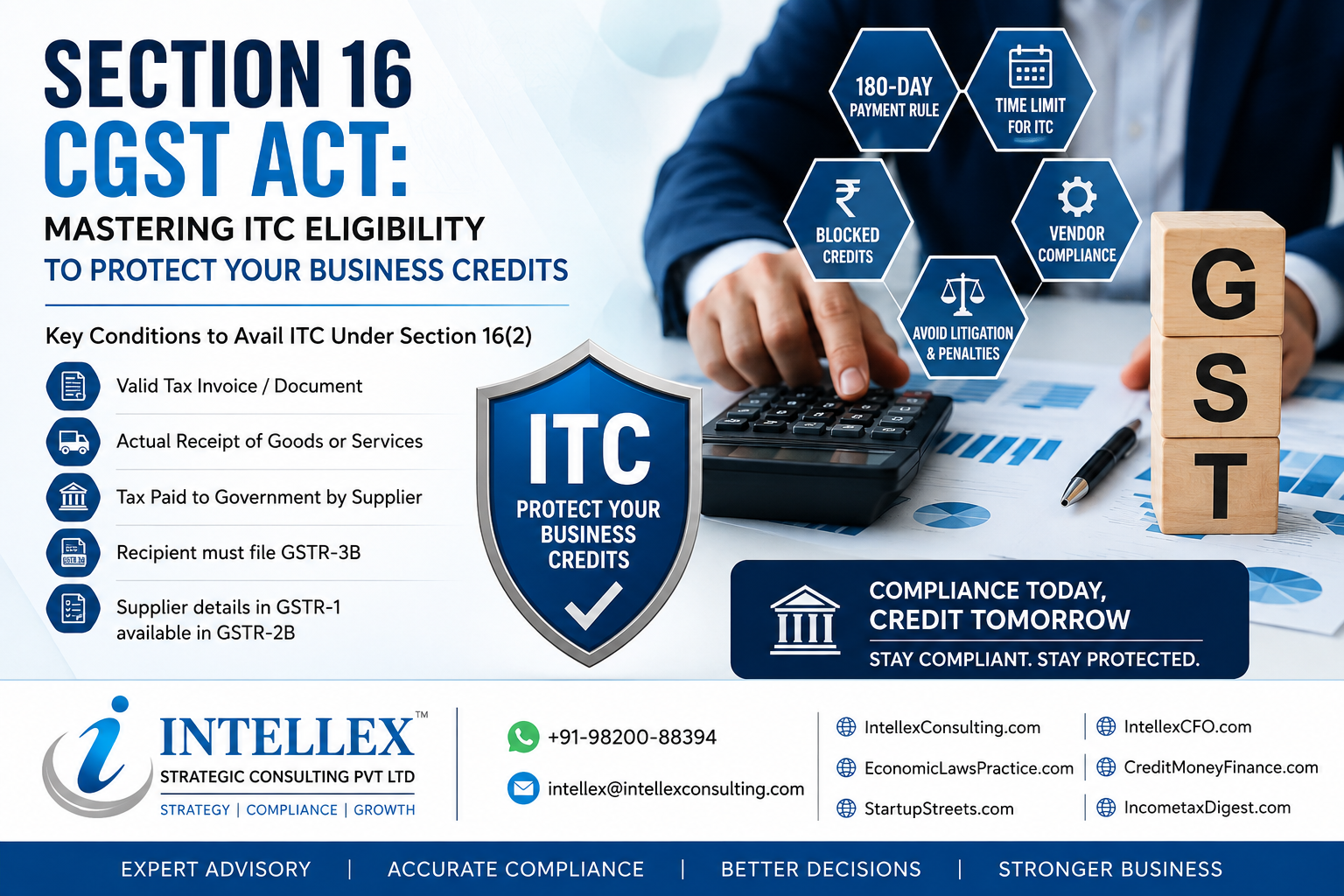
2. Incorrect or Missed Input Tax Credit (ITC) Claims
Input Tax Credit remains one of the most litigated areas under GST.
Many businesses still claim ITC without properly reconciling GSTR-2B with purchase records.
Common ITC Errors
- Claiming blocked credits
- Availing ITC without valid tax invoice
- Claiming ITC for personal expenses
- Duplicate ITC claims
- Vendor non-compliance issues
- Failure to reconcile GSTR-2B
High-Risk Areas
Blocked credits under Section 17(5) continue to create major disputes, especially relating to:
- Motor vehicles
- Employee welfare expenses
- Club memberships
- Personal consumption
- Certain construction expenses
Consequences
- ITC reversal
- Interest and penalties
- Litigation exposure
- Vendor disputes
Best Practice
Before claiming ITC:
- Reconcile GSTR-2B monthly
- Verify vendor filing status
- Maintain invoice documentation
- Check ITC eligibility carefully
3. Late Filing of GST Returns
Delayed filing remains one of the biggest avoidable compliance failures among MSMEs.
Returns Commonly Delayed
- GSTR-1
- GSTR-3B
- CMP-08
- GSTR-9
Consequences of Late Filing
- Late fees
- Interest liability
- Blocking of e-way bill generation
- GST registration suspension
- Increased compliance rating risk
Repeated non-compliance may also lead to cancellation proceedings.
Best Practice
Maintain a GST compliance calendar and implement internal filing controls to ensure all returns are filed before due dates.
4. Ignoring Reverse Charge Mechanism (RCM)
Many small businesses fail to identify transactions covered under Reverse Charge Mechanism (RCM).
Common RCM Transactions
- Legal services
- GTA services
- Certain import transactions
- Purchases from unregistered suppliers (where applicable)
- Director remuneration in specific cases
Risks
Failure to pay GST under RCM can lead to:
- Tax demand
- Interest
- Penalties
- ITC complications
Best Practice
Maintain a separate RCM tracking system and review vendor payments periodically.
5. Mismatch Between E-Way Bills and GSTR-1
The GST department now actively reconciles e-way bill data with invoice reporting in GSTR-1.
Common Problems
- E-way bill generated but invoice not reported
- Wrong invoice number
- Incorrect taxable value
- Mismatch in recipient GSTIN
Consequences
- Automated scrutiny notices
- Physical verification risk
- Movement tracking issues
Best Practice
Ensure every e-way bill transaction is reflected correctly in sales reporting.
6. Wrong Use of Composition Scheme
Many businesses continue under the composition scheme even after exceeding turnover thresholds.
Common Errors
- Failure to monitor turnover
- Charging tax illegally
- Issuing improper invoices
- Interstate supply violations
Consequences
If ineligible businesses continue under composition:
- Normal GST rates may apply retrospectively
- Interest and penalties may be imposed
- ITC complications may arise
Best Practice
Review turnover regularly and assess eligibility before continuing under composition.
7. Incorrect or Non-Filing of GSTR-9
Annual return filing errors can trigger future departmental scrutiny.
Common Mistakes
- Incorrect turnover disclosure
- Wrong ITC reporting
- Failure to reconcile annual figures
- Missing HSN details
Risks
- Late fees
- Audit selection
- GST notices
- Litigation exposure
Best Practice
Conduct yearly GST reconciliation before filing GSTR-9.
8. Failure to Implement E-Invoicing
E-invoicing compliance has become increasingly important in 2026.
Businesses crossing the prescribed turnover threshold must generate valid Invoice Reference Numbers (IRNs).
Common Errors
- Failure to generate IRN
- Incorrect invoice schema
- ERP integration failures
- Delayed invoice reporting
Consequences
Invoices may become invalid under GST law, affecting:
- ITC availability to customers
- Tax compliance
- Customer relationships
- Departmental scrutiny
Best Practice
Immediately implement e-invoicing systems once threshold limits are crossed.
9. Incorrect HSN Code Reporting
Incorrect HSN/SAC reporting continues to create compliance disputes.
Common Problems
- Using outdated HSN codes
- Wrong classification
- Incorrect tax rate mapping
Risks
- Tax demands
- ITC denial to customers
- Interest and penalties
- Classification litigation
Best Practice
Review product classification periodically and update ERP/accounting systems accordingly.
10. Ignoring GST Notices
One of the most dangerous mistakes is ignoring GST notices issued through the GST portal.
Common Notices in 2026
- Rule 88C mismatch notices
- ITC discrepancy notices
- Registration compliance notices
- Annual return scrutiny notices
Risks of Non-Response
Failure to respond within prescribed timelines may result in:
- Ex-parte assessment orders
- Recovery proceedings
- Bank attachment
- Penalties
- GST registration cancellation
Best Practice
Monitor the GST portal regularly and respond to notices immediately with proper documentation.
Essential GST Compliance Practices for 2026
Businesses should adopt the following compliance framework:
Monthly Compliance Checklist
Reconcile:
- GSTR-1
- GSTR-3B
- GSTR-2B
- Purchase register
- Sales register
- E-way bills
- E-invoices
Verify:
- ITC eligibility
- Vendor compliance
- RCM applicability
- HSN/SAC accuracy
Monitor:
- GST notices
- Return due dates
- Turnover thresholds
- Composition eligibility
File:
- Returns on time
- Correct amendments
- Annual returns accurately
Importance of GST Health Checks
Periodic GST health checks conducted by experienced GST professionals help businesses:
- Detect compliance gaps
- Identify ITC risks
- Prevent notices
- Improve documentation
- Reduce litigation exposure
- Ensure system-level compliance
A proactive GST review is far less expensive than handling tax disputes and recovery proceedings later.
How Technology Is Changing GST Compliance
In 2026, GST administration is increasingly driven by:
- Artificial intelligence
- Automated reconciliations
- Real-time invoice tracking
- Data analytics
- Risk profiling systems
Businesses relying solely on manual accounting processes are far more vulnerable to errors and notices.
Implementing proper accounting systems, ERP integration, reconciliation tools, and professional compliance review mechanisms is now essential.
Conclusion
GST compliance in 2026 is no longer limited to basic return filing. The system is now highly automated, interconnected, and analytics-driven.
Most GST notices and penalties today arise not from deliberate tax evasion but from avoidable procedural lapses, reconciliation failures, and delayed compliance actions.
Businesses that maintain:
- Accurate reconciliations
- Timely filings
- Proper ITC verification
- Correct invoice reporting
- Strong documentation systems
can significantly reduce litigation risk, preserve Input Tax Credit eligibility, and avoid unnecessary penalties.
Professional GST advisory and periodic compliance reviews have become essential for sustainable business operations in India’s evolving tax environment.
GST Advisory & Compliance Support
Intellex Strategic Consulting Pvt Ltd
Businesses seeking professional support for GST compliance, GST notices, reconciliation, litigation management, e-invoicing implementation, ITC review, GST audits, and annual return filing may contact:
Intellex Strategic Consulting Pvt Ltd
📱 WhatsApp: +91-98200-88394
📧 Email: intellex@intellexconsulting.com
Websites:
- Intellex Consulting
- Intellex CFO
- Economic Laws Practice Resources
- Credit Money Finance
- Startup Streets
- Income Tax Digest
Their team provides strategic GST advisory, compliance management, tax litigation assistance, startup advisory, CFO services, and regulatory consulting solutions for businesses across India.
Intellex Strategic Consulting Pvt Ltd
More Featured Articles:
PAN Rules 2026: Major Changes in Quoting, Reporting & Compliance Every Taxpayer Must Know.
How Businesses in the UAE Can Stay Ahead of Compliance Demands in 2026.
Ultimate Guide to Singapore Company Registration 2026: Rules, Costs, and Compliance.
5 thoughts on “Top 10 GST Mistakes Small Businesses Must Avoid in 2026: Complete Compliance Guide to Prevent Notices, Penalties & ITC Loss.”